While we were technically camping last weekend in southern Pennsylvania, we treated our little travel trailer as a home base for day tripping in and around the Hershey, PA area.
One of our stops was Hershey Gardens, perched up on a hilltop across the main road from Hersheypark, where we could see (and hear the screams from) all the rollercoasters. In contrast, Hershey Gardens is a big formal garden with some thematic collections outside, and it has a sizeable butterfly atrium inside with about 500 fluttering lepidopterans (butterflies and moths) and a few bonus animals inside, in addition to about thirty humans at a time.
Based on nothing more than my impressions (not real numbers), it appears that the vast majority of the butterflies in the atrium are some form of Longwing (genus Heliconius). There were lots of False Zebra Longwings, from Ecuador and Peru.
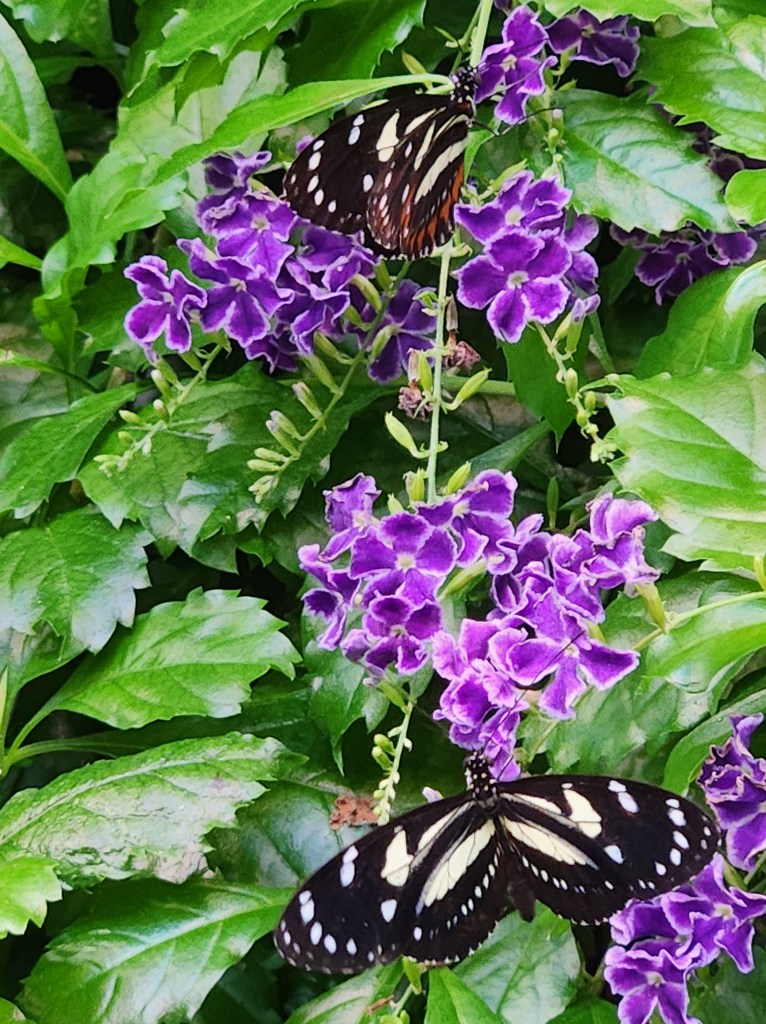
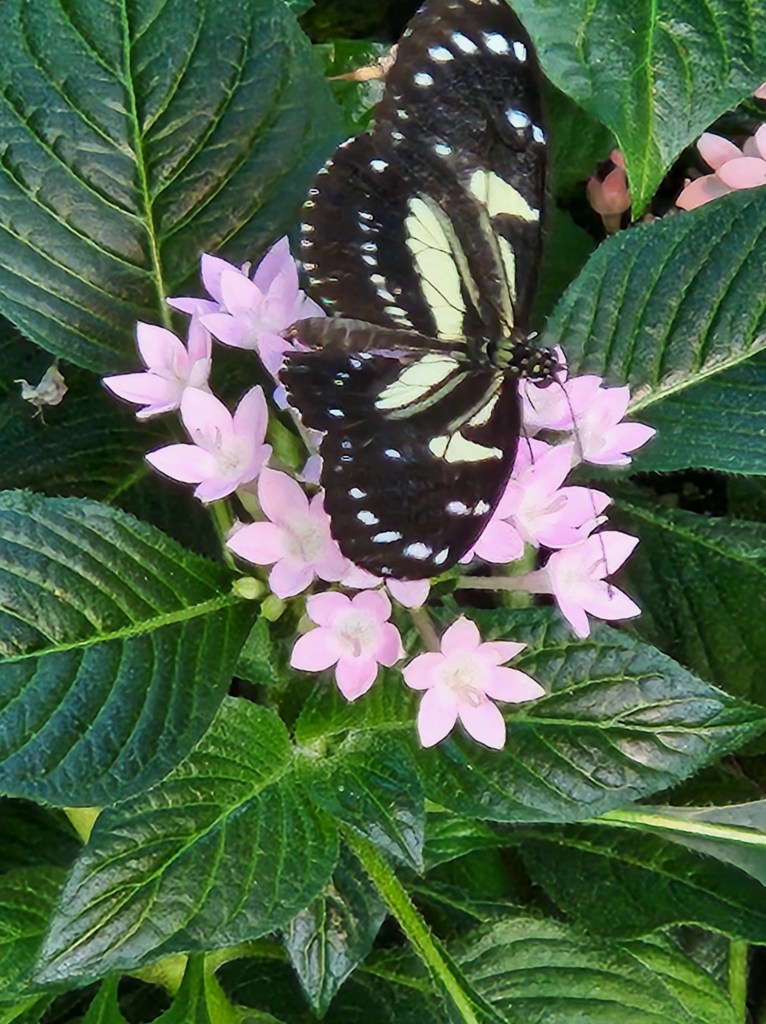
There were also many Tiger Longwings, with more orange patterns. These range from Mexico down through Central America and the northern parts of South America.


There were lots of impressive butterflies that didn’t photograph well. Either they were hidden deep in the foliage or way up high in the treetops, or (like the famous Blue Morpho from the Amazon) were constantly fluttering and flying and impossible (at least for us) to catch in frame and in focus. You’ll just have to trust me when I say that the examples I’m showing here are representative of a much more diverse array – you’ll just have to go visit the place!
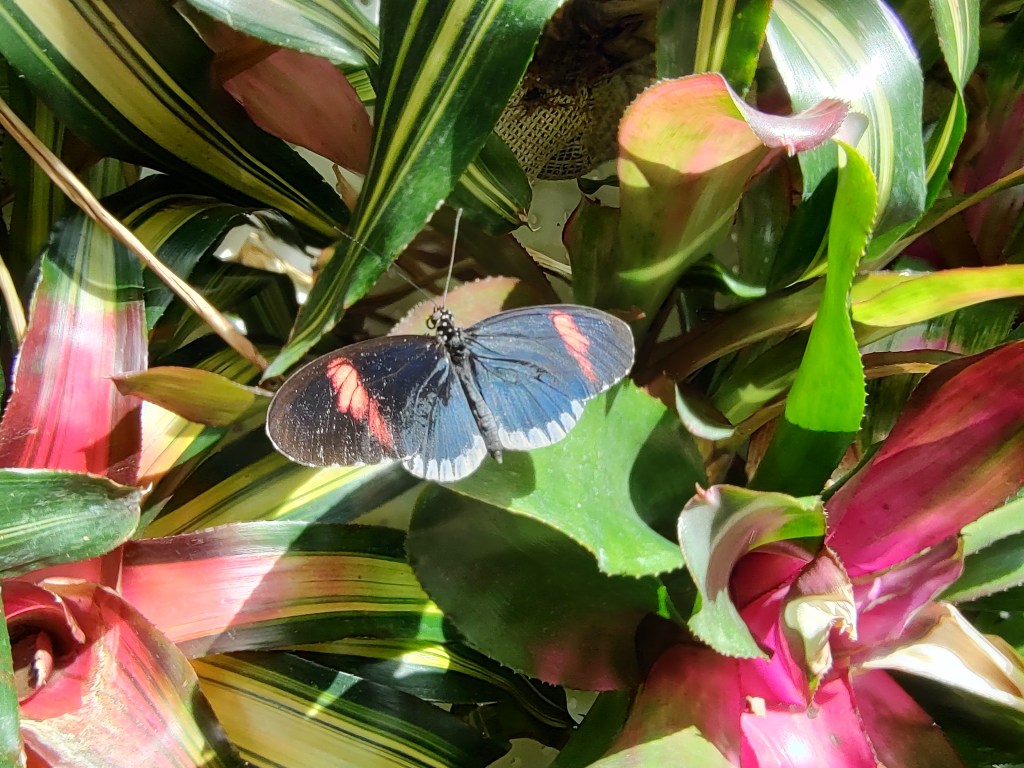
Rounding out the longwings, there were a few Postman butterflies. The example on the left here is a Red Postman, forma a range extending from southern Texas to northern Argentina. The photo on the right is another Postman type, but I couldn’t find a common name for it. The alternating pink and white stripes on the upper wing were distinctive though. This subspecies, Heliconius melpomene plesseni, is from the eastern slopes of the Andes mountains.
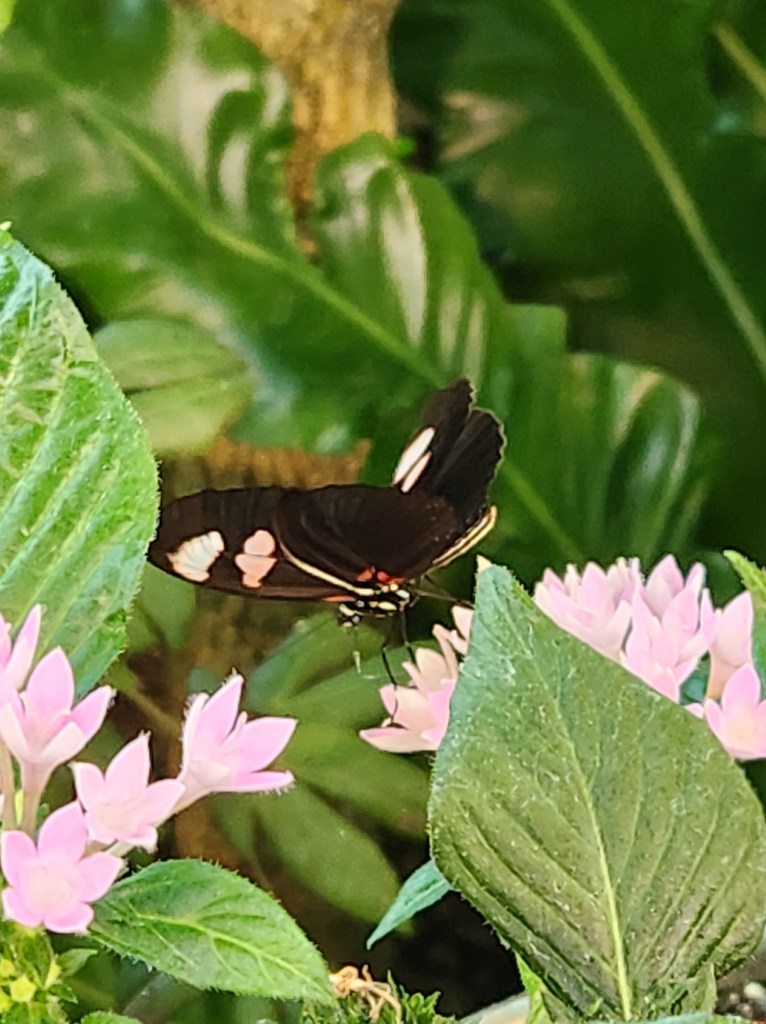
Finally, Cydno Longwings occupy a similar range, from Mexico to northern South America.
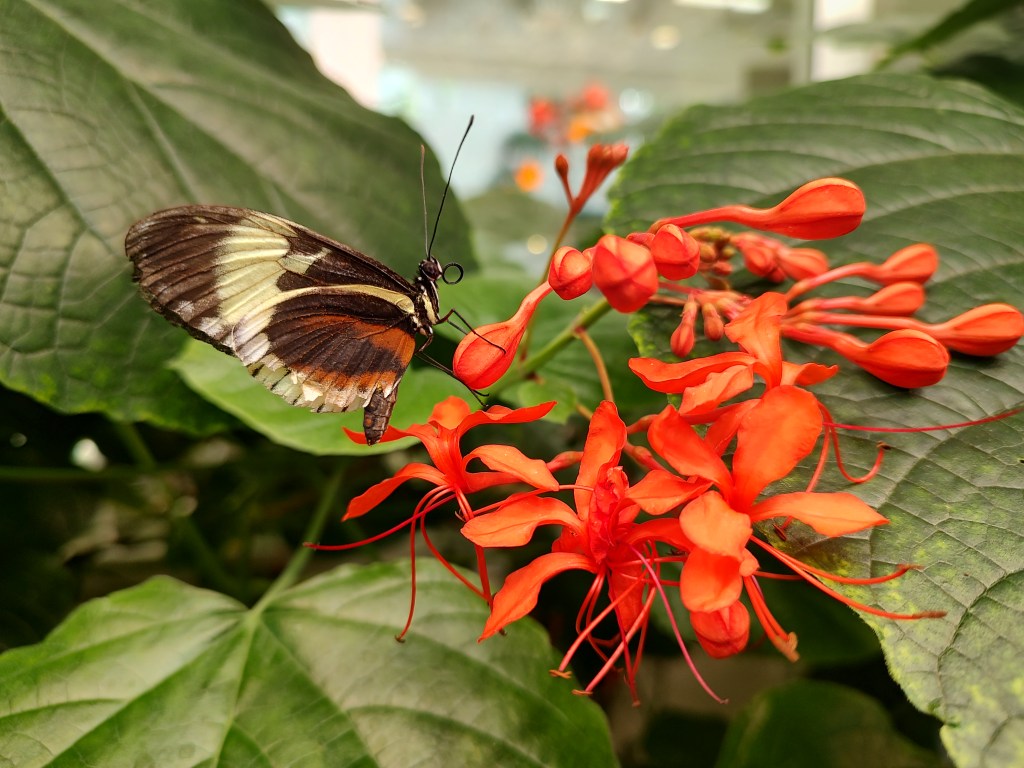
Though it’s called a Julia Heliconian, this orange butterfly is not part of the Heliconius genus, but rather it’s a Dryas iulia. This butterfly is subtropical, like the longwings, but in addition to ranging from southern Texas to Brazil, it also ventures east into Florida and through the Caribbean. It’s also an example of an animal using Batesian mimicry. It is not toxic, but its bright orange color, while conspicuous, associates it with butterflies that are toxic, like Monarchs, and so wise predators tend to avoid it.

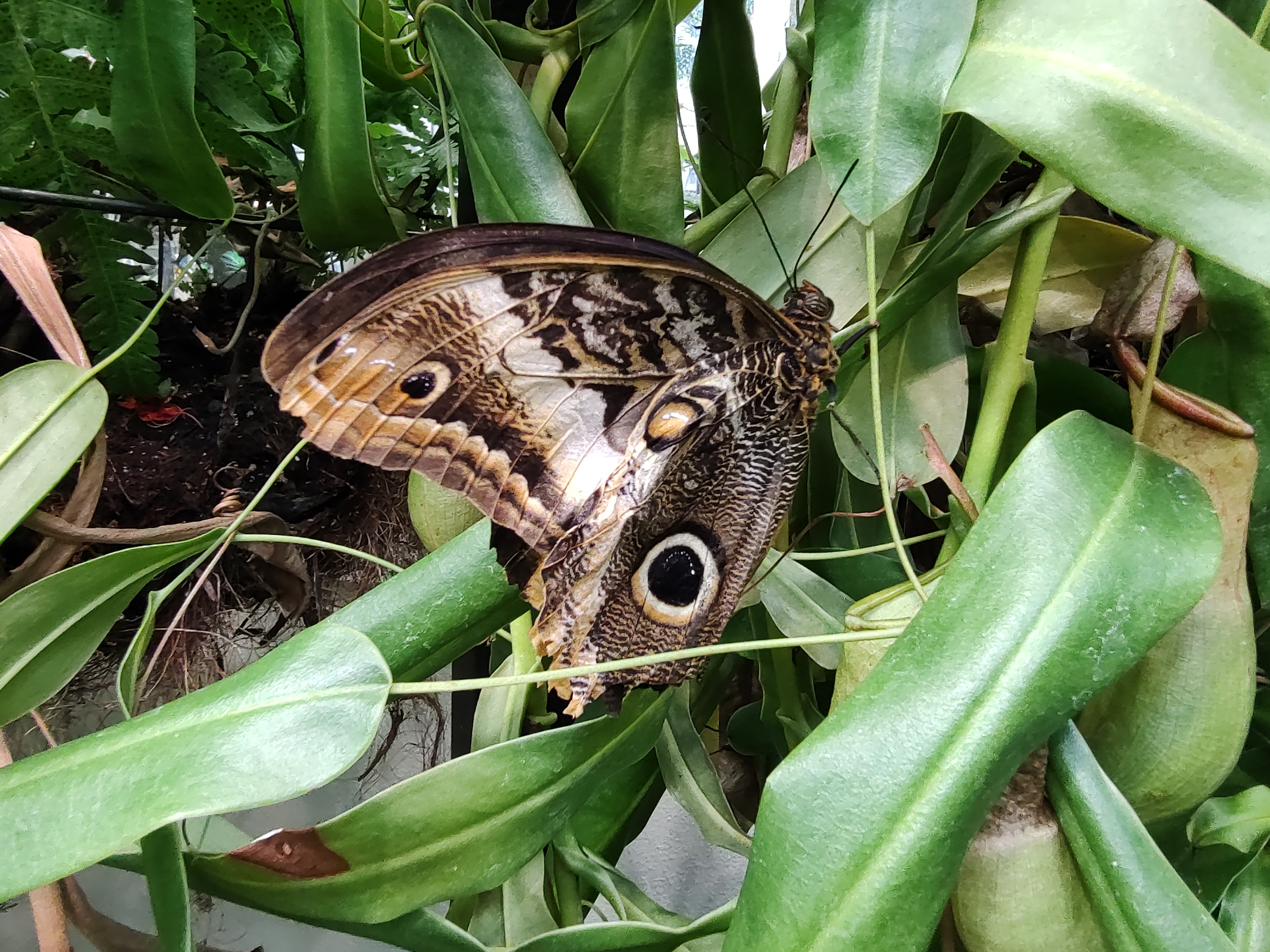
There were lots of Owl butterflies hanging upside down underneath broad leaves. These are large butterflies, about 7 inches (18 cm) across, and we found many of them at the feeding stations scattered throughout the atrium. They appear to enjoy the juices from rotting and fermenting fruit, particularly pineapple. The aroma near these stations was pretty pungent – staff here told us that the butterflies LOVE it, but that they have to change the fruit every few days because it gets too overwhelming for us human visitors.
The other reason that we got excited about the Owl butterflies is that with wings folded, they look very much like Blue Morphos. They were not the same though – the Owls didn’t want to fly (apparently they are active at dusk), and the Morphos didn’t want to stop.

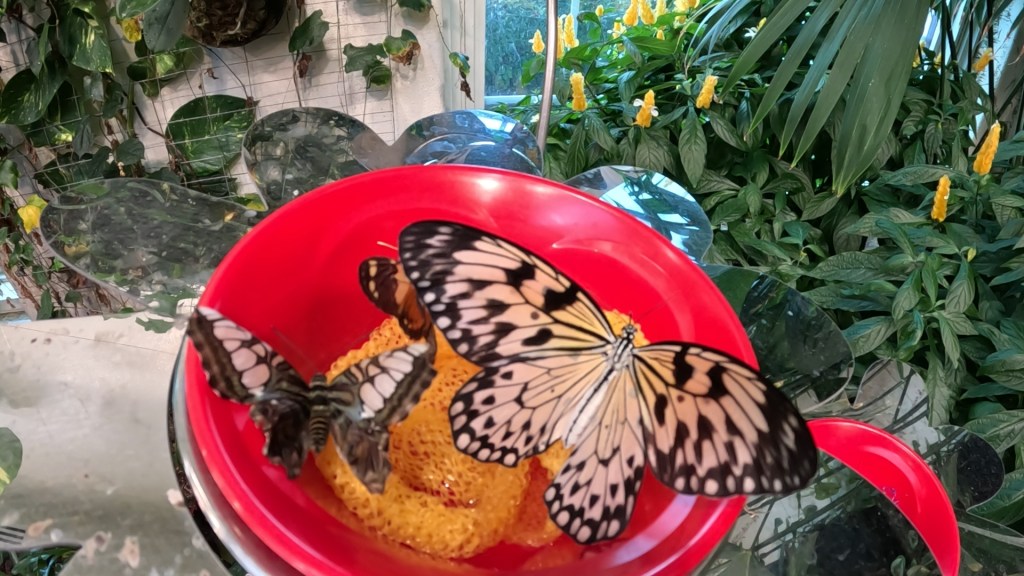
Speaking of feeding stations, here’s a typical example. You could typically find multiple species at each location, but we didn’t take many pictures here because of the lack of “natural” background. The large pale yellow butterfly here is a Rice Paper Butterfly, or Paper Kite (Idea leuconoe) native to southeast Asia – the Philippines, Taiwan, down south and east to northern Australia.
Back to the Americas and the Caribbean, we found this Malachite (Siproeta stelenes) visiting a flower. These larger butterflies weren’t nearly as plentiful as the longwings, but it was striking to see them.

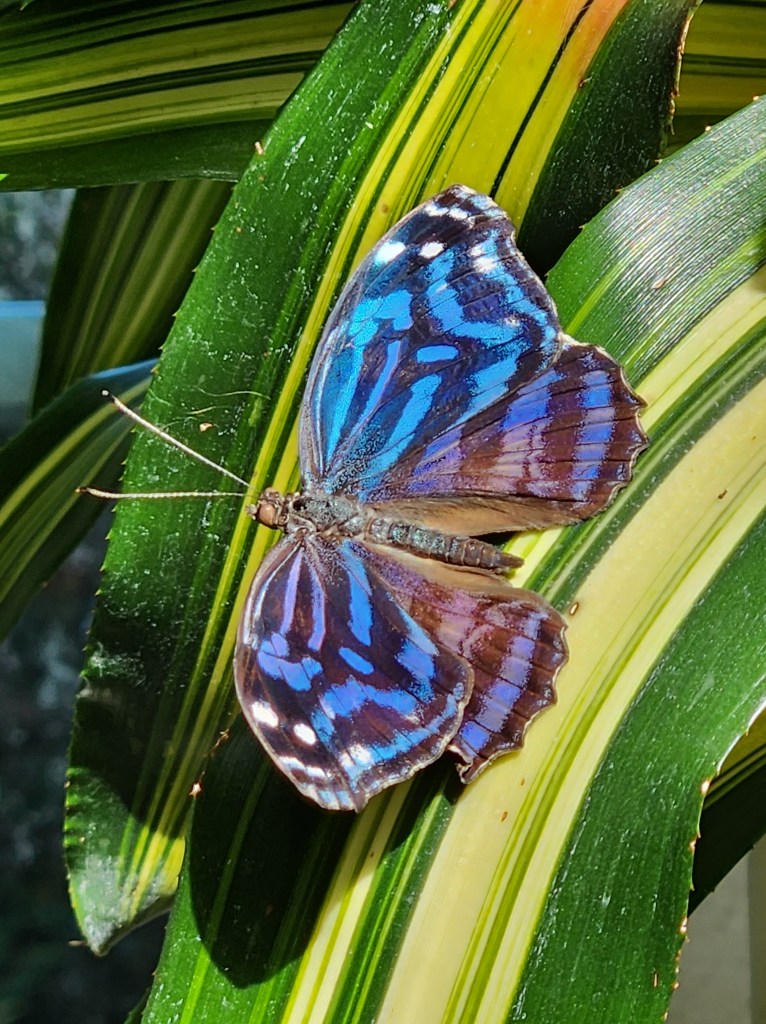
And while we didn’t get any good photos of Morphos (we did see plenty – their structural blue color was strikingly iridescent and beautiful!) we did catch this Mexican Bluewing (Myscelia ethusa) from (you guessed it), Mexico.
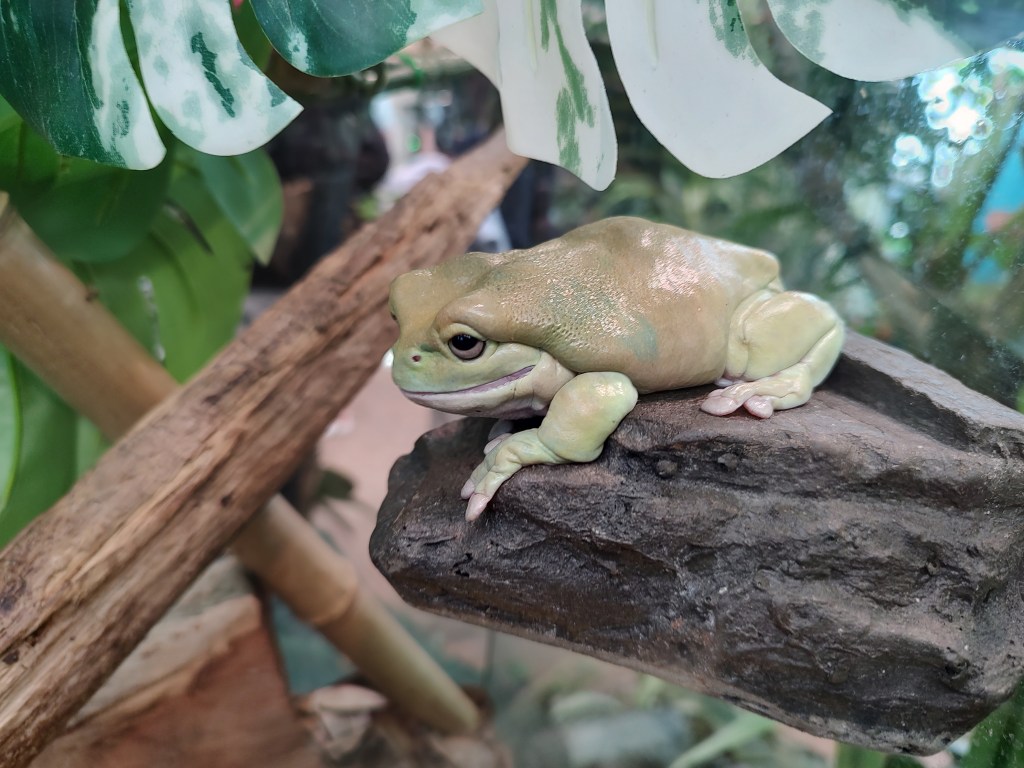
There’s a little area in the center of the atrium that is home to other animals – some poison dart frogs, a gecko, a python. I’m going to share a picture of an Australian Green Tree Frog that resided in that section, but not right now. First, when you head outside, you walk into a large formal rose garden with several hybrid cultivars that have resulted from deliberate cross-breeding over the years. The roses were pretty, but we were fascinated watching the effort the bumblebees exerted getting down into those flowers.

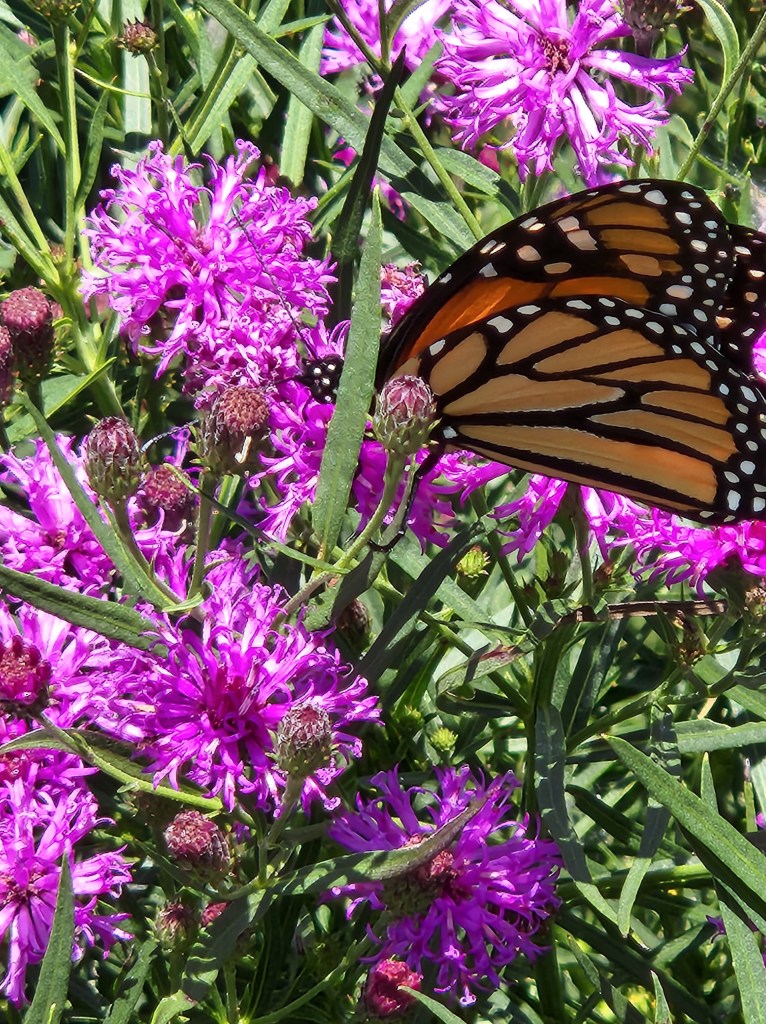
We also saw several Monarch butterflies outdoors. There were several filling up on nectar from a large patch of Ironweed.
And… to close out this tale, I want to take us back inside to the Australian Green Tree Frog. According to Wikipedia, it has a nickname, probably because of its expression, of “dumpy tree frog”, but I think that’s unfair. This frog has seen, and it knows some things…
Get Out There!
NOTE: If you like your butterflies with a bit more flutter, check this very short video that shows them in flight, and maybe a few other types.
 Flying Squirrel Outdoors
Beautiful captures of the pretty butterflies.
LikeLike
What a beautiful variety of butterflies they have!
LikeLike
Yes, they do! It is a lovely place. The outdoor gardens are also very nice.
LikeLike