
I’m kind of a slob.
I don’t have a complete disregard for order and cleanliness, but my life – both at home and work – does tend to accumulate a bit of clutter. It’s a symptom of trying to have too many hobbies or too many things going on at the same time. Ideas and projects tend to pile up in various places. I promise I know exactly where everything is and I’ll get to it, eventually.
When I’m camping, though, I tend to take a totally different approach. My gear has been packed in the same (relative) place in my backpack for close to twenty years now. In the tent, I have a specific arrangement and layout as well – specific gear is laid out around my head and body so that I can find it quickly in the dark.

This kind of focus is something I never really thought much about, and it’s not something that I necessarily planned. It’s an approach I’ve slowly honed over the years. In contrast, I recently had a camping experience with a relative newcomer to wilderness and outdoor adventures, and noticed that aside from getting a tent set up and a pad and sleeping bag laid down, this person was having a lot of trouble keeping track of all his “stuff”. It was a stress-inducer, adding discomfort to an already-uncomfortable, unfamiliar camping experience.
It’s a simple thing, really, but consistency in how you pack, how you set up your “bedroom” and how you arrange your kitchen really does remove guesswork and increase the subconscious comfort level. Routine reduces stress. I find if I’m consistent with the small stuff, the big things fall into place.
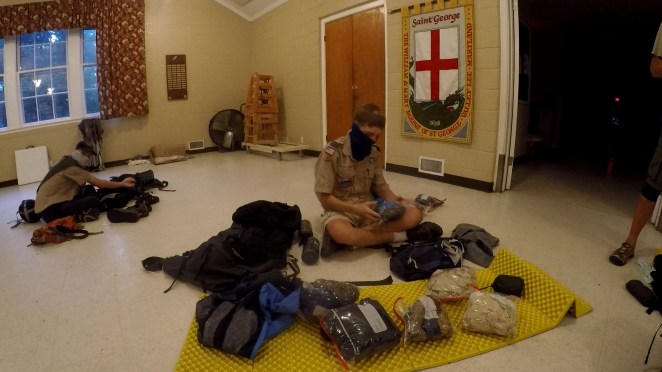
There are no set rules to this, no right or wrong arrangements, other than in the case of a backpack, keeping dense, heavy items low and close to your center of gravity. Individuals typically have to figure out what best works for them. In addition, backpacks come and go over the years, and pocket / compartment arrangements change, so some flexibility is required. But here’s what I do. Left and right are based on looking at the outside (not the strap-side) of the pack —
-----------------------------
- Right side pocket - Water purification (Steripen), headlamp, repair items
- Left side pocket - First Aid, bandana, bug spray, toothbrush
- Center pocket - Pack cover, rain jacket (both easily reachable without having to dig through gear)
- Bottom compartment - Mess kit, Stove (whisperlite style is typical, though occasionally I'll carry a canister and screw-on-burner), 50' of 1/8" rope packed in a tall plastic coffee cup, toilet paper, battery power-pack
- Main compartment (lined entirely with a heavy-duty contractor-grade garbage bag) - From bottom to top: inflatable ground pad, sleeping bag, clothes packed in a nylon bag, tent*, food (in another nylon bag), "extra" water (outside the garbage bag liner in case bottles leak)
- Top compartment (brain) - Extra garbage bags, ziplock bags, and snacks, small bag of waterproof matches, emergency dry tinder
- On belt - Water bottle on one side, fuel bottle on the other (to avoid leaks inside the pack), compass and ferro rod in belt pocket
- Right pants pocket - Knife (Leatherman skeletool), cash, ID, credit card, and phone (running GPS tracking) in a lower pocket on my convertible pants
- Left pants pocket - Disposable lighter, lip balm

*Typically, I will remove the rigid tent poles from my tent bag, stuff the soft stuff into the pack and strap the poles up under the brain.
------------------------------
This setup is not only consistent in that I know where everything is. It’s ALSO an arrangement that lets me keep everything packed (90%) ALL of the time. Whenever I want to head out, I pack my sleeping bag, clothes, headlamp, add food and fill up fuel and water bottles, and I’m gone. There’s very little impediment to getting out of the house. To the degree possible, I tend to take this same pack when I’m paddling, car camping… really anything, as managing this known loadout is so predictable to me it’s less risky than trying to repack for anything less than an expedition-scale journey.
When I arrive at camp, I can start working from the top down. I’ll pull out the tent and get it set up. Food and water come out in one pull (in the nylon bag) – I usually have my on-trail snacks in the brain so I can get to them without digging, and that requires a step here to consolidate, because this one bag later becomes my bear/animal bag, a single place containing all my smelly items. Along with the food, I’ll place my mess kit, coffee cup and rope, stove and fuel canister by the spot where I’ll be cooking (away from the tent in bear country).
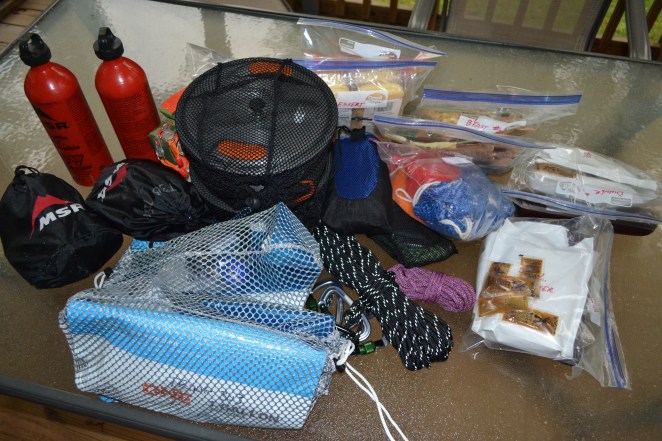
My clothes, sleeping bag and ground pad all come out and go into the tent. I use the consolidated bag of extra/dirty clothes as my pillow. I normally find myself sleeping solo in a 2-person tent these days. So I’ll inflate my pad and get my sleeping bag laid out on one side (or diagonally, depending on the surface arrangement and slope underneath). Pack goes into the tent on the left side by my knees. Pocket contents go into a mesh pouch in the tent by my head. Headlamp comes out and goes into a pants pocket (unless it’s already dark). Later, at night, I’ll put clothes I’ve been wearing by my pack. My water bottle goes above my head on the right side. My phone lays flat on my right up against the door, and my eyeglasses and headlamp go right next to my phone. This way none of that is going to get crushed, and I can quickly access it in the middle of the night if needed. I leave my boots outside the door, but under the fly in the vestibule area. (I just have to remember to check for spiders and other critters in the morning before I put them on – but this keeps extra dirt and wet out of the tent).
Back at the kitchen, my 50′ rope serves (primarily) as my bear bag rope – although it HAS been used for other things. A rope is a great thing to have. I use 1/8″ synthetic line made for sailing, as it’s strong, light, and not stretchy. Before I lose light (hopefully), I’ll get a site picked and get my rope thrown over a good limb enabling me to hang a bag 10 feet up and 4 feet out from the trunk, ideally.
For meals, I like to pack individual meals (I make my own, I tend NOT to bring the commercial freeze-dried stuff) in a gallon zip-lock each. That way, my meal of choice can be identified and isolated easily, and the bag it’s packed in becomes a garbage bag for any packaging that’s left while I’m cooking. As I mentioned, I like whisperlight style stoves that burn white gas – it’s not as quick and not necessarily as light as a jet-boil or similar canister stove, but a) it gives me control to fry and simmer and brown, etc (i.e. not just for hot water), and b) it works all year, even in the cold depths of winter, since I can directly control fuel pressure.
After dinner, and after I’ve cleaned up, everything, including pots, goes into the bear bag and I hang it all. Water comes back to the tent with me.

I recognize that it’s hard for beginners to anticipate the flow of camp chores and get things arranged the way I’ve described. But I’ll suggest that my approach ought to at least serve as a good starting point. From trip to trip, you’ll find that you refine your loadout based on what you need, what works for you. In any case, the goal is to be consistent – being organized like this really helps manage the routine in a way that takes a lot of the thought and worry out of making a home in the outdoors, and helps you keep track of everything. It’s an essential skill in “how to camp”, in my opinion. I haven’t really touched on situations where things are not going well – bad weather, gear failure, emergency situations – but routine packing and organization like this also reduce risk and make dealing with sub-standard situations easier and smoother as well.
I’d appreciate hearing your tips and tricks that you’ve adapted to keep things as consistent as possible. As settled as I think I’ve got my camping system, I’m always interested in hearing other approaches and learning from others!
Get Out There!
 Flying Squirrel Outdoors
One thought on “Better Camping Through Hyper-Organization”