
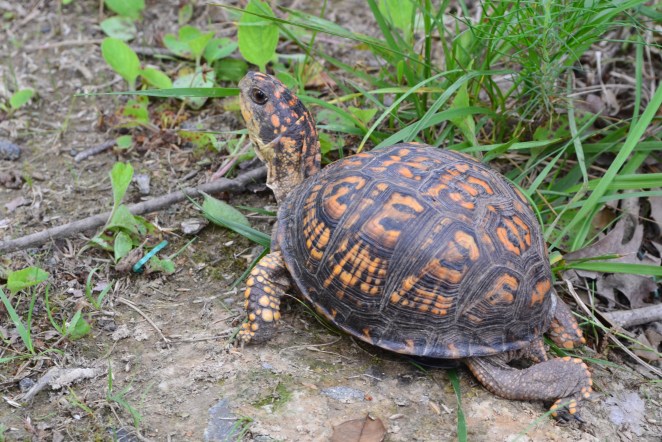
I was listening to a Smithsonian podcast this week (shout out to Side Door, great program!), and the episode started with the host joining a pair of wildlife ecologists in an “undisclosed location” in Virginia, looking for what I thought was the most common of common backyard critters, the eastern box turtle. My first reaction was to think this was silly. Eastern box turtles are everywhere! This time of year I see one trying to cross the road just about every day.
I had no idea, but it turns out that eastern box turtles are caught up in a massive international crime ring. When I think of wildlife trafficking, my mind immediately goes to poaching of African megafauna like elephants and rhinos, or exotic pets like birds, fish, and some snakes. But turtles? Our humble, slow-moving backyard neighbors that we carefully move off hiking trails and relocate from our driveways?
It turns out I was naive.
Box turtles are experiencing a decline. Their population has decreased 67% in one study area in rural Maryland over the past 30 years, and almost 75% over a similar timeframe in southern Pennsylvania. Much of this decline is attributable to habitat loss, getting hit by cars, disease, and predation of their nests. But a significant, and increasing, concern, is removal of the turtles by human poachers.
A Hidden World of Criminal Activity
Prompted by the Smithsonian story, I started trying to learn more about this. It turns out that just a few months ago, in March 2025, a man named Sai Keung Tin was sentenced to 30 months in prison for smuggling over 2,000 turtles from the U.S. to Hong Kong over the course of five years. Though a few other species were represented, most of the animals were eastern box turtles taken from New York and New Jersey. I’m not going to get into how much value these turtles represent, but suffice to say if you’re someone who has the right buyer in the right markets, turtle smuggling can be very profitable. Two thousand animals is not someone occasionally picking up a turtle they found. That’s an industrial operation.
Eastern box turtles are apparently prized in places like China and Hong Kong for their distinctive patterns and colors. I have to admit their orange and black shell patterns are beautiful, but I didn’t realized there was such a market for them. They’re sought after as exotic pets, but they’re also used in traditional medicines and religious ceremonies.
Unfortunately for them, turtles are easier to smuggle than many other animals. They’re incredibly hardy creatures that can survive horrific shipping conditions: stuffed into socks, taped up, shipped without food or water.

As with many things, the internet has made conditions worse for turtles. What used to be a niche trade has exploded into an environment where anyone can sell turtles online. Illicit trade in turtles used to be primarily an Asian problem, but as turtle populations in Asia declined, and the internet enabled broader communication, interest increased in African and North American species. Turtle trafficking is now a global problem, and the humble eastern box turtle is a favorite target.
I Wish I’d Known Sooner
I’ll admit, as a kid I kept a few wild animals as pets. A turtle here, a snake there. At one point I had collected red eft newts and sold them to other neighborhood kids. I may have been only 8 years old, but technically, that’s wild animal trafficking, and (today, at least) that would be illegal. Not to mention, keeping wild animals penned up is cruel. Even the most common animals have independent agency, specific territories, daily habits… Pulling them away and disrupting their lives or relocating them to new locations can be pretty traumatic. (As a bit of an aside here, these animals all have agency and intent! When you see a turtle crossing the road, it’s doing that intentionally, not just randomly wandering. If you want to help move the turtle to safety, move it in the direction it was headed – otherwise it will just try again!)
For these reasons, even recovered or rescued trafficked turtles pose challenges. They don’t necessarily respond well to being released into a foreign (to them) environment. Additionally, individuals may carry diseases that would infect a native population. Picture a New York turtle being released in South Carolina – that’s not necessarily healthy for anyone. So, turtles can’t just be returned to the wild, and caring for them is difficult.
While individual turtles can be pretty resilient, turtle populations are particularly vulnerable to disruption from capture. Turtles live long, age slowly, and reproduce even more slowly. Female eastern box turtles don’t even start reproducing until they’re around 10 years old, and it takes an average of 40 years for a single female to replace herself in the wild. Removing individual turtles from a population can literally set them back decades.
Knowing that they’re being targeted, I realize now that innocent actions on the internet sometimes contribute to eastern box turtles being harvested. For example, I’ve shared photos of turtle encounters on social media, posted about finding them on specific trails, mentioned general locations.
It seems crazy that this would be problematic, but for bad actors, I’m giving clues. Poachers use exactly this kind of publicly available information to target populations. They scour social media, scientific articles, even community science apps to figure out where to find turtles. That innocent iNaturalist post or trail report? It might be providing a roadmap for illegal collectors.

Fighting Back
The good news is that people much smarter than me have been working on this problem. The Collaborative to Combat the Illegal Trade in Turtles (CCITT) formed in 2018, bringing together scientists, law enforcement, and conservationists. They’ve identified five critical areas for action: coordinating state regulations, providing resources for law enforcement, enhancing public outreach, improving care facilities for confiscated turtles, and implementing science-based planning for their eventual release.
Some states are stepping up. South Carolina, Florida, Missouri, Texas, Virginia, and West Virginia have all enhanced their regulations around wild turtle collection. But it’s still a patchwork system that makes enforcement challenging.
What We Can Do
This whole revelation has changed how I think about “common” wildlife, and there are concrete steps we can all take:
Report suspicious activity. If you see someone collecting large numbers of turtles, or notice unusual activity around known turtle habitats, call the U.S. Fish and Wildlife Service at 1-844-FWS-TIPS. There are rewards for information leading to arrests.
Stop sharing locations online. I think this is more an issue of vulnerability awareness than a criticism of sharing information. I wouldn’t have (for example) shared the specific location of a rare salamander. With eastern box turtles, I just didn’t know (and frankly still having problems processing this) that they’re being targeted. That knowledge is going to make me be more careful about citing their locations.
Be a conscientious consumer. If you’re considering a turtle as a pet, adopt from shelters or ask for certification that any purchased turtle was captive-bred. Never buy wild-caught animals.
Leave turtles in the wild. This seems obvious, but apparently it needs saying: the best way to keep native turtles in the wild is to leave them there.
Support the “Raise the Blade” initiative. If you’re a landowner, keep your mower blades above six inches to avoid injuring turtles in fields.

I have to admit, learning about this crisis has been a real wake-up call. It’s a reminder that all wildlife needs attention and awareness, not just the charismatic megafauna or animals already on the endangered species list. I completely missed a massive illegal trade happening right under my nose. It’s made me realize how much more there is to learn about the threats facing our native wildlife.
Eastern box turtles have been around for millions of years, since long before dinosaurs dominated the planet. They’ve survived ice ages, continental drift, at least one mass extinction event and countless other changes to our planet. The idea that they might not survive our current era – not because of climate change or habitat loss alone, but because of organized crime – is both infuriating and heartbreaking.
The next time you see an eastern box turtle on a trail, take a moment to appreciate not just its beauty, but its vulnerability. These ancient creatures need our protection now more than ever. They’ve been silently disappearing while most of us, myself included, weren’t even paying attention.
It’s time to start paying attention.
Get Out There
Sources
- Sidedoor, Podcast by Smithsonian Institution, 2 part series - "Shellshocked", July 2025
- "Chinese National Sentenced To Prison For Smuggling Turtles From US to Hong Kong", Thao Nguyen, USA Today, March 18, 2025
- "Collaborative to Combat the Illegal Trade in Turtles (CCITT)", Partners in Amphibian and Reptile Conservation (PARC)
- "Shell Game", John (J.D.) Kloepfer and Jennifer Sevin PhD, Virginia Department of Wildlife Resources (DWR)
- "Turtles In Trouble", Jennifer Sevin, Kerry Wixted, Lane Kisonak, Bridget Macdonald, Julie Thompson-Slacum, Scott Buchanan and Nancy Karraker; US Fish and Wildlife Service, December 2022
- "Smugglers Gamble With Turtles’ Lives, Causing Disease Outbreak", Bridget Macdonald, US Fish and Wildlife Service
- "Evidence for Recruitment-Mediated Decline in an Eastern Box Turtle (Terrapene carolina carolina) Population Based on a 30-Year Capture–Recapture Data Set from Maryland"; J. Andrew Royle, Michael M. Quinlan, Christopher W. Swarth; BioONE Digital Library, March 28, 2025
 Flying Squirrel Outdoors
Great information. Like you, I had no idea about the problem. Normally, I think about ivory and Rhinocerous horns.
LikeLike
Exactly! This whole thing has made me feel rather protective!
LikeLiked by 1 person