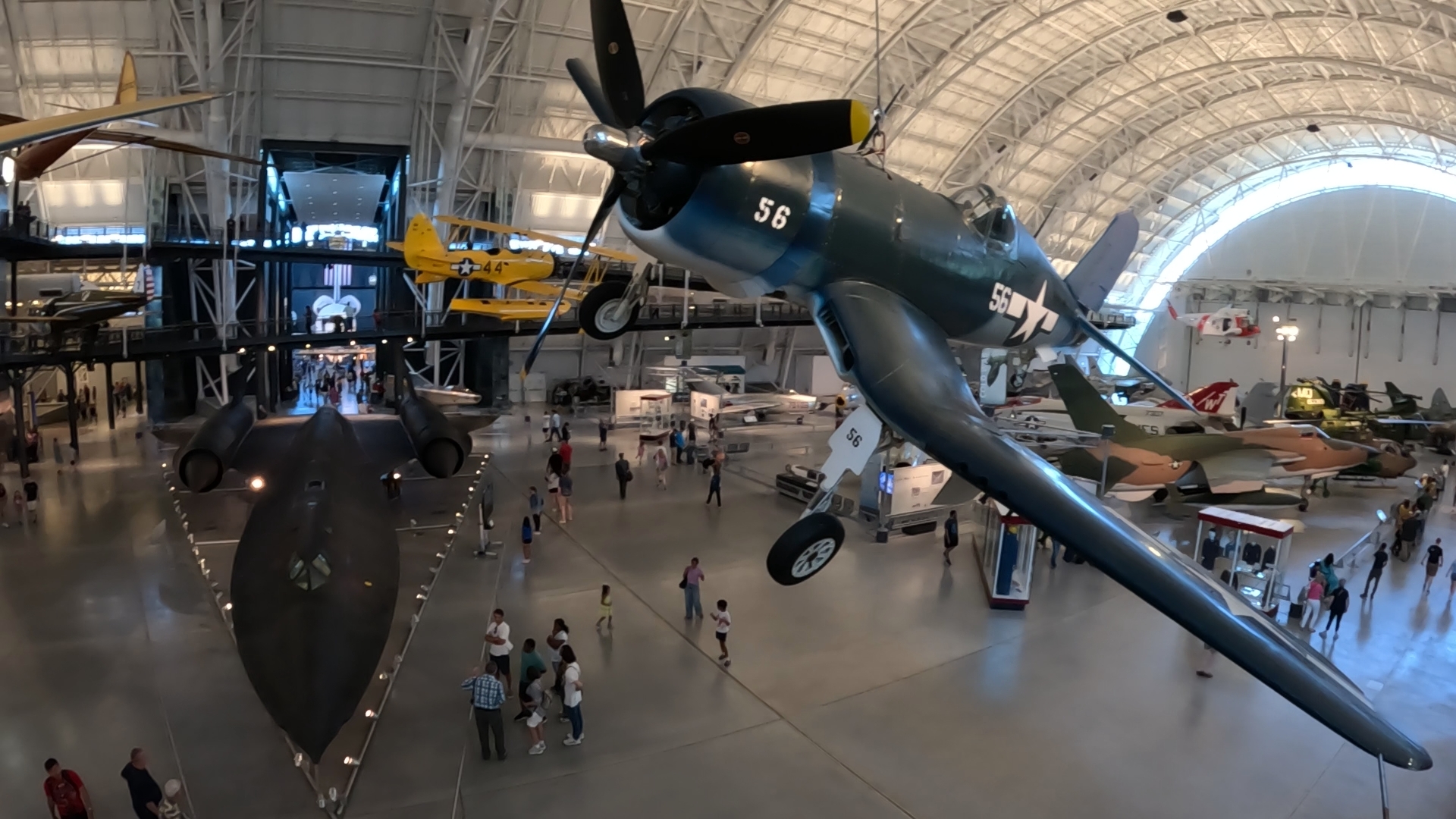
Today I’m going to prioritize the “Flying” part of my persona – it’s been extremely hot this week (over 100 deg F for 4 consecutive days), the humidity is up, it’s just not comfortable. So in lieu of an outdoor trip the family and I decided to go visit the Udvar-Hazy Center, an extension of the Smithsonian’s National Air and Space Museum located just south of Dulles Airport in northern Virginia.
Udvar-Hazy is just far enough from home that I’d always found excuses not to go, but in retrospect I’m not really sure why it took me so long. It’s a really great museum, if you’re into aerospace history. We wound up spending four and a half hours here, and that was “skimming” over a few topics. The examples I point out below are only intended to give a feel for the breadth of the collection. More information and a full list of displays can be found at the Smithsonian’s site, here.
The museum is laid out in large hangars arranged in roughly in a “T” shape, with aircraft suspended at three different levels viewable from the floor and elevated walkways that get you up close to the high exhibits, while providing a top-down perspective on the lower ones. It’s a setup that allows a good look at most exhibits, but the three-dimensional nature of it also can lead to situations where you realize you’ve walked past, or under, a particular aircraft and not noticed it because of focus on something else!

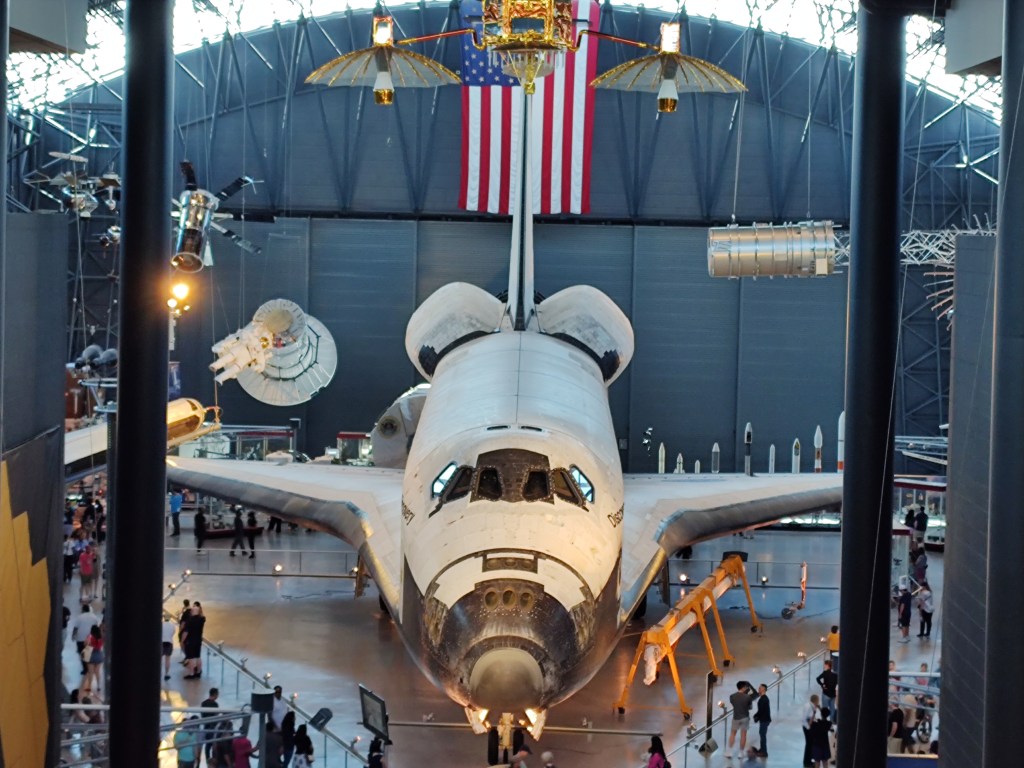
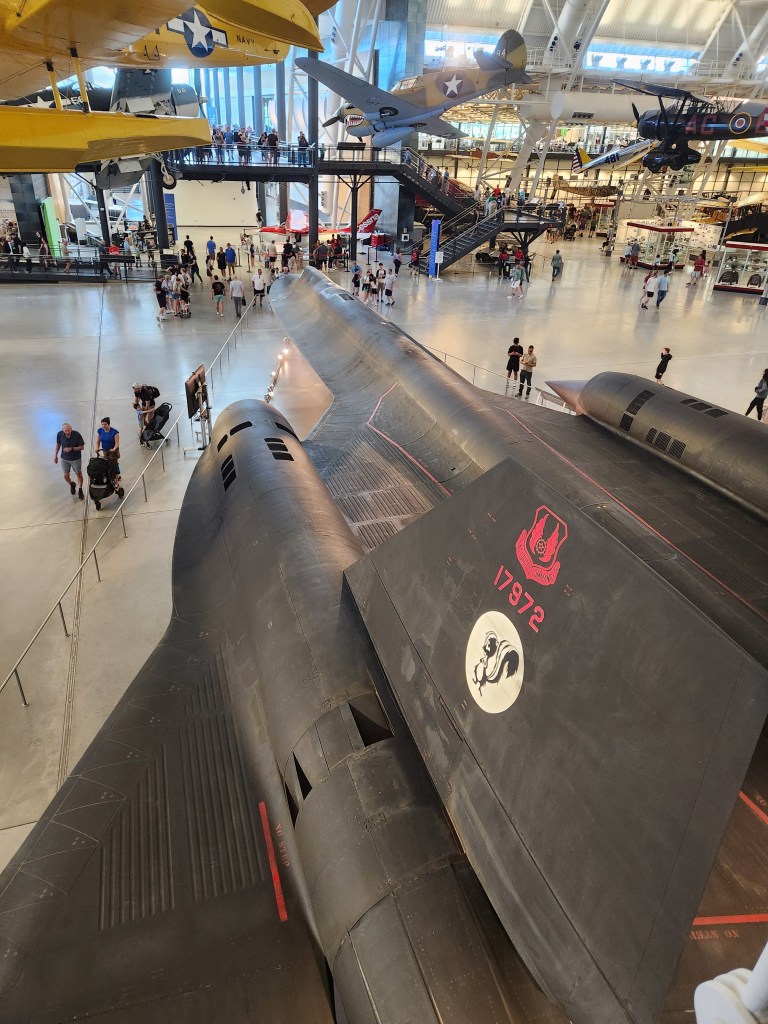
As you enter (admission is free, but parking costs $15), and pass the IMAX theater and the entrance to the observation tower (a 360-degree glass tower with views of live operations at Dulles a few miles away), you’re greeted with an eye-level view of a Vought F-4U Corsair on the right, a North American P-40 Warhawk on the left, a top down view of a Lockheed SR-71 Blackbird front and center on the floor below, and beyond, a nose-on view of the Space Shuttle Discovery in the space hall beyond. It’s an impressive first look and welcome to a fantastic set of exhibits.
“Modern” Warbirds
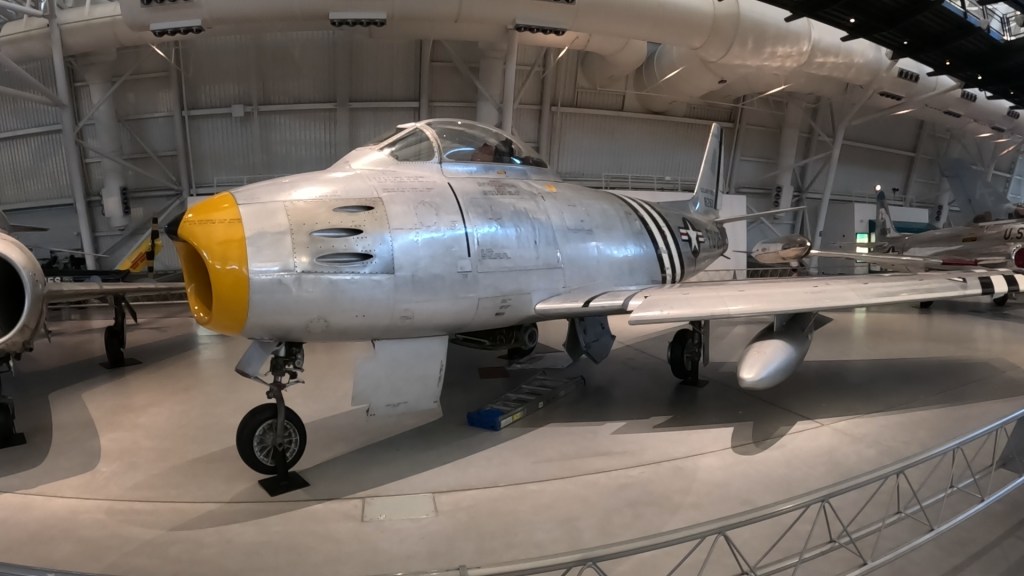
In the gallery to the right, you’ll find modern (back to the 50’s) military hardware, including a North American F-86 Sabre from the Korean War era and several century-series fighters from the Vietnam era, including a Republic F-105 Thunderchief (the “Thud”), and a North American F-100 Super Saber. Naval Aviation is also well represented by a Grumman A-6 Intruder and and E/A-6B Prowler, a Grumman F-14 Tomcat, a McDonnell-Douglas (now Boeing) F-18C Hornet in Blue Angels livery, and a Lockheed-Martin F-35B Lightning, the vertical takeoff and landing variant used by the US Marine Corps.
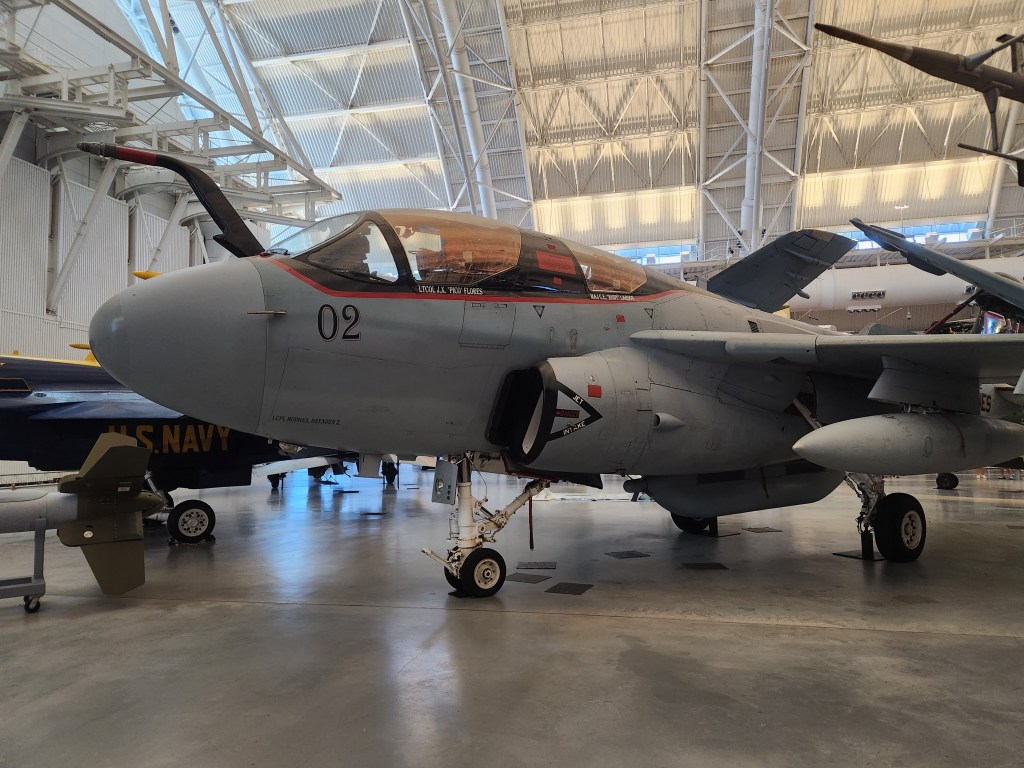
The gallery also contains some Soviet aircraft, including a MiG-15 posed side by side with its American adversary, the F-86, and the U.S.S.R.’s cold-war workhorse, the MiG-21.
This section of the museum also contains an extensive collection of aircraft engines, including some foreign makes, that chronicle the development of powerplants from the Wright engine, through the rotary and radial makes of WW-I, large radials and inline piston engines from WW-II, and the development of turbojets, ramjets, turboprops and turbofans. There’s a nice arrangement here of the lift fan and the articulating nozzle used by the F-35B that give some good insight into how that aircraft hovers so effectively. Here you can also see the Lycoming XR-7755-3, the largest reciprocating aircraft engine ever built. Weighing in at over 6,000 lb, the engine produced more than 5,000 hp from 36 cylinders when tested in 1946 – just in time for emerging jet engine technology to render it obsolete.
World War II
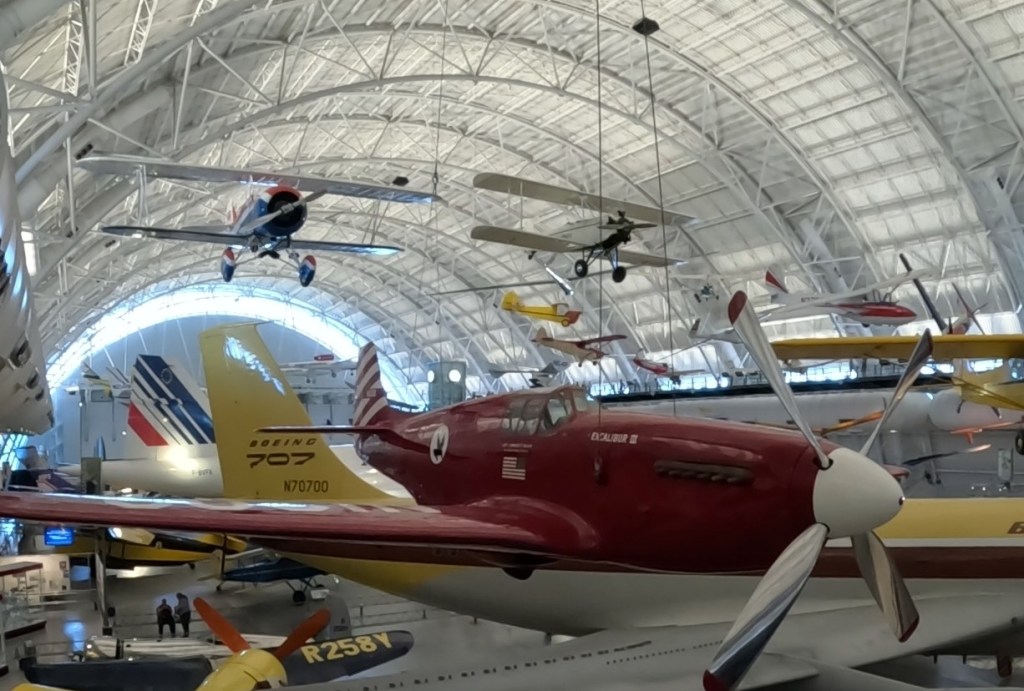
The larger gallery opposite the “modern” craft contains examples from just about every other aviation type (aside from spacecraft, we’ll get there). The World War II area is not as large as some museums, but it contains some gems. Aside from the P-40 and F-4U prominently displayed near the entrance, there’s a Republic P-47 Thunderbolt, a Lockheed P-38 Lightning, a North American P-51C Mustang (albeit one that has been modified for efficiency in long-distance air racing), and a rare twin engine Northrop P-61C Black Widow night fighter.
There are several rare Japanese aircraft, including one of only four surviving examples of the Kawanishi N1K Shiden-Kai, a land-based fighter. Next to it, on floats, is the Aichi M6a Seiran, designed to be launched from submarines. A twin-engine Nakajima JN-1 Gekko, configured with radar antennas for use as a night fighter is here, and tucked away between the completed aircraft is the fuselage of a Kyushu J7W Shinden. One of only two prototype aircraft completed, the Shinden has a unique canard configuration and was built to counter bombing raids by B-29s, but never saw service. (If you’ve seen the movie Godzilla Minus One, the unique airplane featured in that story is a Shinden.)
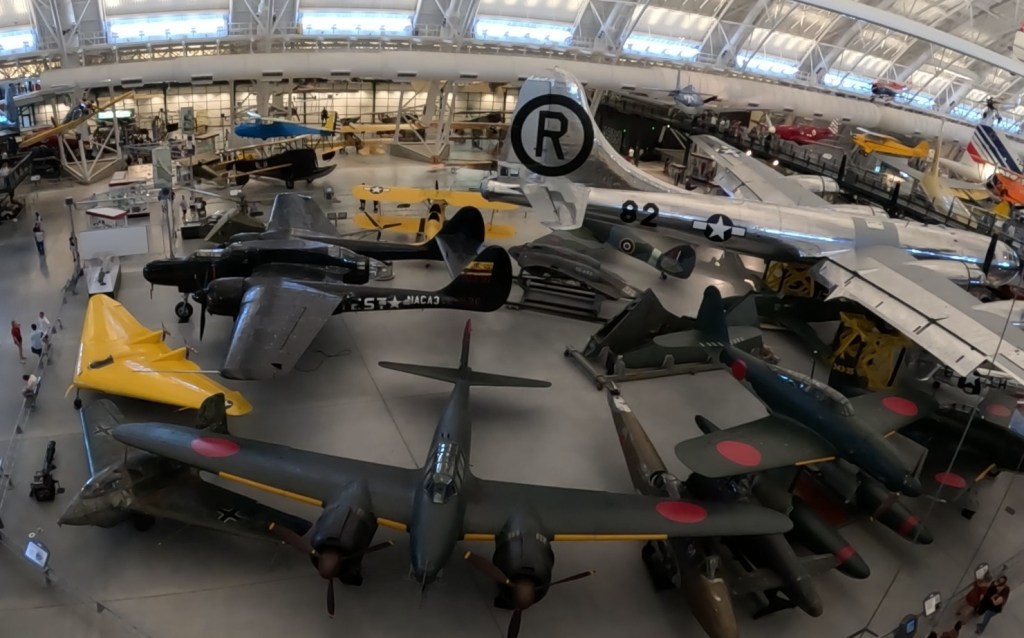
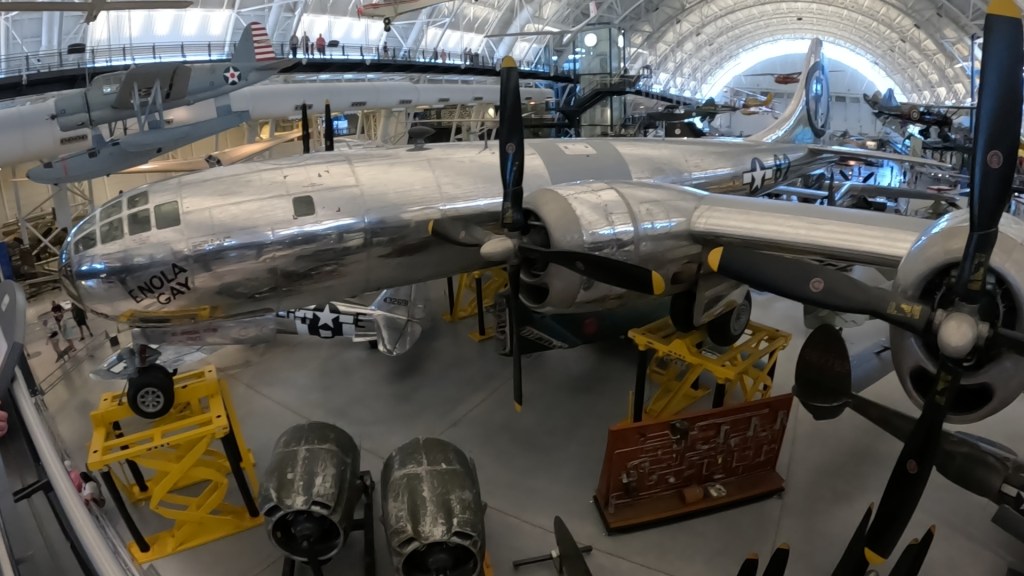
American aircraft used in the Pacific Theater include a Grumman F6F-3 Hellcat, a Vought Sikorsky OS2U Kingfisher floatplane, and of course, dominating the gallery, the Boeing B-29 Superfortress, the Enola Gay, the aircraft that dropped the first atomic weapon used in wartime. It released “Little Boy” over Hiroshima on August 6, 1945, and changed the world and the (potential) nature of warfare forever.

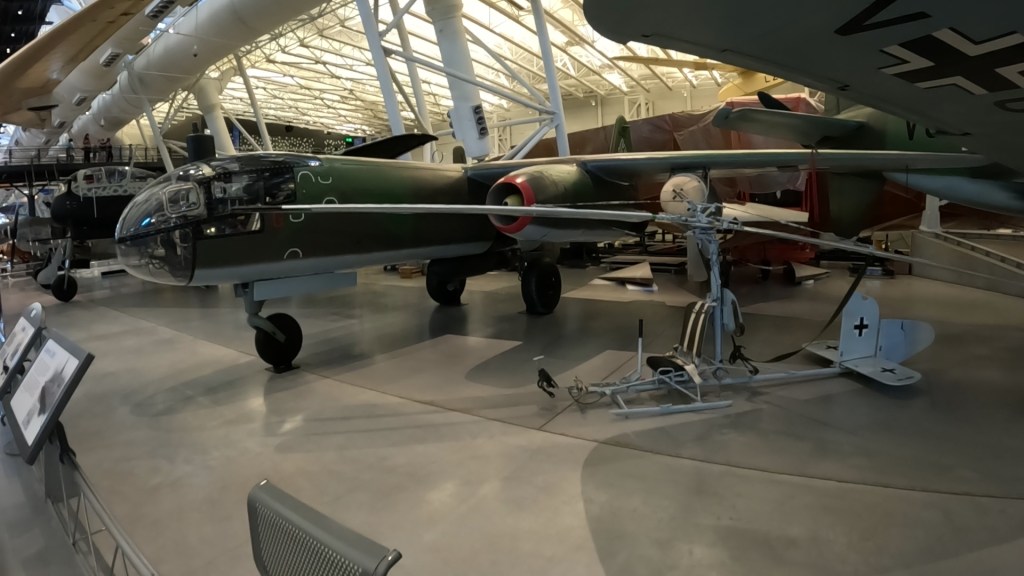
German aircraft also get attention here. There’s a rare Messerschmitt Me 163 Komet, the only operational rocket-powered fighter aircraft in history. There’s a Focke-Wulf Fw 190, an aircraft built in large numbers during the war, but one I’d never seen before. There’s an Arado Ar 234 Blitz, the world’s first operational turbojet-powered bomber that was used primarily as a fast reconnaissance aircraft. And finally, a craft I’d never heard of, a Focke Achgelis Fa 330A. This tiny thing is essentially a three-bladed, unpowered gyroplane, towed aloft and flown as a kite in which an observer would sit and report ship sightings through a telephone line strung along its tow rope. It was meant to be launched from U-Boats, but the submarine captains didn’t like them as they tended to give away the position of the U-Boat more easily than it provided intelligence about other ships.

Everything Else
Not to give the other aircraft exhibits here short shrift, but there are LOTS of civilian aircraft on display here as well. There’s a section devoted to gliders and sailplanes, some examples of cheap “aircraft for the masses”, including homebuilts and early attempts at roadable aircraft. There are ultralights, hang gliders, an impressive collection of gyrocopters, helicopters, personal and business aircraft, and the gondolas of several record-setting hot air and gas-hybrid balloons.
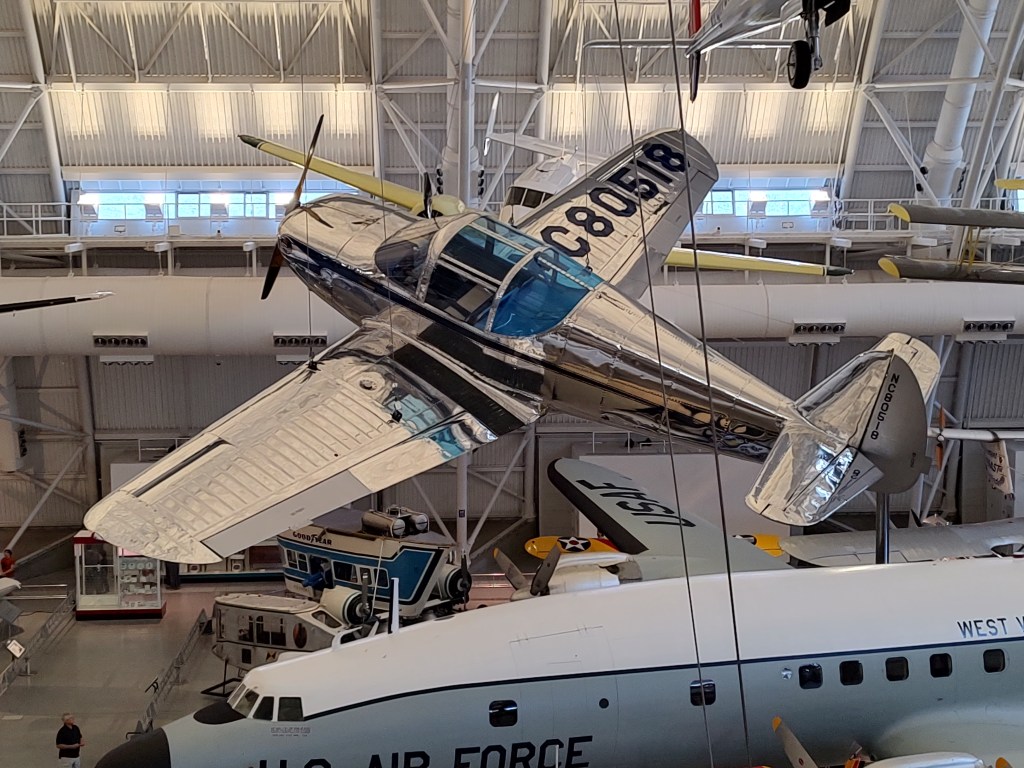
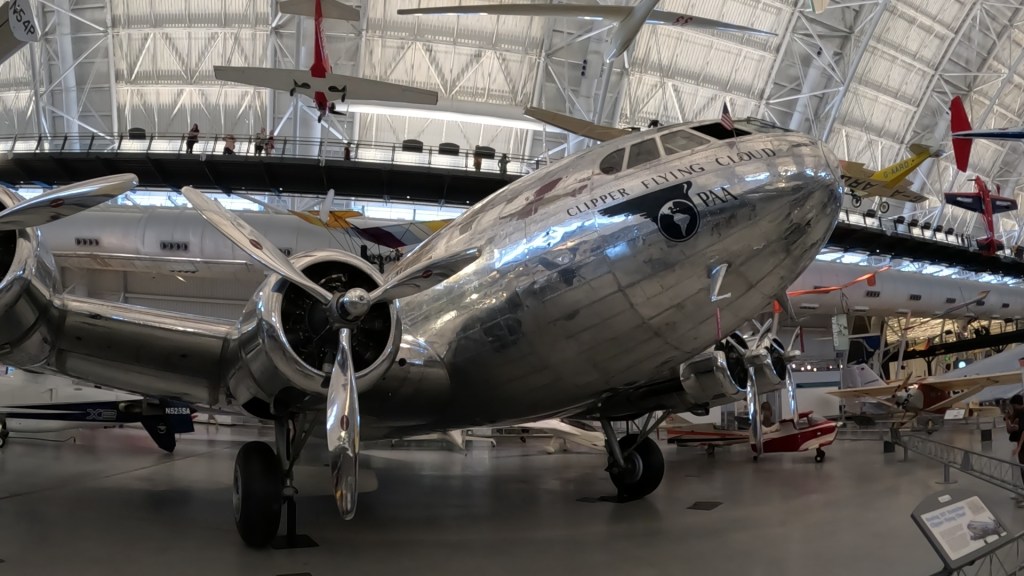
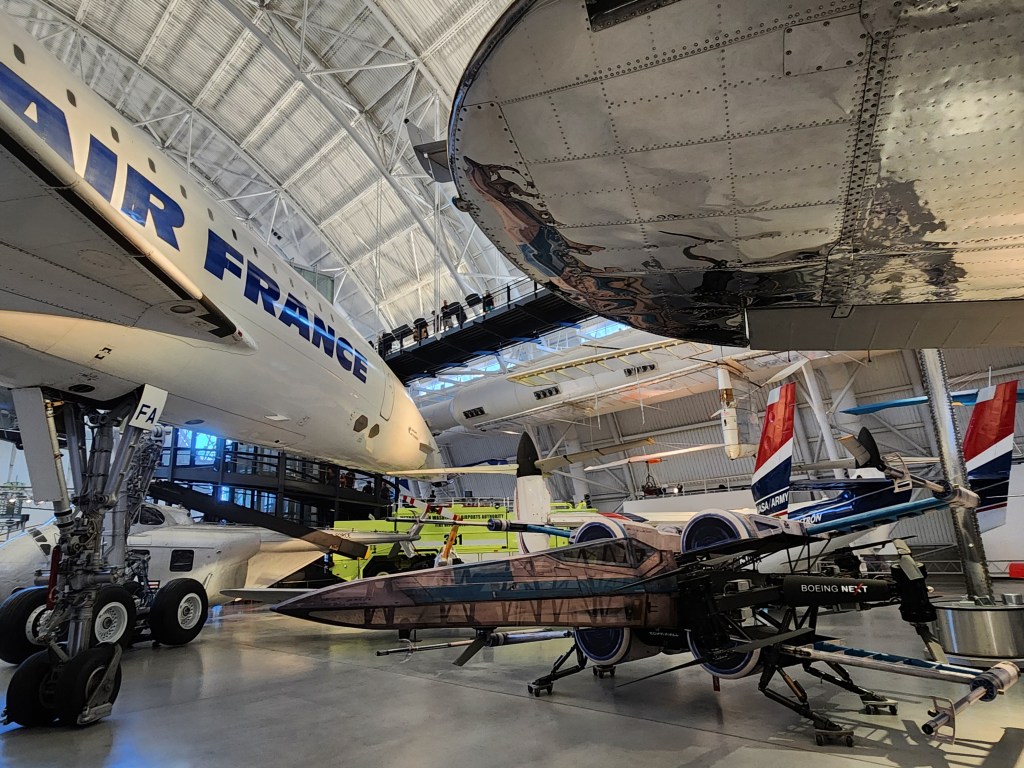
There’s an XV-15, the prototype tilt-rotor that led to the development of the Bell Boeing MV-22 and the Bell 609. There’s a Concorde here in Air France livery, absolutely dominating the commercial aircraft area with many displays tucked under its massive wings. There’s a Boeing 307 Stratoliner, the world’s first pressurized airliner, built using the wings, engines, and general layout of a B-17 bomber. There is a Lockheed Super-Constellation in West Virginia Air National Guard livery. There are inter-war biplanes used as military trainers and to support early exploration of the poles, and as air mail platforms. There are agricultural application aircraft, including an Air Tractor AT-400A dressed up like Dusty Crophopper from the Pixar movie Planes. There’s even an X-Wing Fighter from Star Wars – actually a 12-rotored cargo drone built by Boeing and outfitted with an X-Wing “costume” used (with creative lighting and special effects) at the opening of the Star Wars area at Disney World.
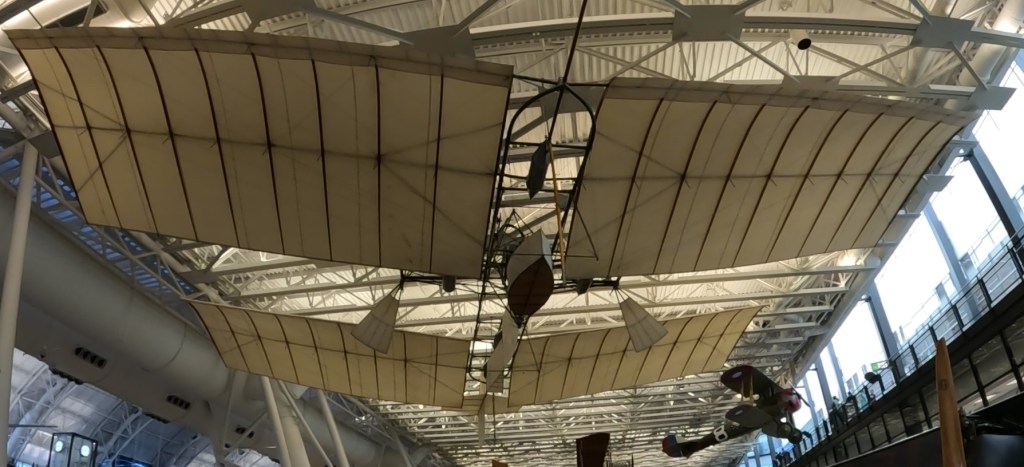
The early history of flight is also well represented, with several craft hardly recognizable as airplanes. Yes, there are some classic World War I biplanes – a SPAD, a Nieuport 28, a Fokker D.VII – but there is also a French twin engine Caudron G.4 bomber with no solid fuselage, just wings, engines, cockpit and tail connected to each other by struts and wires. Hanging high above, a Langley Aerodrome A looks more like an airborne sailboat, or a train of hang gliders attached nose to tail. Even the museum writeup doesn’t hold back in its description of how this craft failed – but that’s how we learn, right?

One particular aircraft in the aerobatic/sport section caught my eye. A bright red Monocoupe 110 Special called “Little Butch” bears the name of Woody Edmondson, a man who happened to be a good friend of my grandparents back in the 1930s, about the time they (my grandparents) themselves were married in an airborne ceremony onboard a Stinson Reliant – a very unique occurrence at the time. My family had no idea about the connection to this specific airplane, but during a family visit to Udvar-Hazy some years ago (I was not able to participate), my grandmother, now passed, looked up and asked, “Why is Woody’s plane here?” As you can imagine, that event started some investigation and family story-telling that none of the rest of us anticipated.

Missiles and Spacecraft
Spacecraft have their own hangar at Udvar-Hazy, one that is dominated by the Space Shuttle Discovery in the middle of the space. The perimeter of the gallery, though, contains lots of interesting artifacts and a history of the development of space technology.

It’s hard not to start with rockets and missiles, and the tie between German (primarily) World War II efforts and the early successes of the US. There are displays outlining the development of rocket propulsion, using solid rocket motors, pulse jets (ala the V-1 Buzz Bomb), liquid and hybrid engines.
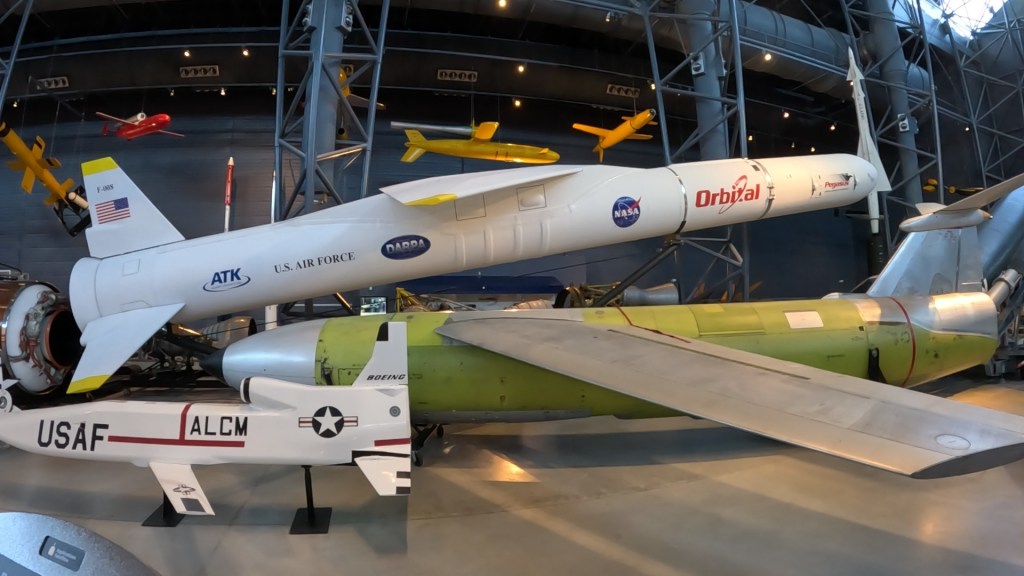
Early missiles are well-represented. There’s an early German Rheintochter R 1, with three sets of handmade wooden fins. There are rockets built in the 1940s, two and a half stories tall but with a range of only 70 miles. Then, as you walk through time and round the corner, you see rockets built in the 80s (and later) half this size that can carry nuclear warheads over 3,000 miles after being launched from a submarine. The discussion of launch vehicles intended for satellite deployment and human spaceflight is fairly limited here (there’s quite a bit at the National Air and Space Museum on the mall in DC), but there are some examples – Orbital’s Pegasus air-launched satellite deployment system is here, and there are models and sections of the Titan rockets used for the Gemini program, and of the Saturn V rocket that was used in Apollo. Components, such as guidance systems and communications gear, are present, and there are several relics from ground control stations dating back as far as the late 40s.

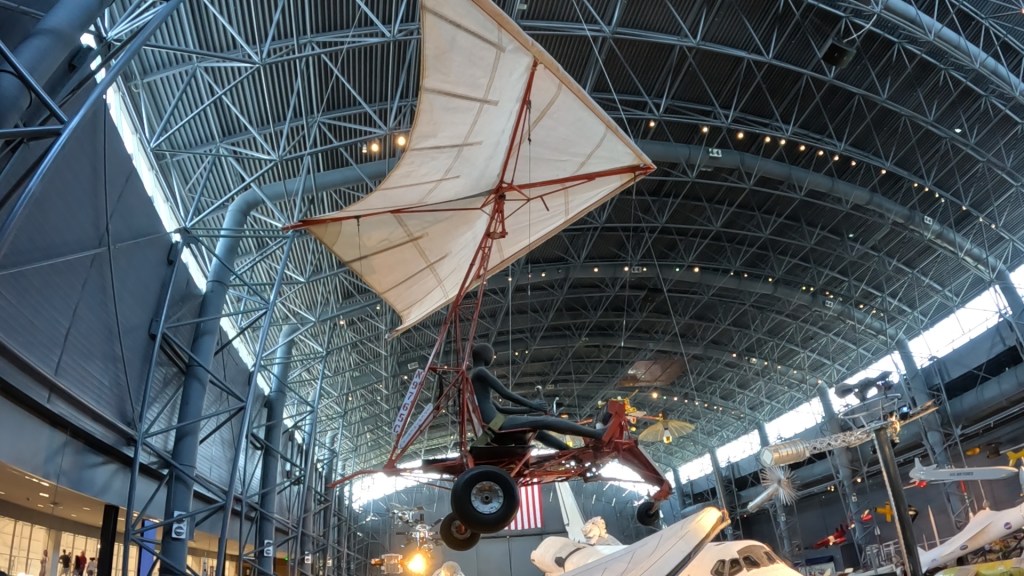
There are several exhibits focused on the Mercury and Gemini programs, outlining early suborbital flights and the first forays into Earth’s orbit. One thing we were surprised to learn is that one of the early ideas for Gemini recovery basically involved a steerable hang glider above the capsule, with deployable landing gear. This idea was eventually abandoned in favor of more predictable parachutes and water landings, but for a while there, the approach was completely different. As part of this experimentation, the museum displays a tiny one-seat craft with an ancient hang glider attached – not unlike a more modern ultralight, but built before high-tech synthetic materials were readily available. Apparently this thing was towed as high as 12,000 feet and released for a piloted descent back to a runway. Both Gus Grissom and Neil Armstrong flew this thing, and that idea is as terrifying as any cutting edge high-speed, high powered rockets these astronauts flew!

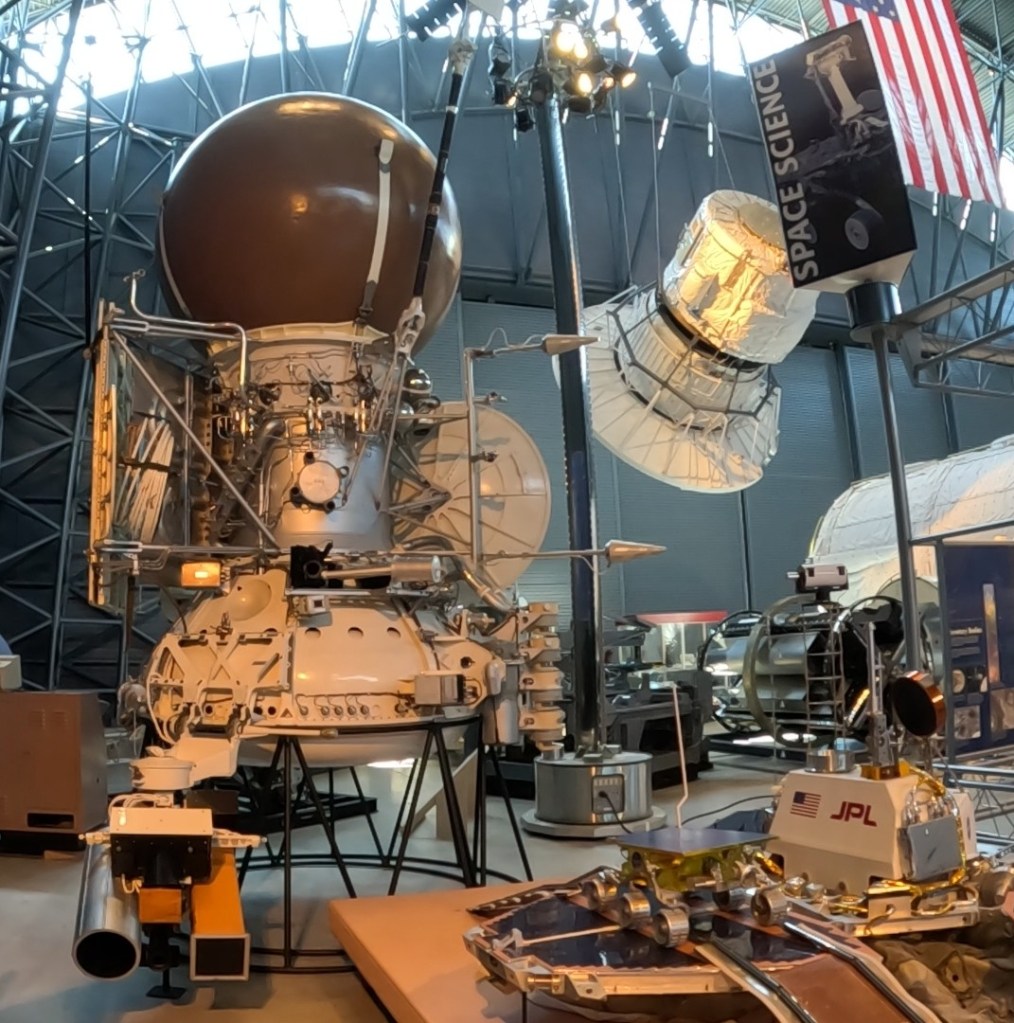
There’s a display containing spare equipment and engineering models of the Mars Sojourner and Pathfinder vehicles, as well as a copy of Ingenuity, the famous Mars helicopter. There’s quite a bit of information on SpaceLab, a European Space Agency (ESA) module that flew in the cargo bay of the Space Shuttle to conduct micro-gravity experiments before the days of the International Space Station.
One of the more interesting displays here is the Vega “bus”, the joint Soviet and European mission in the early 80s that dropped off both a Venera lander and an atmospheric balloon at Venus and then continued to fly through the tail of Halley’s Comet.
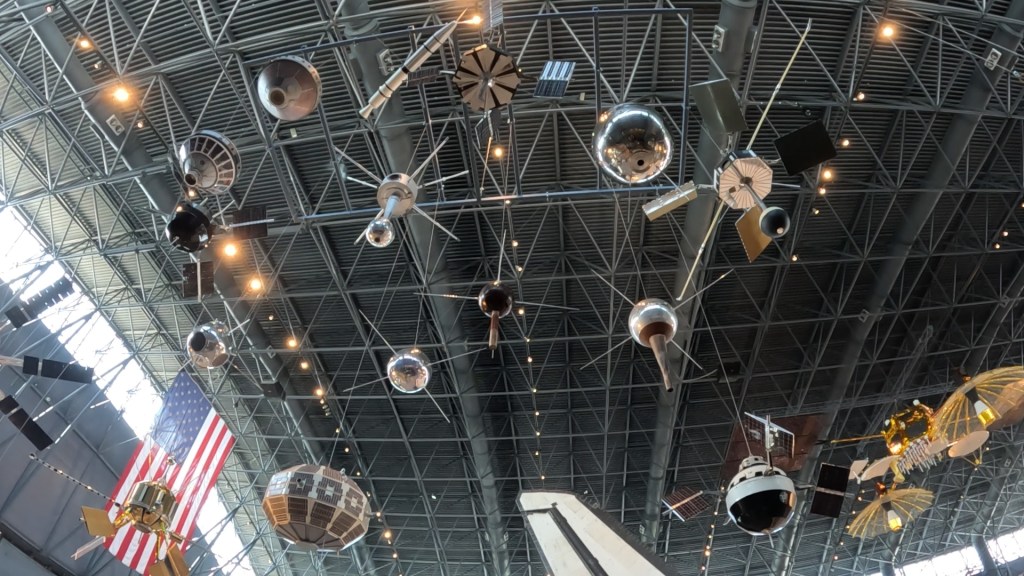
There’s a collection of early satellites. Reminders that Sputnik was only the size of a basketball, and Vanguard, the United States’s first satellite, even smaller.
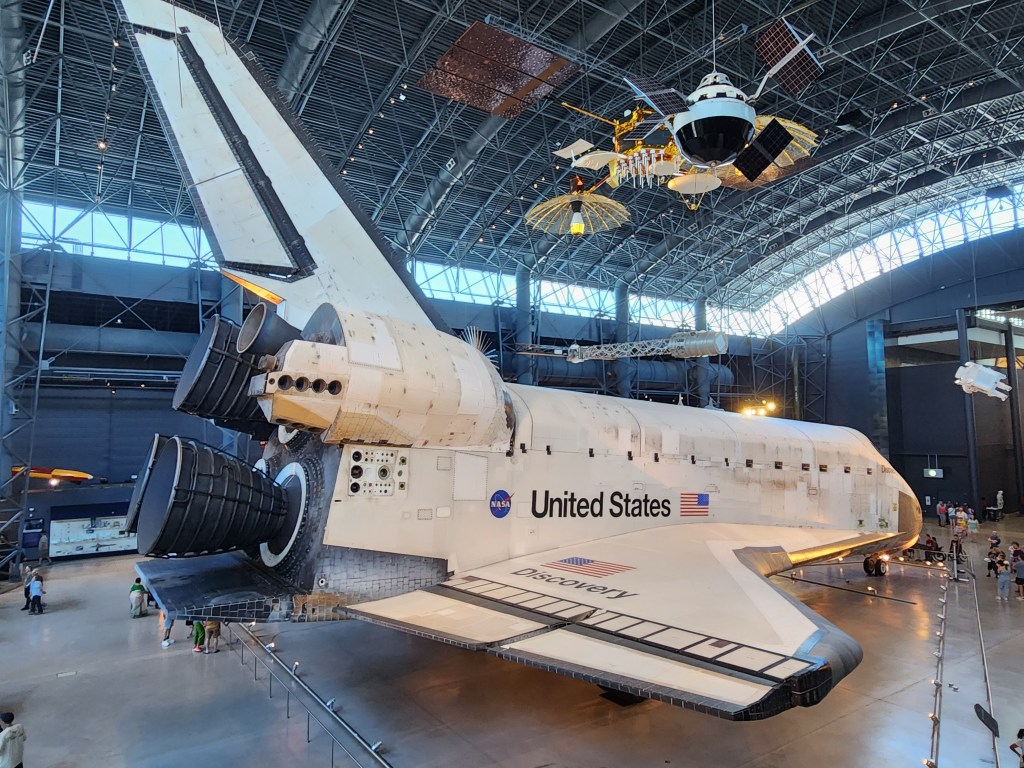
And then, there’s Discovery. The Shuttle program was transformational for space operations, combining an orbiter with the capability to launch and recover satellites, perform experiments on orbit, and recover back on Earth to be reused. This is the second shuttle I’ve seen up close (the other being Endeavor, at Kennedy Space Center in Florida), and the enormous size of the orbiter is one of its most striking features. It’s an impressive vehicle, and it combines very high tech elements – the precision of the ablative heat-shield tiles, the engines – with extremely low tech items that make it clear these vehicles were built in the 70s and 80s. The hinges along the cargo bay can only be described as klunky. The angles, particularly on the tail surfaces and the aft end of the fuselage, evoke ideas of carpentry more than aerospace precision that we see in the use of modern composite materials. Nonetheless, Discovery is impressive, and is worth the visit in and of itself.

Thoughts
All in all, I’m surprised I never made it to Udvar-Hazy before. It may have been due to some subconscious disappointment in the Air and Space museum on the mall, but any doubts were not well founded. It’s an excellent museum with a wide variety of displays, some very rare, some extremely notable from a historical perspective.
I would definitely go back. And in fact, knowing that the DC museum has recently undergone renovations, seeing Udvar-Hazy is inspiring me to go back to the mall and see how that museum has been updated. It’s been a while since I’ve been there, too.
I can promise I don’t intend to use my time blogging about these types of topics very much – but there is a reason I’m a “Flying Squirrel”. If you’re at all interested in aviation, aircraft, spacecraft, or military history, Udvar-Hazy is worth a visit!
Get Out There
 Flying Squirrel Outdoors
That is a terrific air museum. We visited a few years ago. Thanks for the photos and reminders.
LikeLiked by 1 person
I was impressed. Great exhibits and really well done – it appears they rotate some of the more obscure exhibits fairly regularly, so it stays fairly fresh.
LikeLike