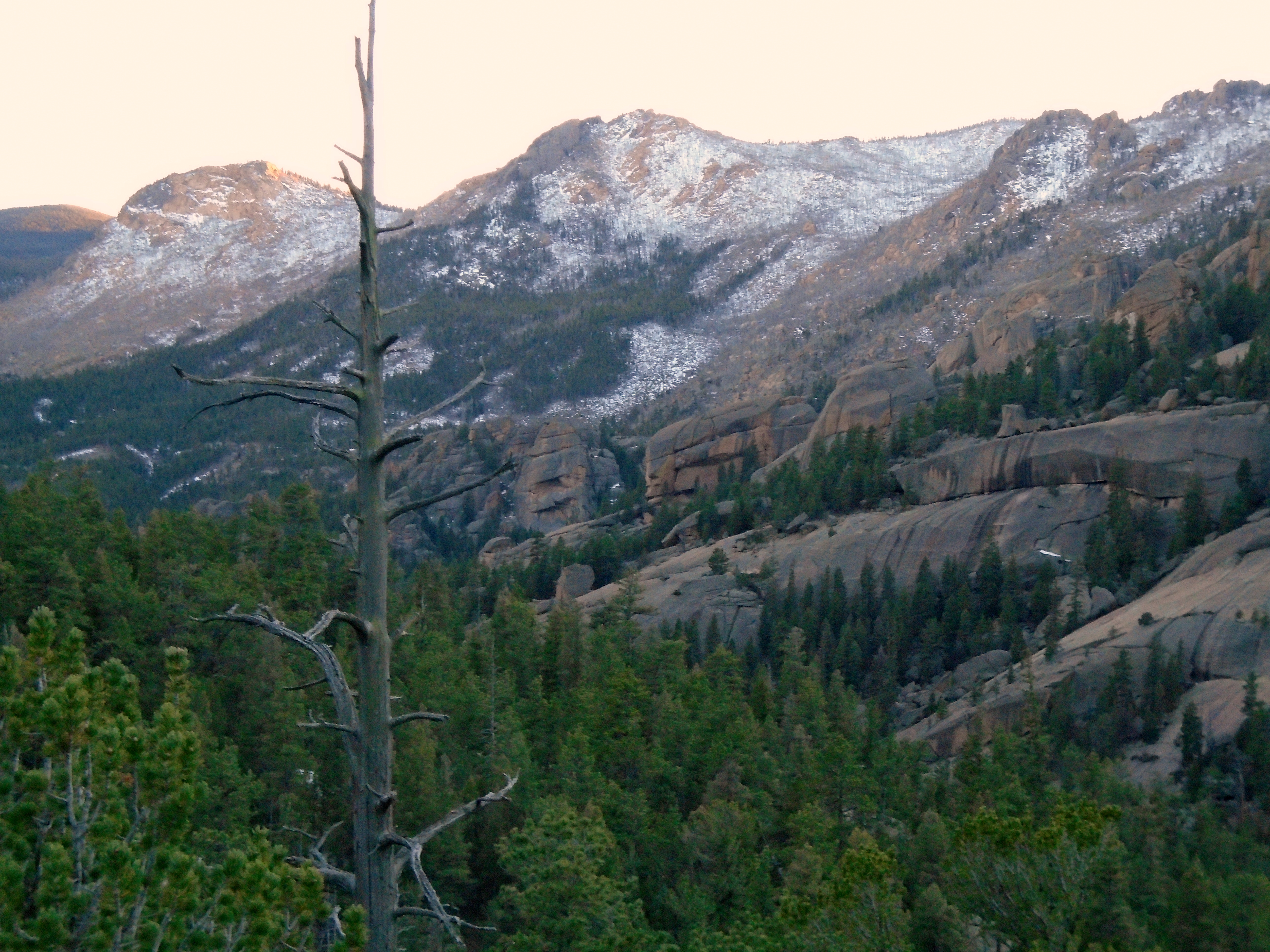
Mountains aren’t less steep if you have a higher income. Rain doesn’t preferentially fall on those with certain ethnic backgrounds. A higher level of education does not correlate to ability to hike more miles in a day.
Time spent in the outdoors is time spent exploring the core of what it means to be a human animal, a part of nature. Once there, the various advantages and disadvantages that are so critical to life in our various man-made social constructs tend to be minimized. Experience in the outdoors is an equalizer, where the unforgiving forces of nature treat everyone with the same indifference.
It’s no mystery then, why time outdoors is such a great way to decompress, to recuperate and rejuvenate, to team-build, to learn leadership skills. Put people from all walks of life into an environment where everybody is just a little out of their daily element, where time slows, schedules can be forgotten, basic resources such as food, water, and shelter become common pursuits that you can’t just pay for, and simple survival becomes a tangible objective, and we let the usual barriers between us fall.

For many of us, time outdoors is also spiritual. Whether or not a person ties their experience to belief in or recognition of a supreme creator, the outdoors offers places where we can experience true awe, where we measure ourselves against the grandeur of a mountaintop view, the power of a waterfall, an intimate forest glade, or a wildlife encounter, and feel both humbled and inspired. Time spent surrounded by the wonder of creation can, for some of us, lift the soul more than time in any church.
If time in the outdoors is to work its magic, however, it needs to be something we can all enjoy. A universal human experience shouldn’t be put behind fences and privatized for the benefit or profit of the select few. To do so eliminates the idea of nature as an equalizing basic human experience, and reintroduces the hierarchy of social inequality that is so pervasive elsewhere. Wilderness areas cease to become a public escape, and instead become an extension of the man-made societal construct separating the haves and have-nots.
I live on the east coast, where public lands are few and far between. For many, public municipal or urban parks are the only accessible access to nature. For those more fortunate, it’s still challenging to find immersion in nature. Views without man-made structures are almost impossible, and even the most remote areas are often still within earshot of traffic on an Interstate highway and airliners overhead. It may be viewed as hypocritical that someone like myself, living in a part of the country that’s already been largely parceled into private ownership, should suggest that the same not happen elsewhere, specifically in the west. I’ll accept that – I’m not in a position to dictate the use of every parcel, and I recognize that some of our public lands, while accessible for outdoor recreation, are primarily focused on management of natural resources. There’s a need for that, and there’s a need to manage public lands. But there’s also a need for wilderness.

That said, I contend – and I’ve said before – that there are many things in this world, in this country, that have intrinsic value that cannot be measured in terms of the profit they might yield. It is the function of Government to protect life, liberty and the pursuit of happiness for all, and when it comes to public lands that is inclusive of both management and conservation, as well as protecting access to things that increase general welfare and the common good.
There are many legitimate reasons to leverage public resources to increase public welfare, but that doesn’t seem to be the motivation behind Congress looking to sell 250 million acres of public land, with few restrictions, “to any interested party”. Rather than public good, this appears to trade the public good for private profit to those that can afford it. It is right, just, and essential that we question and understand the motives and the expected outcomes of such a decision.
Again, I live far away from the acreage in question. The land proposed for sale all lies within Alaska, Arizona, California, Colorado, Idaho, Nevada, New Mexico, Oregon, Utah, Washington and Wyoming. My voice is only one, and it may very well be uninformed with regard to the impact and utilization of a specific piece of land. I may be wrong in this. But speaking both as someone who has witnessed the value of access to the outdoors AND as someone who has limited wilderness opportunity, it seems it would be a shame to lose a public resource to the highest bidder, with very little stated objective than to turn land into profit.

Ask questions, make your voice heard, and get answers from elected representatives. A decision this significant shouldn’t take place without vocal public engagement, but we the people are going to have to demand to be heard, as it seems apparent that very few in our Government are actually interested in soliciting our opinions.
Get Out There


I lived most of my life Out West recreating on its extensive public lands. The plan to sell them off seems to be driven by two interests: (1) the ideological – “public” is the dreaded socialism and if you can’t pay for it, you don’t deserve it and (2) the commercial – there’s money (for some) to be made via extraction (mining & logging) and real estate. I cannot hold morally with the premise of (1). Interest (2) ignores the fact that recreation (hiking, hunting, fishing, ATV, etc., etc.) on these public lands brings a steadier, longer lasting income to the small towns (and the states they’re in) than does one-and-done extraction. Imagine the town of Bishop without the Eastern Sierra or West Yellowstone with the adjacent national park or Ely (MN) with a giant open pit nickel mine instead of the Boundary Waters or no hunting the western states without paying an exorbitant land use fee. Selling these lands is madness.
LikeLike
Excellent point on the broader financial impact to gateway towns. I’m definitely against this sale as well, but try to remain cognizant that “I’m not from around there”. That land is my land too, but I’ll leave room for not being aware of potential good reasons having to do with particular plots. (FWIW I haven’t yet heard any).
And wrt your point number 1 – couldn’t agree more. It’s a moral failure to believe that anything for the common good is fundamentally a waste, or that access to the most basic resources must somehow be earned. Its wide appeal and accessibility is one of the best things about public land. Like I say, things have value outside monetary value. It’s a shame that isn’t a more common part of our public discourse.
LikeLike
Thank you. Your post is excellent. While I now live in Virginia, I spent the majority of my life living in the west and have a deep appreciation for the beauty and value of national parks, monuments, wilderness areas and other public lands for us, our children and future generations. I’m now spending five months exploring various national parks and monuments in the Southwest. And I’ve been including a section on the current threats in each of my posts, and, like you encouraging the public to become actively involved in the effort to save our heritage. The public lands belong to all of us— not certain political interests in Washington and elsewhere who only see them as potential profit.
LikeLiked by 1 person
Thanks, Curt. Like so many things, this is one of those threats that don’t (at least not immediately or openly) affect many people’s daily lives. I think our “leaders” are hoping that public apathy will allow them to continue to take away public resources one by one.
LikeLike
Hopefully, the sleeping giant will wake up before it is too late. But there are signs.
LikeLiked by 1 person
I share your love of the outdoors as well as your concerns about protecting and maintaining our public lands, conservation areas and green spaces. You’re right, there isn’t much wilderness left. And there’s already not enough parks to meet demand. It’s the same in Canada unless you travel further up north.
LikeLiked by 1 person
There’s an irony here that we really need wilderness areas close to population centers in order for those areas to get the attention and support they need, while somehow protecting their wild nature. People don’t seem to care about those far flung places they’ll never see, even if their destruction impacts everybody.
LikeLiked by 1 person