A lot of my blog-posting derives from encountering something interesting that prompts me to go down a road of research and discovery. This is one of those posts.
Last week, my son and I spent three days and two nights backpacking in Great Smoky Mountains National Park (more on that soon, including video), and we had an unexpected encounter with wild hogs high up on a mountain ridge, above 5,500 feet. Until we saw them, we had no idea there were wild hogs in the Smokies. Here’s what we’ve learned in the week since.
Who are these pigs and where did they come from?
In the early 1900s, a businessman named George Gordon Moore established a 1600-acre private game hunting reserve on Hooper Bald, a peak that stands at 5,429 feet, in Graham County, NC. The initial stock of hunting targets included 14 Russian wild boar (Sus scrofa) and 4 bison, and eventually expanded to include a diverse menagerie (adding black bears, wild turkeys, elk, and mule deer) held in large pens across the mountaintop, entertaining guests at a lodge that served as an exotic getaway for close to 20 years.
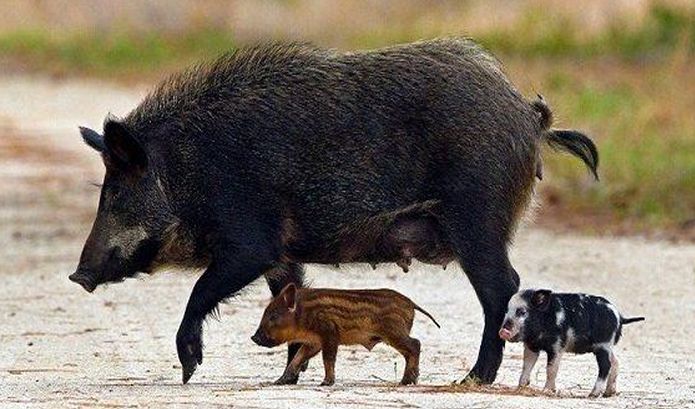
In the early 20’s, many of the wild boars escaped the reserve and started to roam the land now covered by the National Park. Some interbred and hybridized with domestic pigs. The resulting hogs are therefore distinct from most feral pigs in the United States, in that they BEGAN as wild boars, and not simply escaped farm animals.
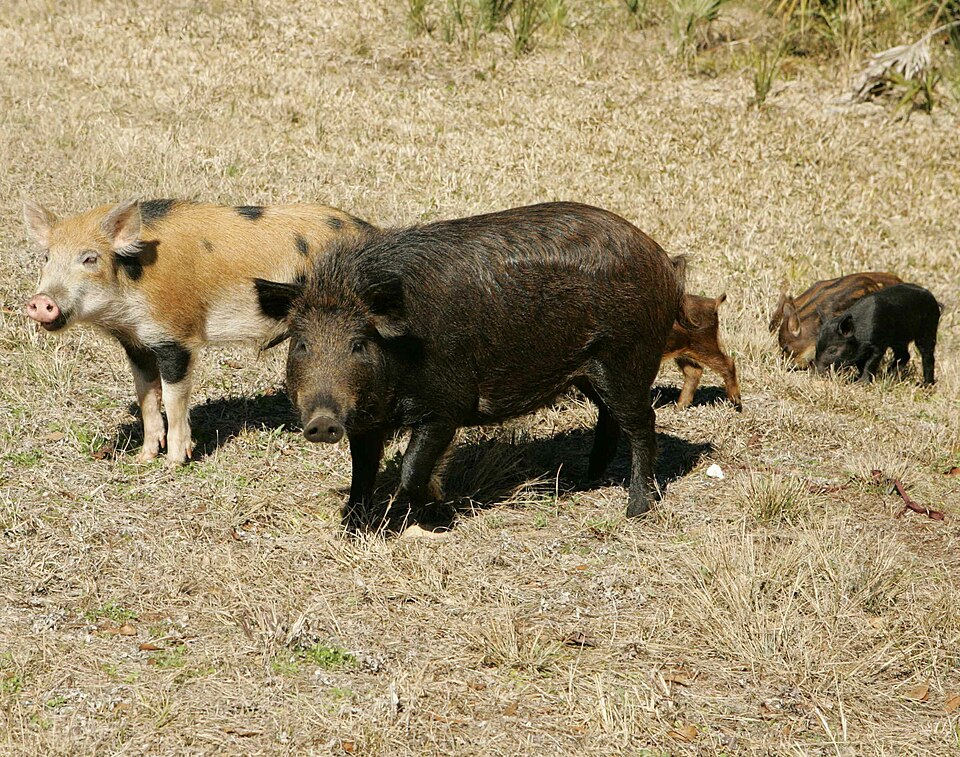
Most feral pigs are direct descendants of domestic pigs. Pigs have a capacity to radically change in just one generation, as environmental stresses trigger an epigenetic response. Genes that are normally suppressed by selective breeding and easy living on a managed farm are activated early in a pig’s life. Some piglets pick up on stress hormones while in utero, others through milk or environmental stresses shortly after birth, and these stresses cause rapid and dramatic physical changes. They grow bigger, hairier, their snouts elongate and their foreheads flatten, and they grow substantial lower tusks, sharpened by rubbing against their upper teeth. All these changes facilitate more efficient and more aggressive rooting through the forest floor and improve the ability for these omnivores to survive a wilderness lifestyle.
In the Smokies, the combination of Russian wild hogs with domestic stock results in a particularly hardy, resilient breed of pig. Its genes include the best of both worlds, so to speak – a combination of wild adaptation and the increased fertility of domestic pigs. They are also highly intelligent. Pigs are one of the few animals with the capacity for self-recognition when viewing themselves in a mirror (along with chimps and dolphins), and it is believed that wild pigs are actually smarter, and more wily than their domestic counterparts.
The pigs in the Smokies are generally smaller than other feral hogs. Males average about 125 pounds and stand 2-3 feet tall at the shoulder, and are 4-5 feet long. They are typically active at night, though occasionally seen during the day. They travel in family groups until the piglets reach sexual maturity between 6 and 12 months of age, and then tend to be solitary until the next year’s breeding season. They tend to hang out at higher elevations during the summer, where it’s cooler, and then descend in the fall to gorge on acorns and other mast food sources, and to avoid the wind and ice of high altitude winters.
They are also, thankfully, more skittish and wary of humans than other pigs, though like all feral hogs they can be unpredictable and occasionally aggressive.
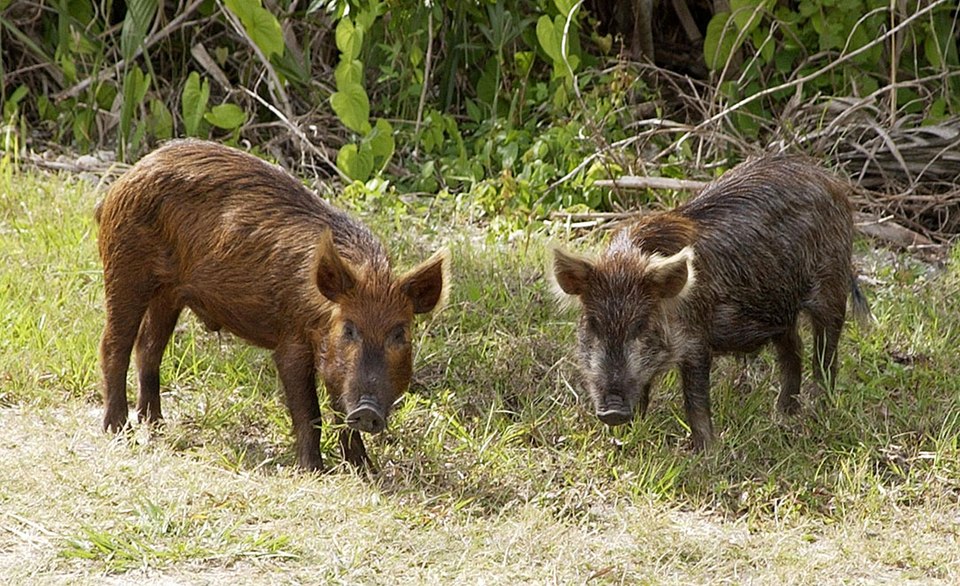
We saw a large sow and a single piglet in broad daylight, at about 10am, on Mt. Sterling ridge in North Carolina, about 60 miles northeast of Hooper Bald where the original population escaped. My son saw them first, thinking he had spotted a bear. The sow was laying in a muddy wallow, and was about the size and color of a black bear, but he noticed a swishing, wiry-haired tail, which identified it as “not a bear”. We didn’t know what it actually was, though, until both jumped off and ran, quickly, away from the trail and off into the woods.
Things happened too quickly to get a picture of these particular hogs, but the public-domain photos here are generally representative of what we encountered.
Impacts
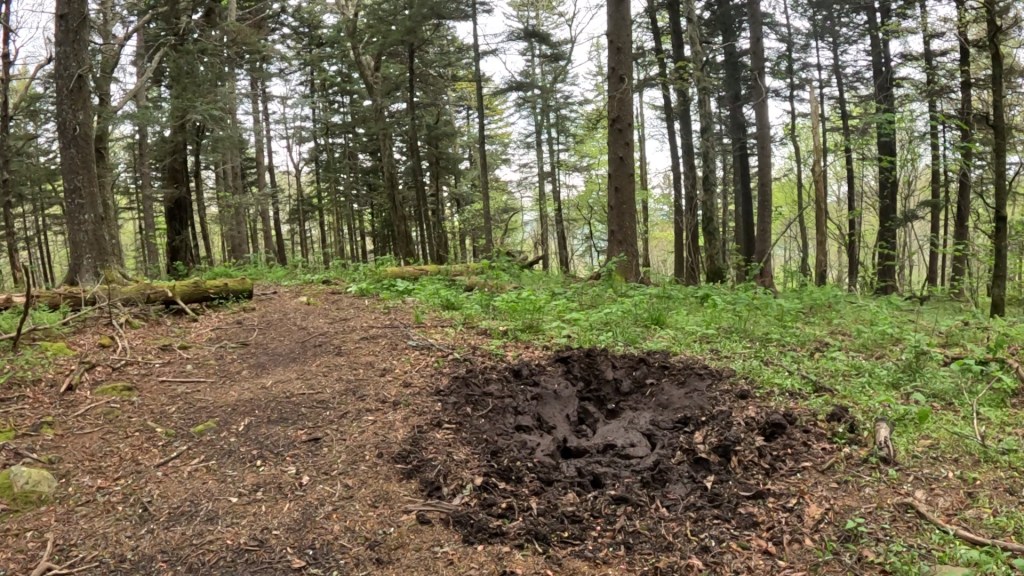
Feral pigs are non-native, invasive, and really destructive. We happened to see the pigs before we saw indirect evidence of them, but we pretty immediately started to see the torn-up earth resulting from their rooting. Generally, we’d see areas covering hundreds of square feet where the ground was overturned to a depth of about 4 inches, almost as if someone had done a very untidy plowing or tilling job. We didn’t see this directly, but in the park their rooting also impacts some of the historical artifacts in the park, particularly at sites of old cabins and cemeteries.
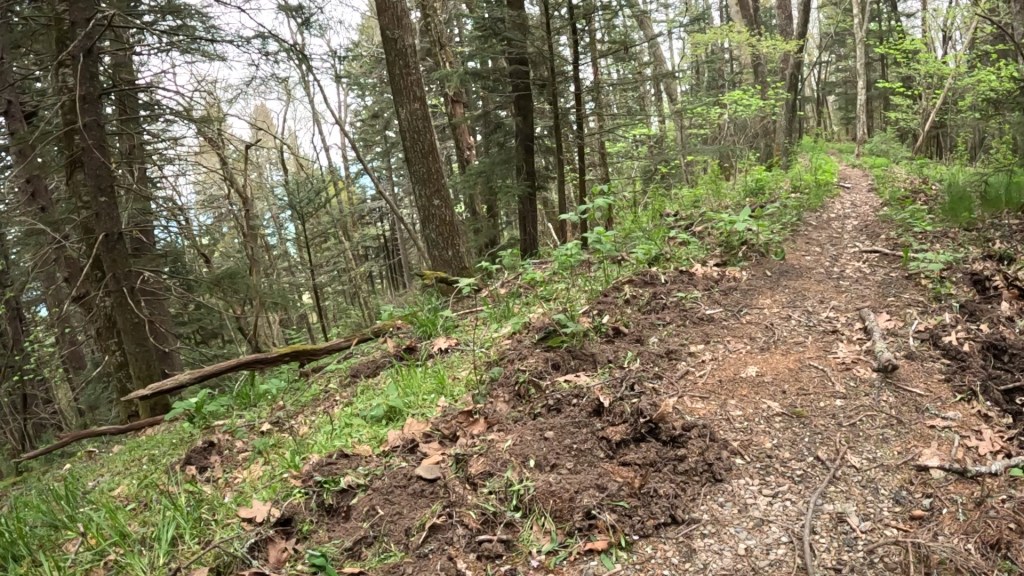
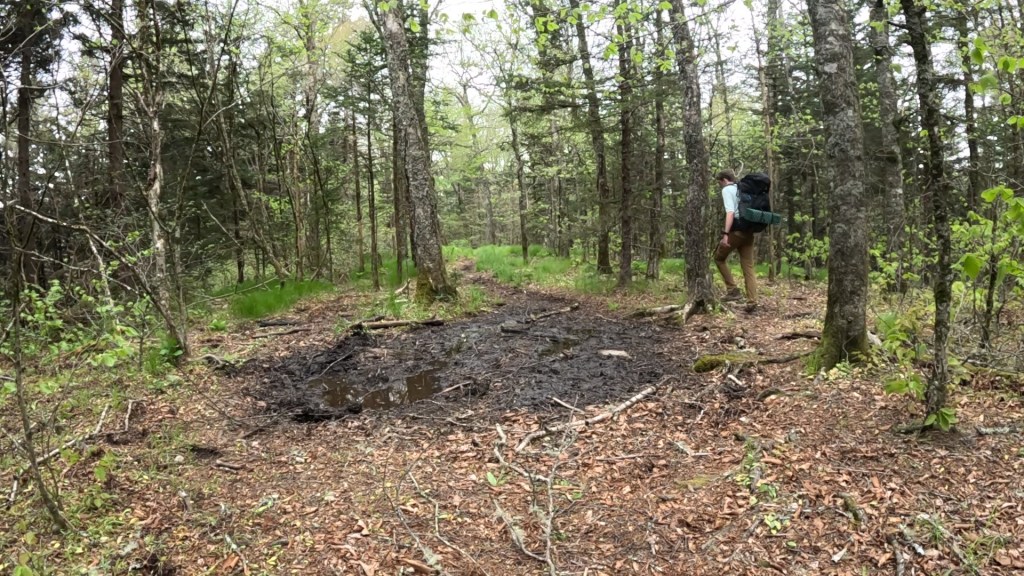
Additionally, we’d see deep wallows, pits dug to a depth between 8-12 inches, typically muddy or filled with rain water, where the animals would lounge and cool off, or cover themselves with mud to keep the flies away. These wallows often take advantage of already-soft soil and low lying areas, and can result in contamination and silting of streams, affecting fish and other aquatic populations.
Feral pigs will eat almost anything, but in the park they are typically rooting for tubers and bulbs, destroying wildflowers and endangered plants in the process. They will also eat small mammals, snakes, mushrooms, bird eggs, and salamanders. In an environment like the Smokies, many of these prey items are also species that need protection, but the pigs don’t seem to know, or care about that.
In addition, their foraging competes directly with native animals, like bear or deer, consuming resources that the native fauna rely on.
The hogs also carry and spread disease. In addition to the contamination of water sources through coliform bacteria in their feces, wild hogs spread Aujeszky’s Disease, or Pseudorabies. Pseudorabies is often fatal in infected mammals, and can infect black bear, bobcat, elk, white tailed deer, red fox, grey fox, coyote, mink, raccoon, and domestic animals like dogs, cats, cattle, pigs, and sheep (but not humans).
Population Management
National Park Service personnel don’t realistically expect to eradicate feral hogs within the park, though there are ongoing attempts to manage and reduce the population where possible. Active elimination efforts began in the 1940s, and more than 13000 hogs have been removed since that time. The current population is estimated to number in the hundreds, and about 275 are removed each year, either through shooting or trapping. Wildlife managers have observed that the pigs, over time, have been more challenging to trap, as the less intelligent pigs have been removed from the population and effect we’ve driven the population to become smarter. These “super boar” are much harder to trap.

At one point, the park service allowed hunters to take hogs within the park boundary, but this proved to be ineffective at population control, and introduced challenges with safe activity management within the park. Hogs are generally tracked with wildlife cameras, baited, and tracked by equipping individual “Judas hogs” with GPS collars that give insight into the movement and gathering points of groups. When caught or shot by wildlife managers today, hair, tissue and blood samples are collected, and then often (if free from disease) the carcasses will be left to be scavaged by wild predators.
Feral pigs are generally not considered suitable for human consumption, given the prevalence of pathogens they carry.
Conclusion
To sum up, these pigs are bad for the health of the ecosystem of the Smoky Mountains. They have a significant adverse impact on wildlife, both flora and fauna, and physically alter the landscape. In our case, the sighting of a feral hog was a surprise and a unique, unexpected event in a very eventful backpacking trip (again, more to come on the trip as a whole). They are rare enough, and widely dispersed enough, that we were lucky to see them, particularly during the daytime, but the damage they’ve done and continue to do was widespread, and obvious. They are a persistent reminder of what can happen when human carelessness introduces invasive elements to a landscape where they don’t belong.
Get Out There
 Flying Squirrel Outdoors
I had no idea there were wild hogs in the Smokies!
LikeLiked by 1 person
We didn’t either. There was a definite “does not compute” issue when we first saw them, as they were just not something we thought was within the realm of the possible. Definitely glad these were on the skittish side and not in an aggressive mood!
LikeLiked by 1 person
Thanks for the info. That was very interesting.
LikeLiked by 1 person