Some recent natural science stories that I find interesting:
Caterpillars
Scientists in Hawaii have discovered a very unique caterpillar with a very dangerous lifestyle. First of all, it’s carnivorous – a trait that only 0.13% of all known butterfly/moth species share. Second, it gets its meals by living in spider webs, and scavenging the bits of dead insects that the spider doesn’t eat. To avoid winding up on the menu itself, it sticks the corpses to a silken case around its body and creates a macabre disguise. An ant head here, a beetle butt there, and odd piece of wing, and voila! – Nothing to see here, just a pile of dead bug parts. Certainly not a caterpillar stealing food from a spider that would not hesitate to chow down on it.
Nicknamed “the Bone Collector”, the caterpillar is a member of the Hyposmocoma genus, a group endemic to Hawaii known as the fancy case caterpillars. Its broader family is very common, making up about a third of the total moth species in the islands. This broader family of moths has been around for millions of years – much longer, in fact, than the current islands themselves. Hyposmocoma caterpillars sew silk cases around themselves, and some even adorn themselves with rocks, shells and other debris – but the bone collector is the only one known to camouflage itself with dead insects, and to live literally under the watchful eye of one of its likely predators. Strangely, this caterpillar has only been found in one mountain range on Oahu.
Details of its life cycle are still being investigated, but it is presumed that the caterpillar moves slowly enough, and is camouflaged enough not to draw attention during its larval life, casually munching on the remnants of the insects its host spider captures. When its time as a caterpillar draws to a close, it crawls to a dark corner away from the spider, pupates within its case of exoskeletons, and emerges as a tiny moth. As a moth, its primary objective is to fly off and find a mate. The pregnant female must then find a spider’s web (these are typically non-sticky, cob-webby webs deep in hollow logs and in dark crevices – not big orb-weaver webs stretched across an open space) and lay her eggs. When the new generation hatches, the baby caterpillar is presumed to be too small to draw attention – and then by the time it has grown big enough to look like a snack, it has already disguised itself.
The bone collector fascinates me! It’s such a unique creature, and given its already small population and limited habitat, it really makes me wonder what other weird creatures are out there lurking, undiscovered.
For more info:
- Smithsonian Magazine, April 28, 2025
- Scientific American, April 24, 2025
- Science, April 24, 2025
Lightning Rod Trees
The Tonka Bean tree (Dipteryx oleifera) may have evolved to welcome lightning as an asset in its attempt to dominate the rainforest canopy of Panama. Studies evaluating the impact of increasing storms and storm intensity over Central American rainforests revealed that while lightning strikes are largely fatal to most trees, the tonka bean seems impervious to it. Not only do the tall, spreading tonkas withstand lightning, they appear to actively utilize it to increase its growing circumstances.
Somehow, tonka bean trees are able to channel the electricity without direct harm, but the lightning absolutely decimates any liana vines growing on the tree, AND significantly damages neighboring (non-tonka bean) trees. The result – the tonka bean trees rid themselves of parasitic vines and eliminate nearby competition for sunlight, allowing them to grow taller, and (ironically) make themselves an even more prominent target for future lightning strikes!
More info:
- NPR, April 11, 2025
- Phys.org, March 26, 2025
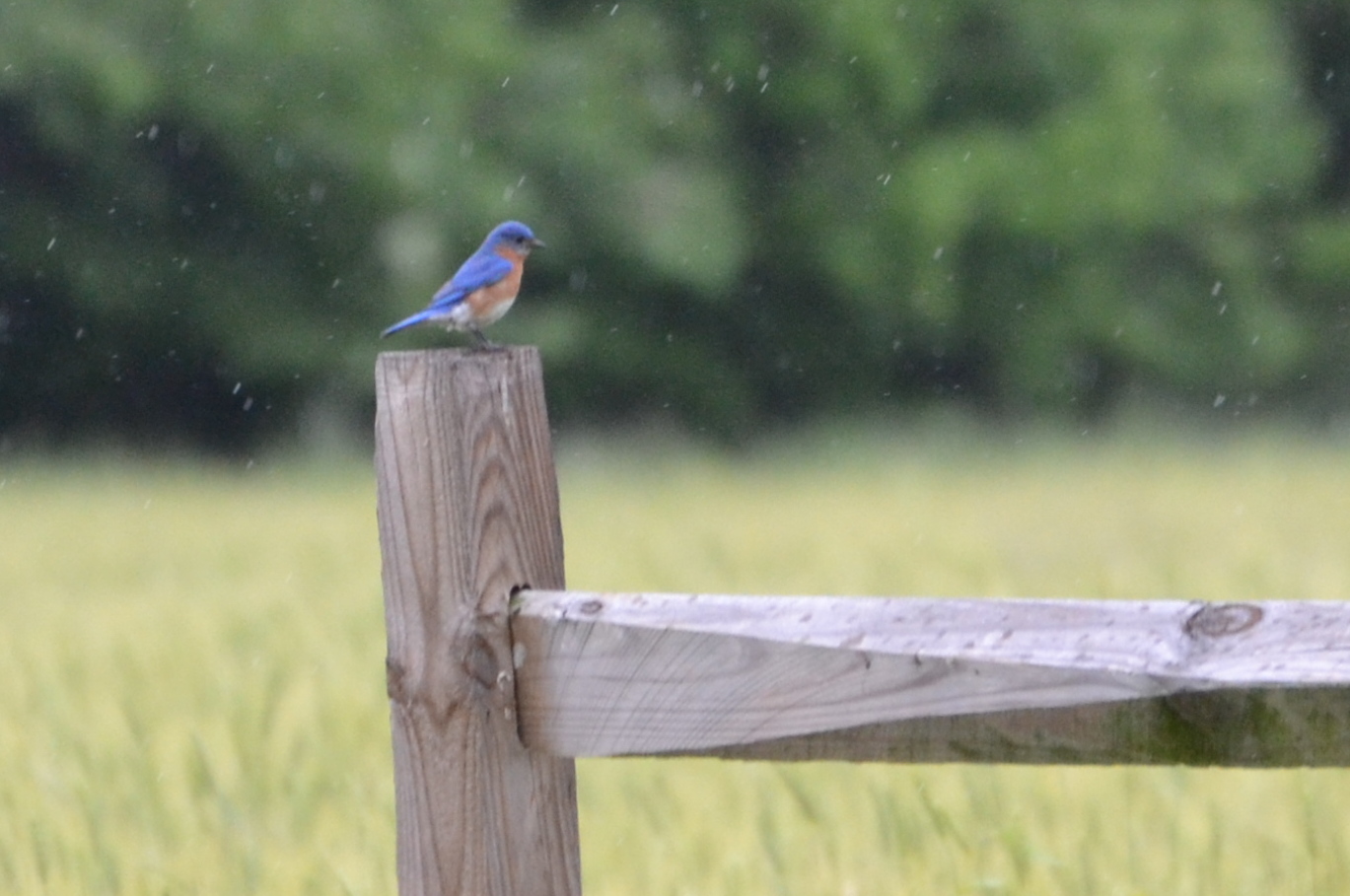
Bluebirds
This is more of a personal story. Do you associate certain smells or objects with strong memories? How about songbirds? For me, the sound of winter crows takes me back to a particular fort I built in the woods as an 8-year-old, or thereabouts. The call of blue jays immediately calls me back to playing on my grandmother’s porch as a kid. I’ve heard these birds all my life – but the association with certain snapshots of my childhood is incredibly strong.
Does anybody else have this?
It got me wondering, so I asked a co-worker (she’s from Spain) about her childhood, and whether or not there was anything like this that followed her across the Atlantic – I wanted to know if there was a particular memory that locked some obscure (to me) European bird deep within her psyche. Realizing she couldn’t hear those birds now, here in the US, I wondered if the reverse was true – if she had memories that were associated with uniquely Spanish wildlife of her childhood.
Sadly, her answer was no. “I lived in the city growing up,” she said, “so there wasn’t much wildlife to interact with.” I was disappointed by the answer…. “BUT,” she continued, “now is different! And much better. I love bluebirds!”
Love the one you’re with, I guess!
Get Out There!
 Flying Squirrel Outdoors
Being a country boy, I spent a great deal of my time out in the woods. So I have lots of bird memories. One of the strongest is I spent time learning how to stalk animals for fun. California Jays would inevitably spot me sneaking through the woods and perch above me in the trees screaming loudly about my presence. I used to get so mad at them. Enjoyed both of your introductory tales. Fascinating. Thanks.
LikeLiked by 1 person
Thanks, Curt. I’ve gained a new appreciation for how observant birds are, in general, and would certainly like to get better at translating their various complaints. Mostly, as you say, they seem to be about me.
LikeLike
Laughing. They let you know when you are interfering with something they want you to do. like get away from their nests!
LikeLike