
About two weeks ago, I wrote about the upcoming total lunar eclipse (the Blood Worm Moon), and mentioned that eclipses tend to come in pairs.
Well, the second half of that pairing is due this Saturday morning, March 29, when much of the North Atlantic, including northwestern Africa, western and northern Europe, and the northeastern corner of North America will see a partial solar eclipse. The umbral shadow of the Moon will MISS the Earth, passing “over” the north pole, if that make sense. So there will be no spots on the Earth where totality will occur – but portions of eastern Canada, in particular, such as Labrador, Newfoundland, Nova Scotia, PEI, New Brunswick and Northern Quebec will see a very pronounced eclipse, with over 90% of the solar disk covered in some places. The northeastern US should get a decent show as well, with everybody northeast of about Boston seeing at least half the Sun covered.
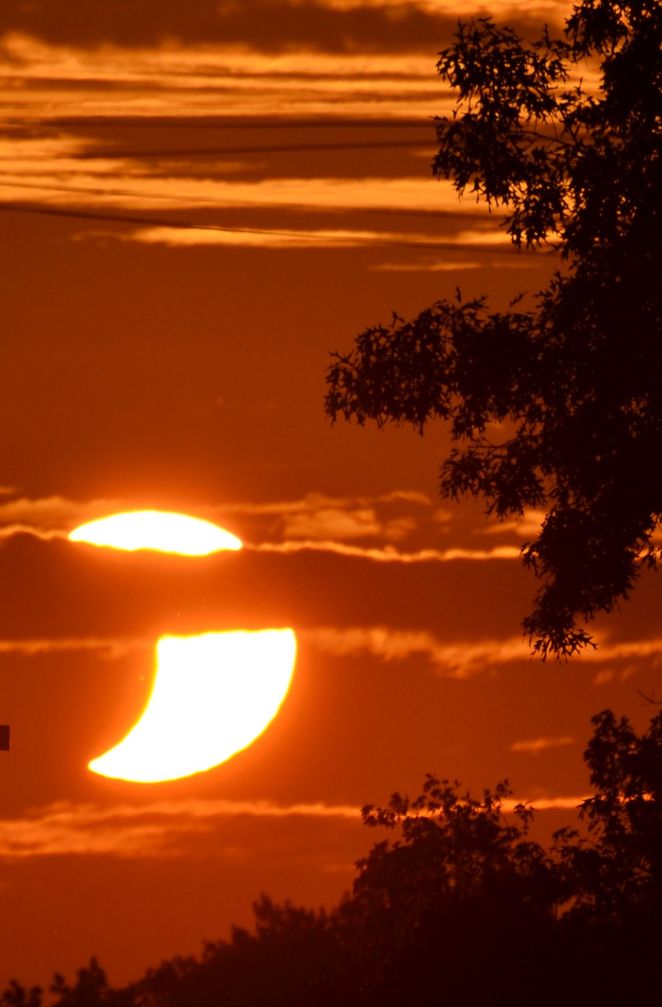
For North America, this will be a sunrise eclipse – the event will begin before sunrise, and if you’re in the right place you’ll see a crescent sun climb above the horizon. If you’re south and west of a line from central Hudson Bay, across the western tip of Lake Ontario down through Washington, DC, you’ll miss this one. The eclipse will be over before sunrise.
If you’re east of that line, though, moving a very short distance northeast will dramatically increase the amount of sun obscured. The “crescent-ness” will be much more dramatic. The graphic below gives an overview of the path of the penumbral (partial) shadow of the Moon during the event. It’s a complicated image, but conveys a lot of data, which I’ll try and explain below. If you’d rather point and click a specific location and get event times, the folks at timeanddate.com have a very nice interface for visualizing the event.

To interpret this image, first realize the shadow is moving perpendicular to the green lines, from southwest to northeast. The times marked on the green lines indicate the passage of maximum shadow in UTC (equivalent to Greenwich Mean Time – GMT). The yellow arcs show the amount of shadow present, with the maximum shadow occurring just east of Hudson Bay, at about 93% coverage.
What makes this event (and this graphic) tricky is that the Earth will be (of course) rotating during the event. From the perspective of the shadow, looking at Earth from space, parts of the US East Coast will be behind the terminator on the dark side of the planet when the eclipse begins, but will rotate into the partial daylight of the eclipsed sun before it ends. That area is marked by the orange lobes making an elongated figure-8 on the west side of the eclipse map. If your location falls WEST of this line, in the western hemisphere, the eclipse is done before sunrise. If you’re INSIDE the lobe, the eclipse will be underway at sunrise. Crescent sun rising. If you’re EAST of that lobe (western Europe, Africa, Iceland and Greenland), the sun will rise, and then the eclipse will begin. You’ll see the whole thing.
As an added twist of mental gymnastics, looking at this globe and realizing where daylight falls, the points on the figure-8 east of the crossover point near the north pole will see the eclipse occurring at SUNSET. Thus, somebody in the Arctic regions of northern Russia will see a crescent sun SET about an hour and a half after eastern Canada saw it rise. Spherical geometry and the movement of orbiting bodies are fun things to wrap your head around!

Another neat thing to catch here – we’re still very near the Vernal Equinox, but we are a week past it towards northern summer. So the north pole is tilted just slightly toward the Sun at this point, and that’s why the crossover point on the sunrise/sunset lines passes close to, but just beyond the north pole toward the “dark” side of the planet.
So, while most of the country will miss this completely, those in New England, Maine, and eastern Canada are in for a pretty cool show. Where I live in the Mid-Atlantic, there may be a barely perceptible chunk taken out of the Sun that disappears only a couple minutes after sunrise, which means I’d have to have a really clear horizon to see anything, and then only briefly. So I HOPE you folks in the northeast will take some pictures and share with the rest of us!
Get Out There!
 Flying Squirrel Outdoors