
Back in 2019, I had the opportunity to combine a work trip with an extra night out backpacking somewhere in the Front Range between Denver and Colorado Springs. A little research led me to the Pike National Forest, Lost Creek Wilderness area, and the Goose Creek Trailhead.
Cutting to the finale, it turned out to be a great trip, but it also became a good example for backcountry risk mitigation that underpins every wilderness trip I take.
Initial Planning
I had two primary concerns going in – first, the remoteness; second, the weather.
Despite the trip occurring in mid-March, in Colorado, I was able to dismiss weather rather early – warm temps were scheduled to prevail with several days on either side of my trip forecasting mild conditions. I also found a nice website with real-time snow depth reports that essentially indicated I’d be snow-free below about 10,000 feet. The only uncertainty would be translating lows in Denver (low 40s) to realistic overnight temperature predictions in the mountains at roughly 9,000 feet. Based on just elevation difference, I could expect anywhere from 12 to 20 deg F difference between my anticipated camp location and Denver. (As a good rule of thumb, figure a reduction of 3 degrees F, or 2 degrees C, per thousand feet, and add some margin). So probably not bitter, but certainly the possibility for temps well below freezing.
On the remoteness – I enjoy solo hiking and camping, but I’ve had enough situations over the years to recognize that solitude increases risk significantly. In this case, I’d be in a remote Wilderness Area requiring 15 miles of dirt road driving to get to the trailhead, putting me completely off-grid, out of reach, and likely not to be found for some time. This is serious business, and requires some thought, planning and preparation. So most of my planning centered around that.

The easiest and most effective mitigation was to plan for some company, so I advertised the idea and found another traveler who was willing to embark on this journey. That alone really lowered the risk and made this trip feasible. A lot of risk gets mitigated simply by adding someone else to the party. Other people add redundant gear, different skill sets, and even somebody who can seek help when someone else is hurt – everything is easier with the buddy system, and your risk drops significantly by having someone else with you. (Just make sure you recognize that the overall group capability is not going to exceed that of the weakest party member.) Solo, you are the weak link. What you have, either on your body, in your pack, or in your bag of mental tricks and experience, is all you’re ever going to be able to rely on.
I also looked at a couple front-country sites: Goose Creek Campground, a few miles from the trailhead, and Lone Rock Campground, near Deckers. Both would be backups in case flights were late, areas were closed, timing just didn’t work – essentially in case we had to abandon plans but still wanted or needed a night in a sleeping bag.
So with all those things in place, this was doable! I identified a potential camping spot on a plateau near a creek crossing, near 9,000 feet somewhere above the intersection between Goose Creek Trail and McCurdy Park Trail, left detailed plans with my wife at home and a trusted partner at work, stuffed my backpack into a checked roller-bag, and got ready to depart for Colorado.
Solo Travel
As the trip date grew closer, my hiking partner had to bow out. If I wanted to complete this trip, I would now have to do it alone. That required a “back to the drawing board” evaluation.
In truth I very rarely do extended trips alone, though I know a great many who do – it’s very rewarding and spiritual, you can revel in the isolation and the connection to the wild. BUT, when you do this, you never THINK anything is going to happen. The reality is that even a minor injury can become a survival situation if you don’t stack the odds in your favor – and it’s not just about me, I’m blessed to have lots of people in my life that genuinely care what happens to me, and I don’t want to either be so selfish as to ignore their worries and let them fret, or be so consistently reckless about my approach to safety as to reduce the support network I have for doing this sort of thing. What I’d MUCH rather do, is be diligent in planning for safety, share those plans with everybody involved, and increase everybody’s confidence level that the journey will be safe and enjoyable, while not sacrificing the adventure.
As an example, I think back to the time I stumbled across a mama black bear and her cub, high up on a mountain outside Tucson – I was alone, but at least those I was traveling with knew where I was. Everything went fine that day, but it could have ended badly…

So I’d like to think I’m wiser now. I’m not saying I DON’T go solo, but I am saying I do what I can to reduce risks, and build contingencies in my favor. There are generally few real concerns about hiking in the front country, and even popular remote areas are safer because they’re popular – lots of people around, even if communication is difficult. Places like the Appalachian Trail are superhighways full of people that can help you. But remote Wilderness Areas like the one I planned to hike into was a place I’d likely not be found for some time. This required some serious thought, planning and preparation.
Visualizing Risk
In many regards I’m a professional risk manager – but I’ve honed that way of thinking because so much of what I do involves doing some inherently risky things. I’m an engineer, I’m a pilot, I venture into the backcountry – if you let the potential downsides of any of these activities overwhelm your thoughts, you’ll never do anything. So instead, you focus on the positives, the potential reward, and then take a systematic approach to think through the what-ifs, and leave yourself some options. Plan such that everything you can possibly control is leaning toward a successful outcome, and then make your backup plans such that you know how you’re going to respond when any of the likely remaining roadblocks do occur.
In a classical risk-management framework, there are two ways of thinking about things going wrong. The first is to recognize that risky events tend to combine. One often-used mental model is to think of a stack of slices of Swiss cheese. Every layer (risk mitigation activity) has holes, or weaknesses in it. Big risks come with big holes, but there may also be some small things, tiny holes, that need attention. If you can stack up additional layers, which will have their own, different holes, you can block some of the original weaknesses. The more layers you have, the less likely it is that you will have a hole that passes all the way through the entire stack. All your risks are blocked, to some degree. In other words, every perceived risk has some level of mitigation to help prevent it from being realized.

The other way to think about risk is to assess every potential problem in terms of its Likelihood and its Severity/Consequence. Typically, each of these categorizations is given a number (subjective) from 1 to 5, and the overall magnitude of the risk is the product of those numbers. For example, I might consider the failure of my stove – it’s unlikely to happen, maybe a 2, and the severity isn’t huge, maybe a 1, as I can always eat some cold food – overall rating 2. Breaking an ankle or a leg is also unlikely, maybe a 1, but that would be a 5 on the consequence scale as my ability to extricate myself might be completely eliminated – overall rating 5. If I have a reliable way to summon outside help, maybe I can mitigate the severity down to a 2 or 3 and suddenly it’s both unlikely and manageable. Serious risks are those things that are both likely and of high consequence. Weather can be one of these – expecting a blizzard to dump two feet of snow along with plummeting temperatures and limiting travel for days could be a 5 on both scales – overall rating 25! You might mitigate this by planning to stay in a reliable shelter for a week, but then you’re planning on being unreachable, which might affect other risks. More realistically, you might mitigate this by avoiding this particular forecast and choosing to cancel or reschedule the trip entirely.
With this mental model, it’s useful to think through your entire trip and establish a list of what-ifs. Anticipate things going wrong, assess things you don’t know, and assign a Likelihood-Consequence score to each one. This gives you a framework to start creating mitigating steps.
Establishing Mitigations
Now that you have a list of things that might go wrong, start figuring out what you can do about those potential problems.
First, know your own limitations. Even under non-emergency conditions, can you physically endure what you’re planning? Are you mentally prepared – including having a frame of mind that lets you objectively evaluate risk? Many have died when desire to reach a summit or other goal (“get-there-itis”) overwhelmed the evidence that it was time to turn back. “Hope” that things won’t happen is not an effective risk-mitigation strategy.
Second, evaluate your equipment needs. I’ve generally shied away from concrete lists of gear (like the Ten Essentials). I prefer to think in terms of systems, and walk through the various needs for a given trip and assess primary and secondary needs. (See an explanation of my FISH IN FERN mnemonic for evaluating gear). Admittedly, your ability to make these determinations rely on, and get easier with, experience. This is why beginner backpackers tend to over-pack, and also why there are certain pieces of gear that experienced trekkers ALWAYS carry, even if they almost NEVER get used. The understanding of risk likelihood and consequence is harder to evaluate without experience. When in doubt, hedge in favor of safety and redundancy.
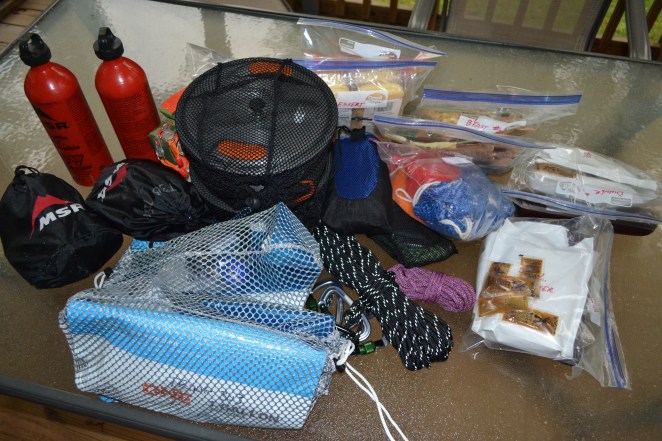
Having made a list of what you need, make a personal evaluation. Can you actually carry everything? Do you HAVE (or have access to) everything? Will you be able to rely on tools and supplies that you trust, that you know how to use? Do you have backups to the more sketchy equipment? For example, everything with batteries CAN fail. What items are you relying on that require power, and what do you do without them?
Third, do you have the skills needed to deal with an emergency situation? Do you understand basic first aid and can you self-administer and self-rescue? Training like basic First Aid or Wilderness First Aid are very useful mitigators here. (Note, there’s an implication here back to equipment – some first-aid equipment will be required, but it is useless to bring things nobody in your party can or knows how to use.) Do you have the means to contact help if needed? (A satellite communicator is a great device here.) Can you perform basic repairs on essential equipment, or is there built in redundancy? (On a wilderness canoe trip in rocky waters, you’d better have a way to patch potential holes in your boat.) Do you have the knowledge and skills to not only do what you PLAN to do, but to deal with what you might HAVE to do?
I don’t care who you are or what you’ve done, everybody has a limit, a set of “personal minimums”, to use aviation lingo, where there’s a line that once crossed leaves you in over your head. It’s easy to picture experiences on the low risk side of that curve (dayhike in the local park) and far on the high risk side (solo first-descent of a whitewater river deep in the Andes), but knowing your own personal boundary, precisely, for trips lying between extremes is difficult. If you enjoy outdoor adventures though, you will be called upon to find that line, understand when you’ve crossed it, and make that difficult and perhaps unpopular decision to turn back and head for safety. Employing “safety in numbers” doesn’t change the existence or the location of this threshold, but it does change the likelihood of crossing it. With a group, you must also be aware of your weakest link, and understand that the least experienced in your party may hit barriers before others.
Recognize Changing Circumstances
Risk management doesn’t end when you’re done prepping for the hike. It’s a constant exercise that should be ongoing throughout your trip. There’s a common discussion in aviation circles that almost every accident is actually the result of a chain of events. Looking back at tragic events, there is almost always a series of events, an alignment of holes in the Swiss cheese, that lead to disaster. Failed equipment, un-forecast weather, unanticipated trail conditions (flooding, blowdowns, ice) are all usually made worse by failure to recognize developing problems and making bad decisions DURING the trip. Breaking the chain of events at any point can save your life. More often that not, this requires introspection and recognition that you might need to make a hard decision and change plans, NOW.
Safety and Satisfaction
It may sound crazy, but risk mitigation is part of what I enjoy about outdoor experiences. I LIKE being able to excel even when the challenges are significant. I ENJOY the boost in self-confidence that comes from nailing a tricky crosswind landing. And I LOVE coming home from a backcountry adventure and being able to say “that was pretty tough, but we did it, and it was a blast.” It’s not the adrenaline rush of cheating death and surviving against the odds that thrills me, it’s the satisfaction of planning, executing, and learning, and the confidence that comes from being trained and prepared, and pushing, safely, the boundaries of what I thought I could accomplish.

When you reach a point where you’re comfortable with the “certain” and the “likely” that they become normal, you can have a much better time, and feel a little more confident stretching into the realms of conditions that add up to “maybe”, or “unlikely”, and sufficient understanding to realize that the “barely ever happens to anybody” situations are not worth agonizing over.
I realize that when I start sharing this philosophy, it’s easy to dwell on dangers – and that runs counter to my objective to convincing people to “Get Out There”. But look at it this way – if you’re a toddler running around the house, there is a never-ending list of things for you to be scared of, and things you’re told not to touch, not to do. An electrical outlet is not particularly dangerous, but you DO have to learn not to stick a fork in one. By the time you go to kindergarten you’re probably not prevented from going up and down stairs on your own, you CERTAINLY aren’t playing with outlets, and you may even be able to help in the kitchen.
Outdoor experiences are a lot like this. You don’t jump into epic month-long wilderness expeditions right off the couch. You need to build experience, maybe tag along with people who know how to make effective and accurate assessments of the potential dangers, and build your own knowledge base that supports confidence in taking on more significant challenges. Above all, know when to turn back, and don’t be afraid to make that call.
There are inherent risks in everything, but proper, effective mitigation significantly increases the outdoor experience.
Takeaways on Risk Mitigation
- Understand the basic trip parameters. In laying out your basic plan – route, entry and exit points, elevation, water accessibility, remoteness, weather – make note of big picture conditions and risk points. Whatever the worst conditions you anticipate, plan for worse (within reason). This drives equipment planning and a broad understanding of the scale of the challenge.
- Identify route contingencies and bailout options. Even if you don’t use them, front-country options are important to understand. If nothing else, these are likely to be the places where you can encounter and/or reach other people if things go badly.
- Bring friends. Two (or more) brains helps evaluate issues and avoids target-fixation on a particular goal if things go wrong. Just make sure you don’t turn this into an ego-contest around who can push boundaries farthest. The WRONG partners can make risk mitigation worse.
- Establish a list of possible risks. Think critically about what-ifs, things that might go wrong, break, or generally screw up your plan. Don’t forget to think about things you may not be able to control, like wildlife encounters, or unreported adverse trail conditions.
- Evaluate the severity of the risks. For each item on your list, assess likelihood and consequence. This helps both identify the items of critical significance and helps make sure you have effective mitigation steps.
- Create Mitigations. Leverage everything you know. Use the bailout options you’ve identified in route planning, assess communication and extrication challenges. Plan to bring backup or redundant gear. Lower the risk score where possible.
- Advertise your plans. Make sure others know your itinerary. Check in with local authorities (park rangers, etc) if possible.
- Continuous risk monitoring. Keep an eye on things as they develop, and don’t be afraid to change plans as you encounter the unexpected, or the unlikely.
Get Out There!
 Flying Squirrel Outdoors