You may or may not have heard, but there’s a really bright comet out there right now. Comet C/2024 G3 ATLAS (catchy!) reached perihelion (closest approach to the sun) on Monday, January 13th. It passed by the Sun at a distance of 0.094 AU. One Astronomical Unit (AU) is the average distance from the Earth to Sun, so this is CLOSE. That’s about 8.7 million miles, well inside the orbit of Mercury. Normally, passing that close to the Sun is a death sentence for comets, as the gravitational field of the Sun is enough to rip them apart – but good old G3 ATLAS survived, plowed right through its closest approach, and is headed back to the outer solar system.
At that point, it was reported to be about Magnitude -3. Brighter than Jupiter and almost as bright as Venus! But, of course, really close to the sun. Now, as it moves away, it’s dimming, but only a little. It is currently just a hair brighter than Magnitude -1 (on this scale, lower numbers are brighter), which makes it a hair dimmer than Sirius, but brighter than every star in Orion. Easily naked-eye visible…. Except….

G3 ATLAS approached the sun from the “south” of the solar system (or “below” it if you picture the solar system as a north-up disk), whipped around the sun, and is immediately plunging south again. For those of us in the northern hemisphere, it will BARELY be above the horizon after the sun has gone down – and even then it will be competing with bright twilight glow. If you live in a place with an obstruction-free, flat western horizon, you may glimpse it in the next few days in the brief time it’s visible, but it likely won’t be much to look at.
For those in the southern hemisphere, you should get a much better view over the next few weeks, as the comet climbs higher in your skies. I know a few observers down-under, and I’m hoping to see some good photos of this comet before it’s gone for good. As of now, this is expected to be the only naked-eye comet of 2025.
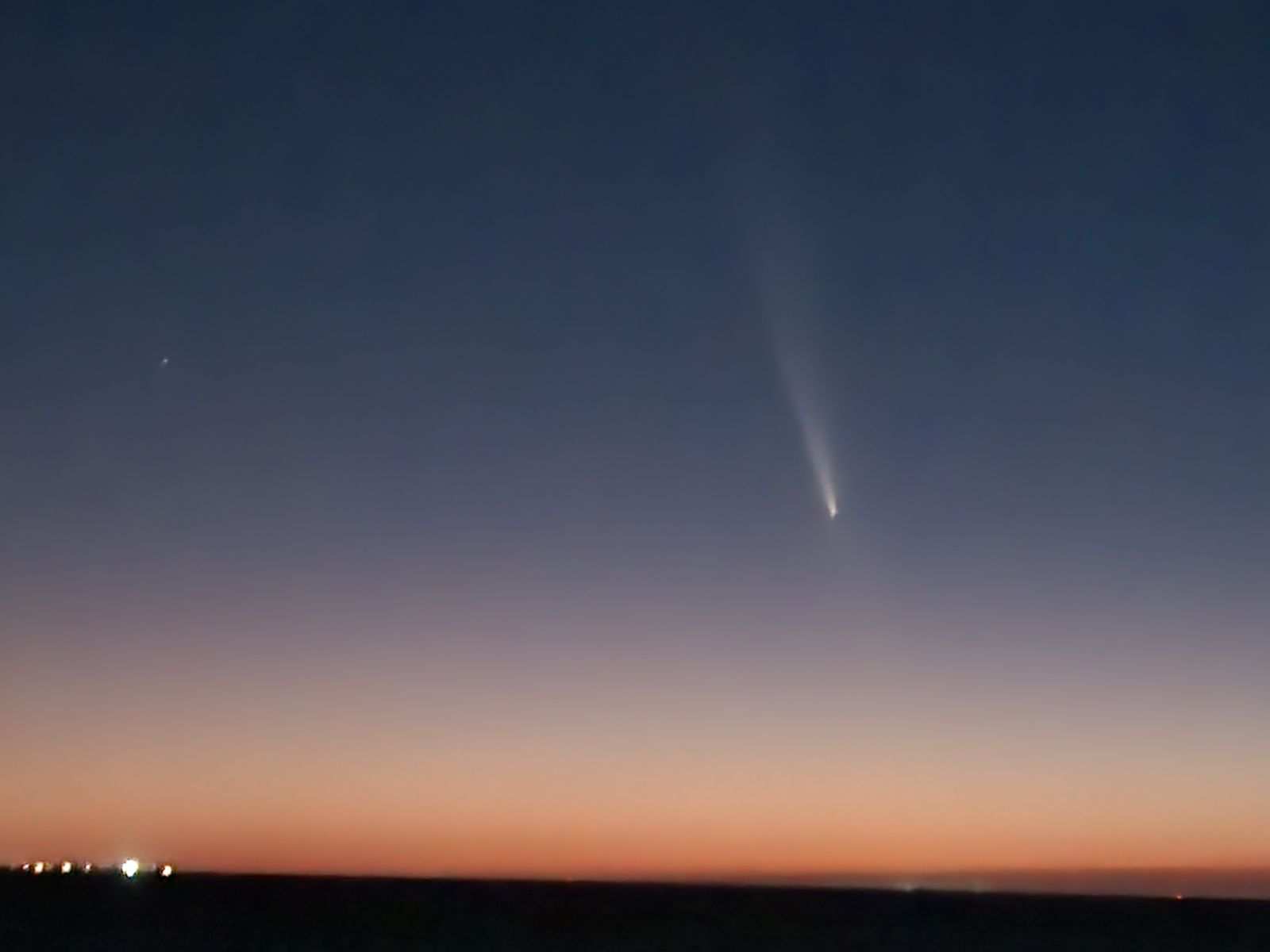
To make up for the poor viewing in the north half of the planet, I offer a three-month-old retrospective, a photo I took of Comet C/2023 A3 Tsuchinshan-ATLAS back on October 11. It’s a fairly low-res shot, made with a smartphone, but still hopefully captures the beauty of the comet. The tail was impressive! This is taken about 45 minutes after sunset, looking out over the Pamlico Sound from Frisco, NC. That’s Venus shining off to the left.

A quick note on comet naming. I think it’s pretty commonly understood that the “common” name – the “ATLAS” or “Tsuchinshan-ATLAS” in these comet names – are references to the comet’s discoverer. In this case, both were initially spotted by the Asteroid Terrestrial-Impact Last Alert System (ATLAS) in South Africa (great job, guys!). Tsuchinshan is the name of the “Purple Mountain” observatory in China which simultaneously reported its discovery of that comet, so Tsuchinshan-ATLAS indicates shared credit for two discoverers.
If YOU discover a comet, it will bear your name! Good luck!
The numerical designation is also clever. If we dissect C/2024 G3 — The “C” means it is a long-period (more than 200 years) or aperiodic (one pass by the Sun and done…) comet. Essentially, if we humans have only recorded it going past the sun once, and don’t expect it back for a long time, we’ll use a “C”. (C/2024 G3 was last here, we think, about 160,000 years ago – though current projections of its trajectory suggest it’s going to go MUCH farther out on this orbit, and not be back for almost 600,000 years).
2024 simply means it was discovered in 2024.
The last letter indicates when it was discovered. “A” would mean the first half of January, “B” is the second half of January, “C” is the first half of February, and so on. So “G3” means it was discovered in the first half of April, and it was the THIRD comet discovered in that 2-week period. (There are a LOT of comets getting discovered on a fairly routine basis).
Using this same method, you can decode that the one I saw back in October – C/2023 A3 – is a long-period comet co-discovered by China’s Purple Mountain and South Africa’s ATLAS during the first half of January, 2023, and it was the third such discovery in that period.
One takeaway – you’ll notice that the time between discovery and being visible to us mortals is a LONG time. Almost 22 months between discovery and perihelion for C/2023 A3, and about 9 months for C/2024 G3. Our observatories and the astronomers that work with them are doing amazing work finding new objects in our stellar neighborhood, and based on the full name of ATLAS, putting in the work to make sure we have plenty of warning about anything new that poses a collision threat. Thankfully, these two are are just pretty to look at.
Get Out There
 Flying Squirrel Outdoors
I will try to see it tomorrow after sunset.
LikeLike
Good luck! I had a local friend tell me (via Instagram) that he was able to catch it – dim in a still orange sky – yesterday evening. He’s inspired me to try a little harder myself. Was too cloudy this evening. I think we’ve only got a day or two more to try…
LikeLiked by 1 person