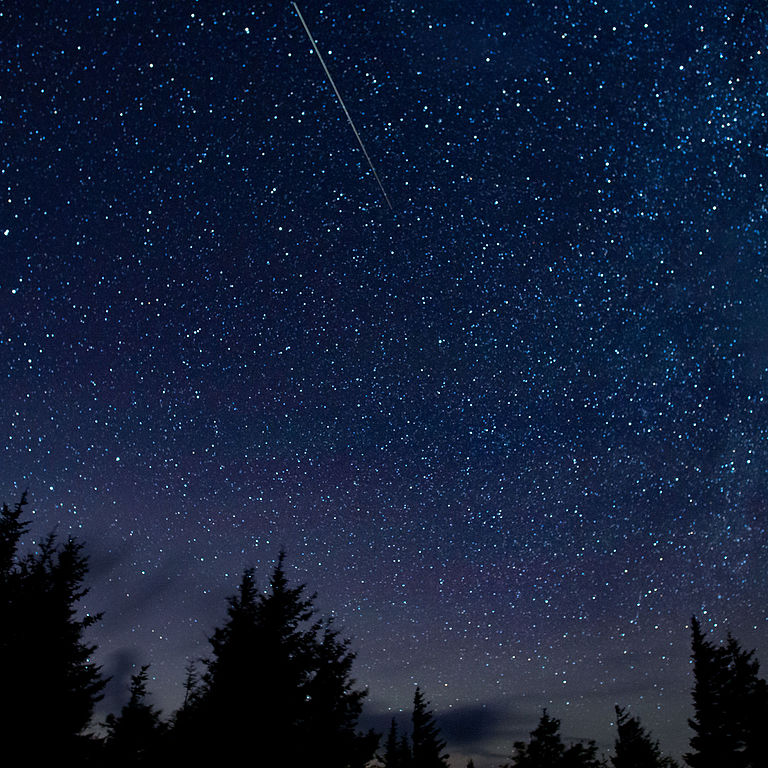
This weekend, if you get an escape from cloudy winter weather and happen to have clear skies, you’ll have the opportunity to see one of the best meteor showers of the year – the Geminids!
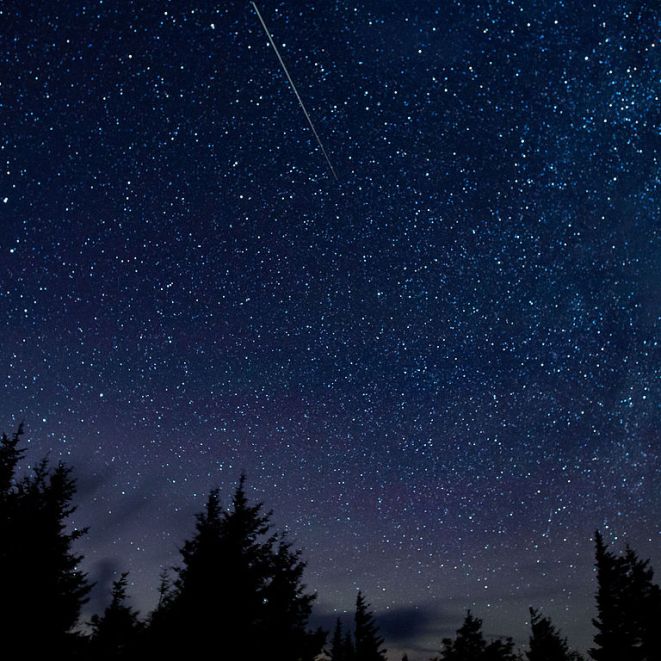
What makes the Geminids so great? Well, a few things:
1) Gemini, the apparent radiant point for this shower, is well above the horizon as early as 9pm. No need to get up in the middle of the night! There’s no need to find Gemini, just look up – but if you’re curious, look east and find Orion. The three stars of Orion’s belt are almost a vertical line, and should be obvious. Gemini is to the left (north) of Orion. Jupiter, unmistakeably bright, is also in Gemini right now. The two stars above it are the heads of the twins – Pollux, and then Castor above it.
2) The Moon won’t mess with things this year. The Moon is a waning crescent, and Moonrise isn’t until about 1:15 am, so there’s very little ambient light there to wash things out!
3) Geminids tend to be prolific, with up to 120 meteors per hour in dark skies!
4) It gets dark early (in the Northern Hemisphere), so you’ll have plenty of time to see a bright streak or a fireball!
5) Unlike most showers, the Geminids do not come from the dusty tail of a comet, but from the debris pulled off an asteroid called 3200 Phaethon. This asteroid gets closer to the Sun than any other named asteroid, and this is what gives the asteroid its name – Phaethon is the son of Helios, the Sun god, in Greek mythology. At its closest approach, Phaethon gets to 0.139 AU from the Sun, or only 14% of the distance between Earth and the Sun. During this passage, the surface of Phaeton reaches approximately 1300 deg C, and between the heat and tidal forces, some bits of the asteroid are stripped off during every orbit. As a result of this, the cloud we’re passing through is not “dust”, but more like stony, maybe even metallic, pebbles. These things are tougher than your average meteor, and so they tend to burn in long, slow streaks. Some of them get extremely bright, and some even burn with a detectable color, depending on their chemical makeup.
So, all things considered, the Geminids are typically a great shower! This year, they peak the evening between the 12th and 13th of December, but like many showers you may see strays now, and up to a few days after the peak.
Good luck, and let me know what you see!
Get Out There
 Flying Squirrel Outdoors