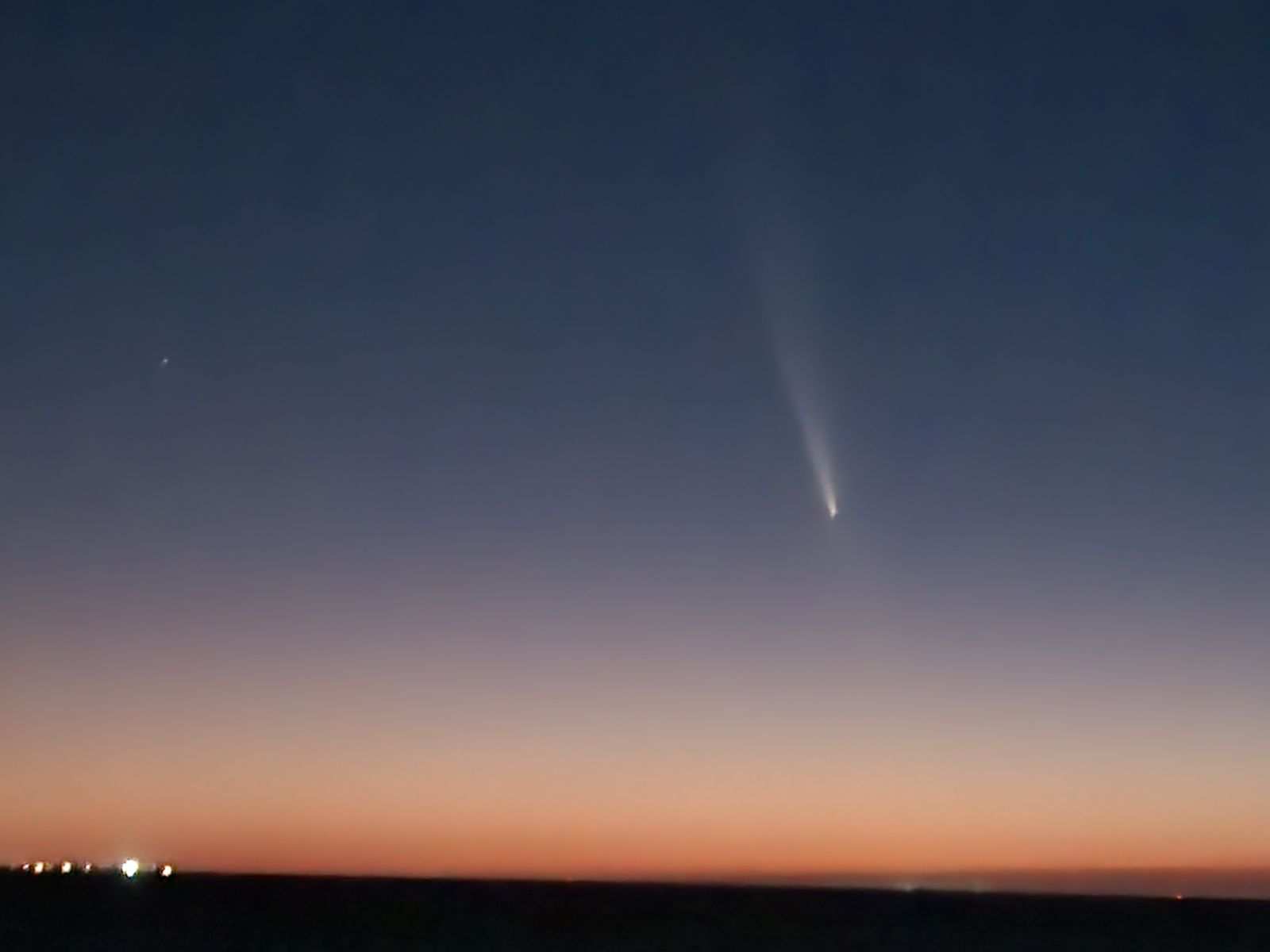
Hey All, I need to interrupt my ongoing discussion of campervan adventures in Washington state to talk about some upcoming backyard astronomy opportunities.
We’ve got TWO marginal comets in the sky right now – one getting dimmer, and one getting brighter (but potentially lower). Neither is easy or straightforward, but worth the effort to seek. At the SAME time, we have a reliable meteor shower, the Orionids, that peak overnight from Oct. 20-21, which happens to correspond to a New Moon. In other words, dark, dark skies! We can hope for a good clear, crisp fall night (in the Northern Hemisphere) as well, and this all adds up to good viewing potential.
For the sake of discussion, I’m going to focus on the Oct 20-21 timeframe, in the hopes you can spot all three events at once. Though it should be said, the comets are visible NOW – they’re both just on the move (as comets always are).
Orionid Meteor Shower
The Orionids are actually the latest thing to see on Oct 20-21, but they’re the simplest to address. Like most meteor showers, peak timing is around 2 in the morning. The radiant (apparent point of origin) is just off the eastern shoulder of Orion, near the red-orange star Betelgeuse. Just after sunrise, if you look toward the eastern horizon, you’ll see the Pleiades star cluster. Orion is about two hours farther east.
Still, even now you might see a meteor move up from the eastern horizon. But the longer you wait, the more you may see. Eventually, the Orionids may generate up to 20 streaks per hour – not a HUGE shower, but a fairly reliable one, caused by the Earth’s passage through the dust left over from Comet Halley. The dark night with no Moon will certainly help!
Comet Lemmon (C/2025 A6)
Various sources have labelled Lemmon as THE comet of 2025. Everything being relative, Lemmon is nowhere near as spectacular as 202’s NEOWISE, or last year’s Tsuchinshan-ATLAS, but it IS likely to be the brightest comet of the year, and perhaps the ONLY naked-eye comet we’ll get to see. It’s also nicely positioned for viewers in the northern hemisphere.
Right now, and up through Oct 20, it’s right at the very edge of naked-eye visibility (Magnitude ~5.9). It shows better through binoculars or even a long camera exposure. Lemmon’s closest approach to Earth will be on the 21st, but from then on out it continues to get closer to the Sun, which is expected to cause lengthening of the tail and increase in overall brightness. At the same time, though, Lemmon is moving west – closer to the setting sun, and so might be tricky to spot as it moves toward brightening skies. It’s a trade-off between brightness of the comet and darkness of the skies in which it resides.
There are some good starry landmarks to help find Comet Lemmon. Look north about an hour after sunset, and look just west and beneath the arcing handle of the big dipper asterism in Ursa Major. On the 21st, a line drawn through the last two stars in the dipper should point right at the comet, which will be sitting right between the first two “kite” stars of Bootes, above the bright star Arcturus. (Though, depending on your latitude, Arcturus may be close to or even below the northwestern horizon).
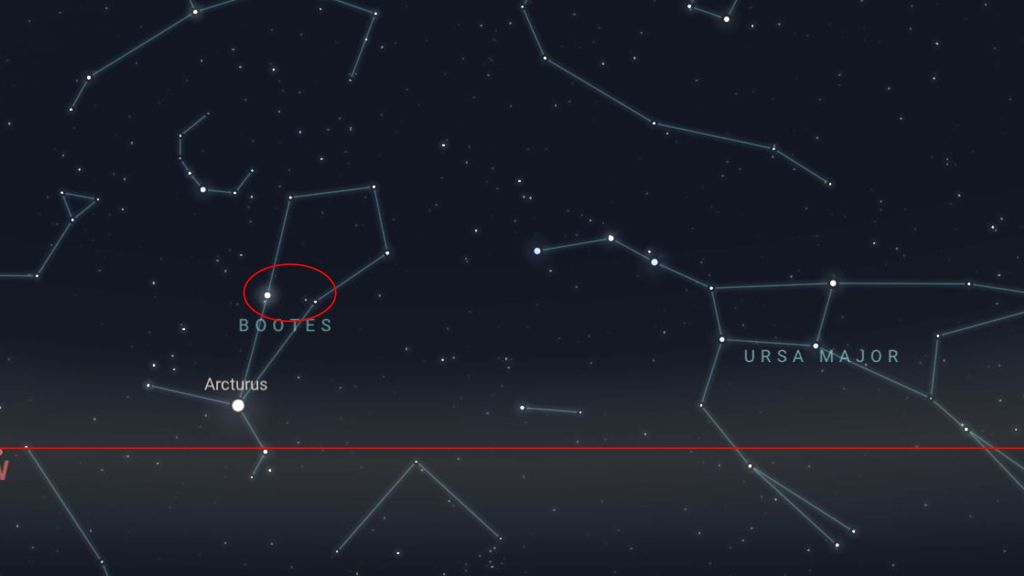
Alternatively, if you’re looking for it NOW (Oct 17) Lemmon should be visible in the pre-dawn early morning hours, when the big dipper has rotated up and its handle points down toward the horizon. Between about 8pm and 5 am, the comet and all nearby references will likely slip below the horizon before re-emerging in the northeast (unless you’re really far north). But Lemmon will rise in dark skies around 5 and be visible before the Sun comes up. By the 21st, though, it will rise too late to be seen within the light of the Sun, and evening viewing is your only option.
Lemmon has a lot of potential to start good and get better, so find it now. Each night it will shift to the west about the width of a finger at arm’s length.
Comet SWAN (C/2025 R2)
After you’ve found Lemmon, turn around and face south to find Comet SWAN. This one is a bit dimmer (Magnitude ~9), but its tail is more impressive. It’s thin, but recent photos have shown it to be about as long as 5 full moon diameters. Binoculars should reveal it. A long-exposure photo might also bring it out – but SWAN is dim enough that it capturing it will be a challenge.
Look above the Teapot of Sagittarius, and to the East (left) of the Milky Way, which runs almost vertically across the sky after sunset these days. On the 21st, SWAN will be about halfway between the Teapot and Altair, the bright star in Aquila at the narrow end of the Summer Triangle.
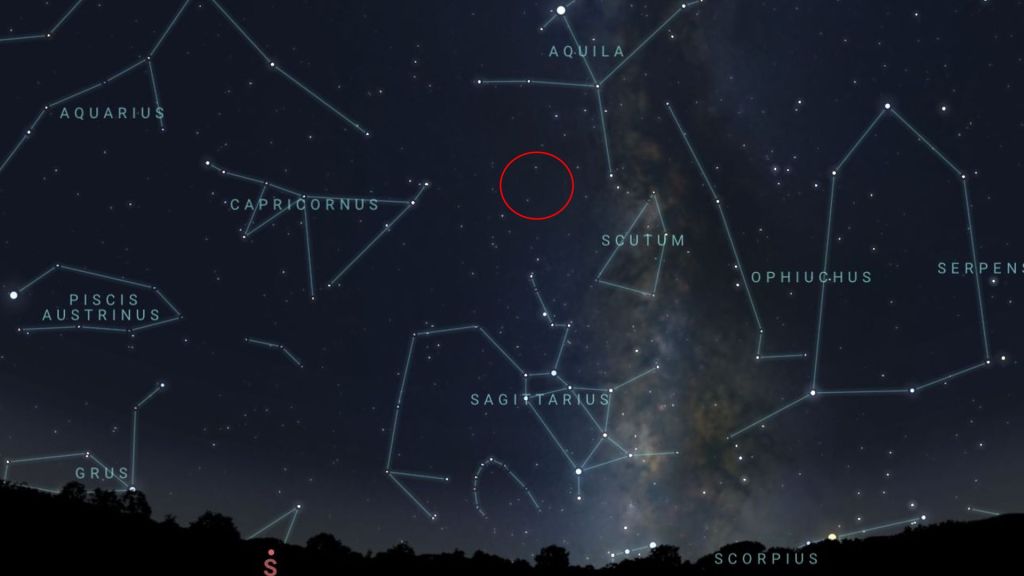
SWAN is moving about a finger-width up and to the left every night, and it’s brightness will be holding steady, although well below naked-eye visibility, for a while.
Good luck to everybody trying to find these various objects. I’m going to be trying to get some photos over the next few days, and will certainly share what I find. I’d appreciate seeing how you do as well!
Get Out There
 Flying Squirrel Outdoors