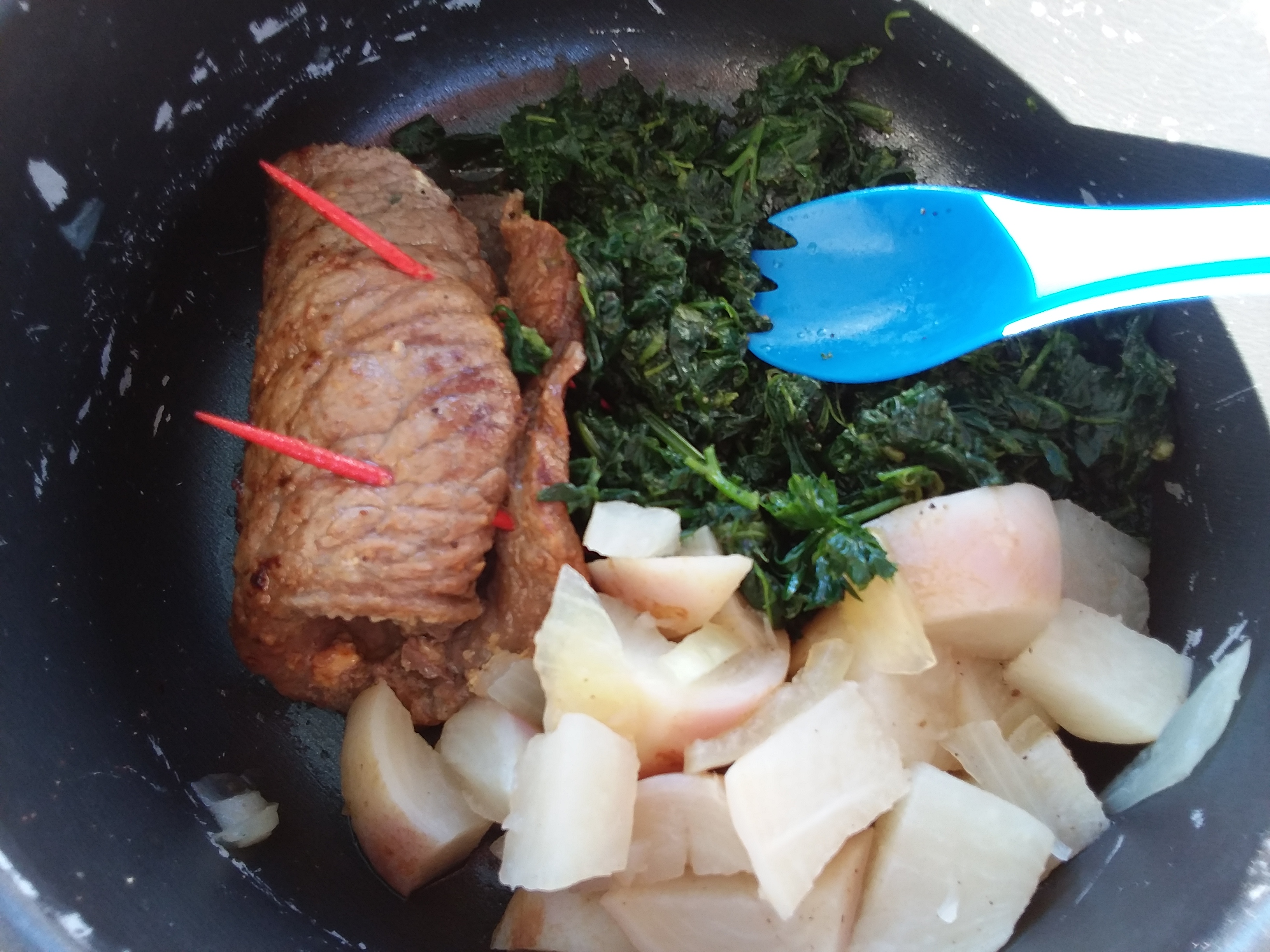
Let me be clear up front – this is not a post about how people might have cooked while “camping” during the Middle Ages. It is, instead, a discussion of repurposing historical, Medieval recipes for modern campsite meals.
The setup was a Scout Camporee a few years back, where the event was built around a Medieval theme. This involved lots of competitions and events for the Scouts with the flair of knights and castles, including a patrol-built catapult competition (graded on distance and accuracy). For these trips, the Scouts would organize as patrols, and within that group (~6 boys) they would manage all their meal planning, camp setup, and resource planning to do well at the competitive events. Given that our Troop tagline was the “Dragonslayers”, this was right up our alley, and our flags and mascots already matched the theme well.
The adults (of which I am one), would make up the “Geezer” patrol, and do our own planning to stay out of the boys’ way and let them do their thing – though there’s always a little unspoken competition to push the art of the possible on food. The adults always want to show the boys what’s possible, and the boys always want to impress the adults with what they’re willing to take on. On this particular event, I was the grubmaster for the Geezers, so I was responsible for menu planning and acquiring our food. Typically the grubmaster is NOT the cook, as those duties rotate over the course of the weekend – but I got creative and wanted to manage the whole thing, because this gave me an excuse to go do some research on Medieval cuisine and structure our entire weekend around the theme of the event.
So, that hopefully explains the why… let’s get to the what.

I was able to find a few sources on Medieval cooking, but the primary site I used for reference was Medieval Cookery. The folks here have done a lot of the homework to translate sparse, Old English descriptions of food from the 13th, 14th and 15th centuries, written in a style long before anything we would call a recipe, into something that can be recreated in the modern day. I’m not going to try and duplicate or take away from the wealth of the resource here – but I will summarize a few of the selections and what I did to make them successful in a camp setting.
This first offering – Dinner, featuring Alows de Beef (England, 15th century), Greens (Netherlands, 15th century), and Pottage Of Turnips (England, 14th century)!
My primary equipment was a large-size 2-burner propane stove (each burner equivalent to a full-sized burner on a home cooktop). And for timing, get the turnips started first and let them cook low and slow while you prepare the beef. The greens can cook up quickly pretty much any time. I did them while the beef was browning.
Alows de Beef
The sample on Medieval Cookery describes this as an appetizer, but it reads like a variation on a modern German beef roulade, so I upped the quantities and made it a main course.
Ingredients (to serve 6 hungry campers)
4 lbs. beef flank steak, or other thinly sliced cut
2 Tbsp. chopped fresh parsley
1 medium onion, slivered
8 hard-cooked egg yolks
2 Tbsp. Butter
1/2 tsp. ginger
1/2 tsp. salt
pinch saffron
Ginger, cinnamon, hard-cooked egg yolks, and vinegar as a garnish
Like I say, this is essentially a roulade. First I boiled all the eggs and extracted the yolks. I cooked 10 to leave enough for garnish, and put the egg whites aside in a cooler to save for breakfast. I then crumbled the yolks, set aside some for the garnish, and mixed with all the other ingredients.
I cut the steak into pieces about 4″ wide and 8″ long, placed a heaping spoonful of the egg mixture in the center, and rolled each into a roulade, and secured them with toothpicks. The original recipe here called for “roasting”, but I arranged the rolls in a large cast-iron skillet with a little butter and browned them, turning occasionally, and keeping covered as much as possible.
Garnish the finished product with a sprinkle of ginger and cinnamon, crumbled egg yolks, and offer vinegar to taste. I guessed, given the Medieval origin, that either a malt vinegar, a red wine vinegar, or perhaps a balsamic would be appropriate here. I channeled modern trends and offered malt vinegar as a side and that worked well.
The resulting flavors are unique to the modern palate, but very tasty, regardless. Cinnamon and ginger are not often found on a main course with beef, cooked egg yolk, onion and parsley. It’s not bad at all, but it’s unlike anything (most of us, I’d guess) are used to.

Greens
This very-creatively named dish is essentially a study in Medieval spices. I suppose it could be made from any number of greens, including wild edibles, but I used two bags of baby spinach as the main anchor here.
Ingredients
2 Large bags of baby spinach
2 Tbsp Sage
3 tsp. Black pepper
1 cup Parsley, chopped
1/4 cup Bread Crumbs
1 cup White Wine
I would guess that the primary green here can be bulk spinach, or even frozen, chopped – I grabbed bagged spinach just for ease of packing to the campsite. The sage, ideally, should be whole leaf sage, chopped. That will yield a more authentic (I think) texture and flavor than the dried stuff out of a spice bottle. I would also guess that long pepper is more appropriate for the period, but given that’s hard to find, regular black pepper is probably fine.
Cooking this is easy. Chop everything, and mix everything together in a large skillet. The spinach might have to go in a bit at a time to let it cook down (it decreases in volume significantly as it cooks), but once it’s a manageable volume, add in the remainder of the wine and let it simmer, covered for a bit.
To me, the bread crumbs are the odd part here. I used fairly small, fine crumbs, which tended to add an occasional “mush” once saturated in wine. If I were to do this again, I’d actually lean into the bread as a uniquely Medieval feature, and do this with crouton-sized bread “crumbs”. I think the variation in texture and the bread as conveyor of wine-flavor would be very interesting.
Pottage Of Turnips
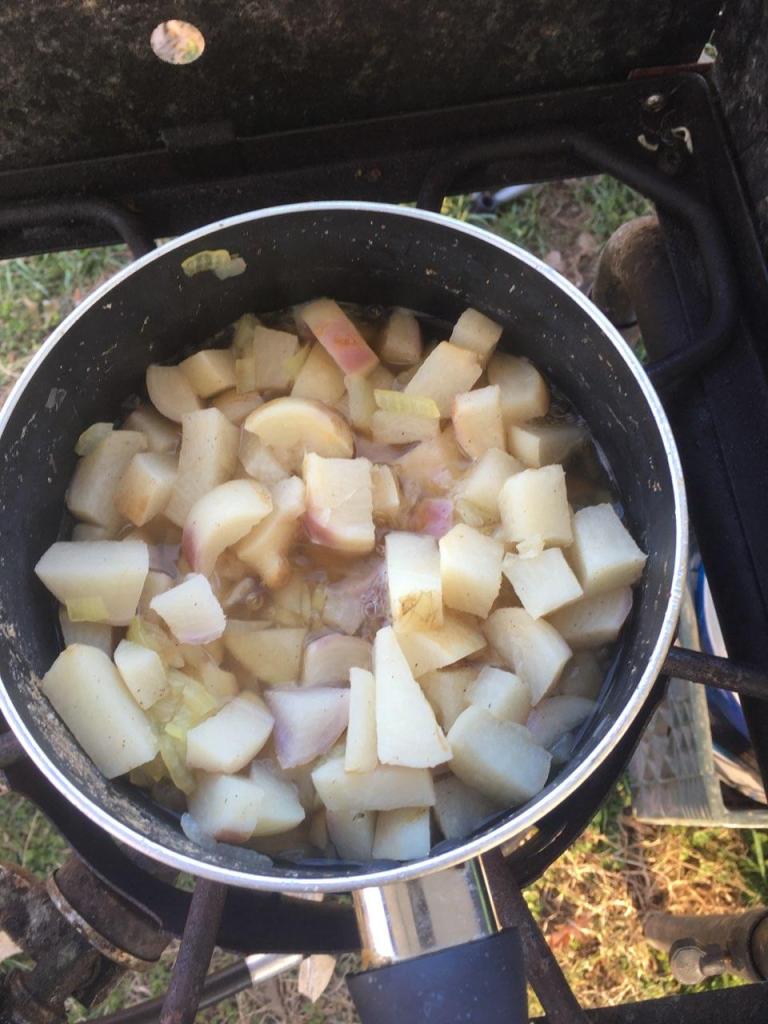
In Medieval lingo, “pottage” refers to any thick soup or stew. I made mine exceptionally thick, so as to make it more vegetable-forward and suitable as a side dish, and not requiring a bowl. Essentially, I used the liquid as a medium for combining flavors, but left it very chunky.
Ingredients
4 - 5 turnips, cut into half-inch cubes
1/2 medium onion, chopped
2 cups chicken or vegetable broth
1/4 tsp. salt
1/2 tsp. Powder Douce
pinch saffron

The sub-recipe for Power Douce is given as:
3 Tbsp. ginger
2 Tbsp. sugar
1 1/2 Tbsp. cinnamon
1 tsp. cloves
1 tsp. nutmeg

Obviously this is way too much powder douce for just this recipe, so do your best to get the ratios right. Given that this is the unique spice offering (and very complimentary to the beef), it won't hurt to have a little more than the 1/2 tsp the recipe calls for. It is interesting to me how the spice combo for this period seems to be "pumpkin spice", even on savory dishes.
To make this, put everything in a medium saucepan, bring to a boil, then reduce heat and simmer slowly, stirring occasionally until everything is tender.
This was a fun one, in that everybody – and I mean everybody who tasted the resulting dish here thought they were eating potatoes. They did have the consistency of a potato, and the “bite” of a raw turnip had been mellowed so that these were just good, savory, tender vegetables. But I had to remind everybody that potatoes come from the New World (South America), and were completely unknown to Europeans in the 1300s!
This was a great excuse to do a little learning about something new, and put it into practice. Thanks to the Geezers, my willing guinea pigs, we all got to try something a little unique, and it generated bragging rights that we were eating period-representative food all weekend.
In my next installment(s), I’ll share what we did for breakfast, lunch and dessert. Hopefully this is a catalyst for your own curiosity, and you’ll go pay Medieval Cookery a visit and get creative in the kitchen!
Get Out There!
 Flying Squirrel Outdoors
A fun project. My thought was that roasting a boar on a spit would have fit right in! Question: Did the geezers get to drink the leftover wine after the scouts had retired?
LikeLiked by 1 person
Ha! We actually talked about doing a full market stall setup and roasting “something”, BUT the site we were occupying had restrictions on digging up the ground for fire pits. Even our campfires had to be on portable above-ground rings. AND, we had recently done Cornish game hens on spits and didn’t want to repeat that.
As for the wine, perish the thought! We’re on duty 24/7 and setting examples, after all. Cooking wine only, used exclusively for cooking! (There WERE times I had to have that conversation with new adults and parents who thought they’d be free to be adults and stop being leaders after hours…)
LikeLike
Would have been fun. When Peggy and I lived in Oregon, our neighbor barbecued a lamb every year on a spit. Man was it good.
Okay, no wine.
LikeLike