
This week I stumbled across an interesting historical tale about Arcturus – the 4th brightest star in the night sky, the brightest in the northern celestial hemisphere, and one that is hanging high above us during these summer months. Looking into it led me down a bit of a rabbit hole of other interesting tidbits, so indulge me as I share some fun facts about this summer star.
Where Is It?
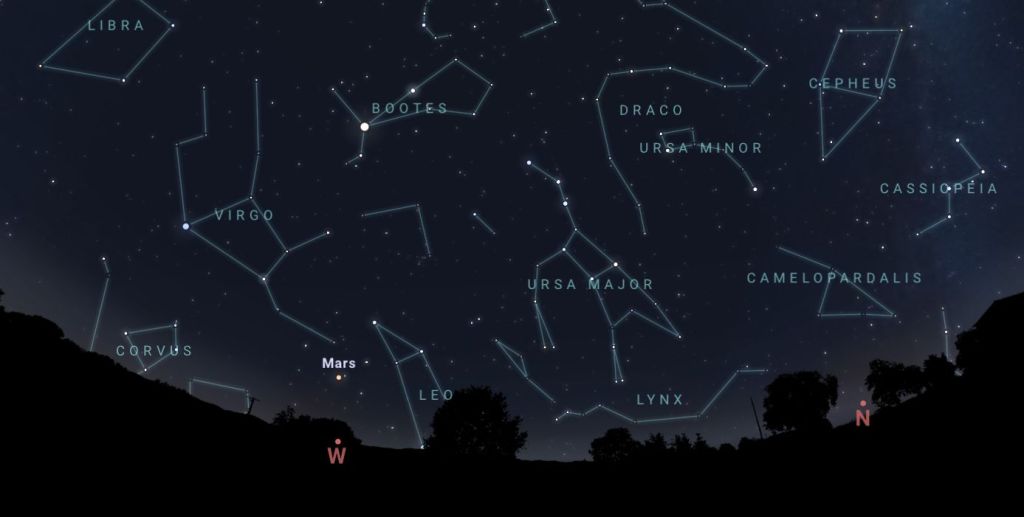
Arcturus is the Alpha – the brightest – star in the constellation Boötes, the Herdsman. To find it, follow the curve of the handle of the Big Dipper (or Plough, if you’re from across the pond). If you continue that curve across the sky, you “Arc to Arcturus”, an obvious star shining brightly at the bottom of a large kite-shaped constellation.
The name “Arcturus” comes from the Greek word for “Guardian of the Bear”. Sure enough Arcturus and Boötes, the Herdsman, follow Ursa Major around the pole, together with the two small dogs in Canes Venatici. Interestingly, Boötes is also known as the Plowman, which fits his position behind “the Plough” – So Boötes and Arcturus work with imagery on both sides of the Atlantic.
Ancient History And Mysterious Origins
Arcturus has been around for a loooong time, of course. It’s estimated to be about 7 billion years old, and people have been observing it, and utilizing it, for thousands of years. At 19-deg North latitude, Arcturus is the zenith star for Hawaii. In other words, it passes DIRECTLY overhead if you’re on those islands – at least, it did about 1,000 years ago (see below regarding the star’s motion). Ancient mariners in Polynesia, who called the star Hokule’a (Hoh Koo LAY ah), the “Star of Joy” could navigate to Hawaii by sailing north (from, say… Tahiti), until Arcturus passed from east to west, directly overhead. They could then turn west and run straight into Hawaii. They could make the return trip by using Sirius, which just happens to be the zenith star for Tahiti.

In 1635, Arcturus became the first star (aside from the Sun) to be viewed during the day time with a telescope. The astronomer Jean-Baptiste Morin was able to accomplish the feat because Arcturus is an extremely large, powerful star. Its diameter is estimated to be 25 times that of the Sun, radiating about 200 times as much energy. It is referred to as a “Red Giant”, but as giant stars go, it’s one of the smaller examples, glowing more orange than red. Despite its size, it is only 10% more massive than the Sun, and its surface temperature is several thousand degrees cooler than the Sun.
Arcturus is one of the first stars determined to show “proper motion” – evidence that it is moving through space relative to our own solar system. Edmond Halley (of comet fame) concluded in 1718 that Arcturus, along with Sirius and Aldebaran, had moved more than half a degree from where the Greek astronomer Hipparchus measured them to be roughly 1,850 years earlier.
It is moving so fast, in fact, that astronomers believe it was born outside the Milky Way galaxy, and that it originated in an ancient dwarf galaxy that merged with the Milky Way billions of years ago. It is moving at 324,000 mph (521,000 km/h) to the celestial south, toward Virgo, and at that rate it will move more than a degree (about twice the width of a full moon) every 1,500 years. These days, it is near its closest approach to our solar system, and it is estimated that in roughly 150,000 years, it will be distant and dim enough to no longer be visible to the naked eye. This also implies that it only became visible within the last few hundred-thousand years, roughly correlating to the emergence of modern humans on Earth, and has been growing brighter ever since.
“Modern Technology”
Now to the story I’d just heard for the first time this week.
In 1933, Arcturus was key to the opening of the Chicago World’s Fair, highlighting a brand new technology, the photocell (or “electric eye”). In a clever act of promotion, Edwin Frost, the retired director of the Yerkes Observatory in Williams Bay, Wisconsin, came up with a clever way to tie the 1933 fair with the 1893 event. At the time, Arcturus was estimated to be 40 light years away (modern estimates place the distance at 36.7 light years). So, Mr. Frost reasoned that light reaching Earth at the opening of the 1933 fair could be fairly stated to have left the star just as the 1893 fair closed, 40 years earlier.
Mr. Frost equipped the eyepieces of four prominent telescopes with newly developed photocells, and planned to use the light of Arcturus to generate an electrical signal which would be transmitted via Western Union telegraph lines to Chicago, and signal the opening of the fair. Thus, the light produced as the 1893 fair closed would be used, directly, to start the new event. The four observatories involved were Frost’s prior employer, the Yerkes Observatory, the Harvard University Observatory, the Allegheny Observatory in Pittsburgh, PA, and the University of Illinois Observatory. At the appointed time of 9:15 pm Chicago time, the telescopes pointed at Arcturus, the photocells were activated, and in response an enormous spotlight at the fairgrounds in Chicago was illuminated to great cheers from the assembled crowd, and other lights at the fair were then turned on to officially open the event.
I have to admit this was an outstanding way to tie astronomical observations and modern technology to an event celebrating scientific development.
So, take the time through the rest of the summer to find and observe Arcturus. As you do, think of the countless other eyes that have relied on this star over thousands of years. Contemplate the fact that we happen to live in a time where this very bright star is visible at all, and that in not that many years (cosmically speaking) it will be gone.
Get Out There
 Flying Squirrel Outdoors