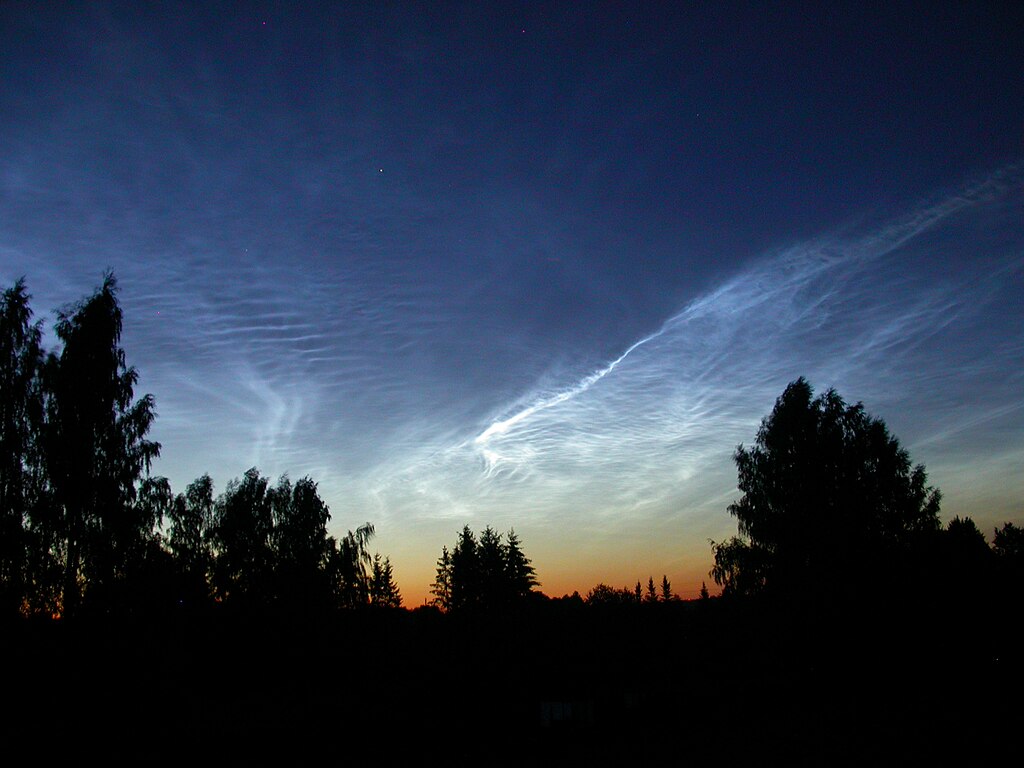
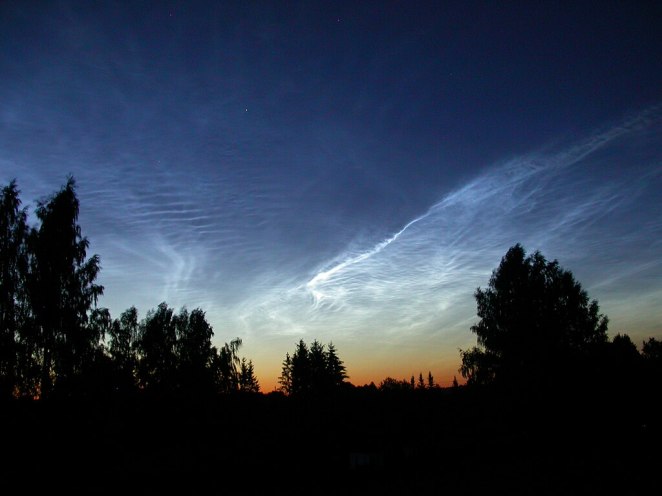
If you’re in high latitudes, step outside on a clear summer night around twilight and look up. If you’re lucky – and increasingly, you might be – you’ll witness one of nature’s most ethereal displays: noctilucent clouds. These delicate, ghostly streaks of silver and blue seem to shimmer against the darkening sky, appearing almost otherworldly in their beauty.
I’ll be honest – I haven’t seen these elusive night-shining clouds yet, but I’ve seen more and more references to them, and so finding them has now become a quest of sorts. These aren’t just rare celestial curiosities anymore. They’re becoming more frequent, and their growing presence tells an interesting story about our changing planet.
What Makes These Clouds So Special?
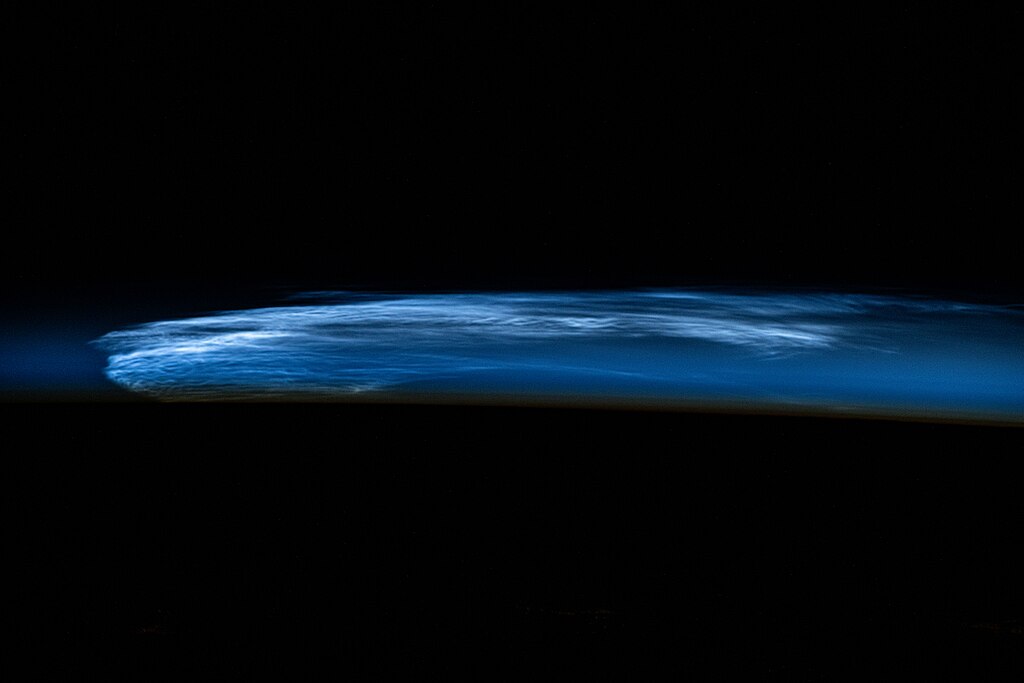
I only recently realized that these clouds are special in any way. The name “noctilucent” literally means “night shining” in Latin, and I was under the impression that they were regular clouds that just happened to be positioned to catch sunlight after dark. And, well… They ARE that, but they catch sunlight because they’re the highest clouds on Earth, forming in the mesosphere about 50 miles above our heads – that’s roughly ten times higher than a commercial airliner flies.
These wispy, delicate formations appear as silver-blue streaks that seem to glow against the night sky. Sometimes they undulate like waves, other times they swirl in mesmerizing patterns. Their characteristic blue tint comes from ozone absorption, giving them an almost supernatural appearance.
The primary component of these clouds is tiny crystals of water ice, each no bigger than 100 nanometers in diameter, or about 1,000 times smaller than the width of a human hair. They form only under the most extreme conditions, when temperatures are below -120°F (-84°C) in one of the driest, thinnest parts of our atmosphere.
Counterintuitively, these frigid conditions actually occur during summer. While we’re sweltering down here, seasonal vertical winds create the coldest temperatures of the year up in the mesosphere.
The Climate Connection: Why We’re Seeing More
When longtime cloud watchers started documenting their experiences two decades ago, spotting noctilucent clouds was like finding a rare bird – it might happen once every few summers if you were incredibly lucky. Now? People across the northern latitudes have good chances of seeing them several times each summer.
The culprit behind this increase is surprisingly specific: methane emissions. As our atmosphere accumulates more greenhouse gases, methane undergoes chemical reactions that produce additional water vapor. That extra moisture gets transported up to the mesosphere, where it becomes the raw material for these high-altitude ice crystals.
Scientists have calculated that methane emissions between 1871 and 2008 more than doubled the amount of mesospheric ice present in our atmosphere. NASA’s AIM spacecraft, which has been monitoring these clouds since 2007, detected the highest increase in noctilucent cloud frequency in 15 years during 2022.
In addition to showing up more often, these clouds are showing up in places they were never seen before. Observers have spotted them as far south as Paris, Utah, and even parts of Turkey and Spain. Climate scientists believe this southward expansion is a direct result of our changing climate.
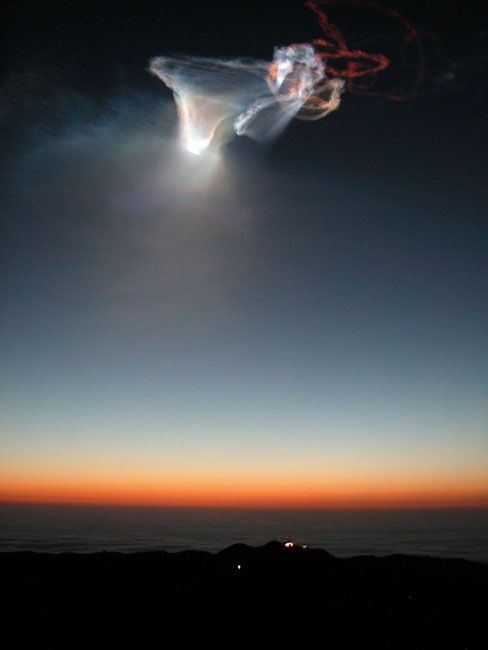
Not all of the changes are climate-related, though. Rocket launches, with their massive water vapor exhaust, can trigger individual noctilucent cloud formations. Rocket launches aren’t enough to drive the overall trend, but they do add material at high enough altitudes to form these clouds when conditions are right.
Your Guide to Cloud Hunting (And My Summer Mission)
The best time to spot these ethereal visitors is during summer months – from mid-May to mid-August in the Northern Hemisphere. Despite their increased frequency, they are still a high-latitude phenomenon, occurring most often between 45 and 80 degrees latitude. Most of Canada stands a pretty good chance, but you have to be along the northern tier of the US – Washington, Montana, North Dakota, etc and east to Maine – to be in the right place. Generally, it seems that if you’re in an area where you might spot aurora, noctilucent clouds are also on the menu.
Timing is everything. These clouds are visible only during astronomical twilight, when you’re in Earth’s shadow but the high clouds are still catching sunlight from below the horizon. Look for them when the sun is between 6° and 16° below the horizon – about an hour or two after sunset toward the west, or an hour or two before sunrise toward the northeast.
Find yourself a spot with a clear view of the horizon. A flat landscape works best – think lakeshores, open fields, or elevated viewpoints. The clouds appear faint and tenuous, so any light pollution or obstructions will make them harder to spot. Noctilucent clouds are subtle, often appearing as faint silver threads against the twilight sky. They might be confused with cirrus clouds at first glance, but they appear much sharper under magnification and have that distinctive blue-silver glow.

Windows to a Changing Sky
These night-shining clouds represent something about our relationship with the natural world. They’re beautiful, yes, but they’re also indicators of large-scale changes happening in Earth’s upper atmosphere. Every time you spot these delicate formations, you’re witnessing a visible manifestation of how our planet’s climate system is evolving.
The increasing frequency of noctilucent clouds serves as a reminder that the atmosphere is interconnected in ways we’re still discovering. Changes we make at ground level – our energy choices, transportation habits, and industrial processes – eventually find their way to the edge of space, creating unexpected beauty along the way.
So the next time you’re outside on a summer evening, take a moment to look up. You might just catch a glimpse of these ethereal visitors, shimmering like silver ghosts against the darkening sky – and if you do, I’d love to hear about it! When you spot them, remember that you’re not just seeing a beautiful natural phenomenon – you’re witnessing a story written in ice crystals and starlight, telling us about the changing world we all share.
Get Out There
 Flying Squirrel Outdoors
One thought on “Noctilucent Clouds – Ethereal Indicators of a Changing Atmosphere”