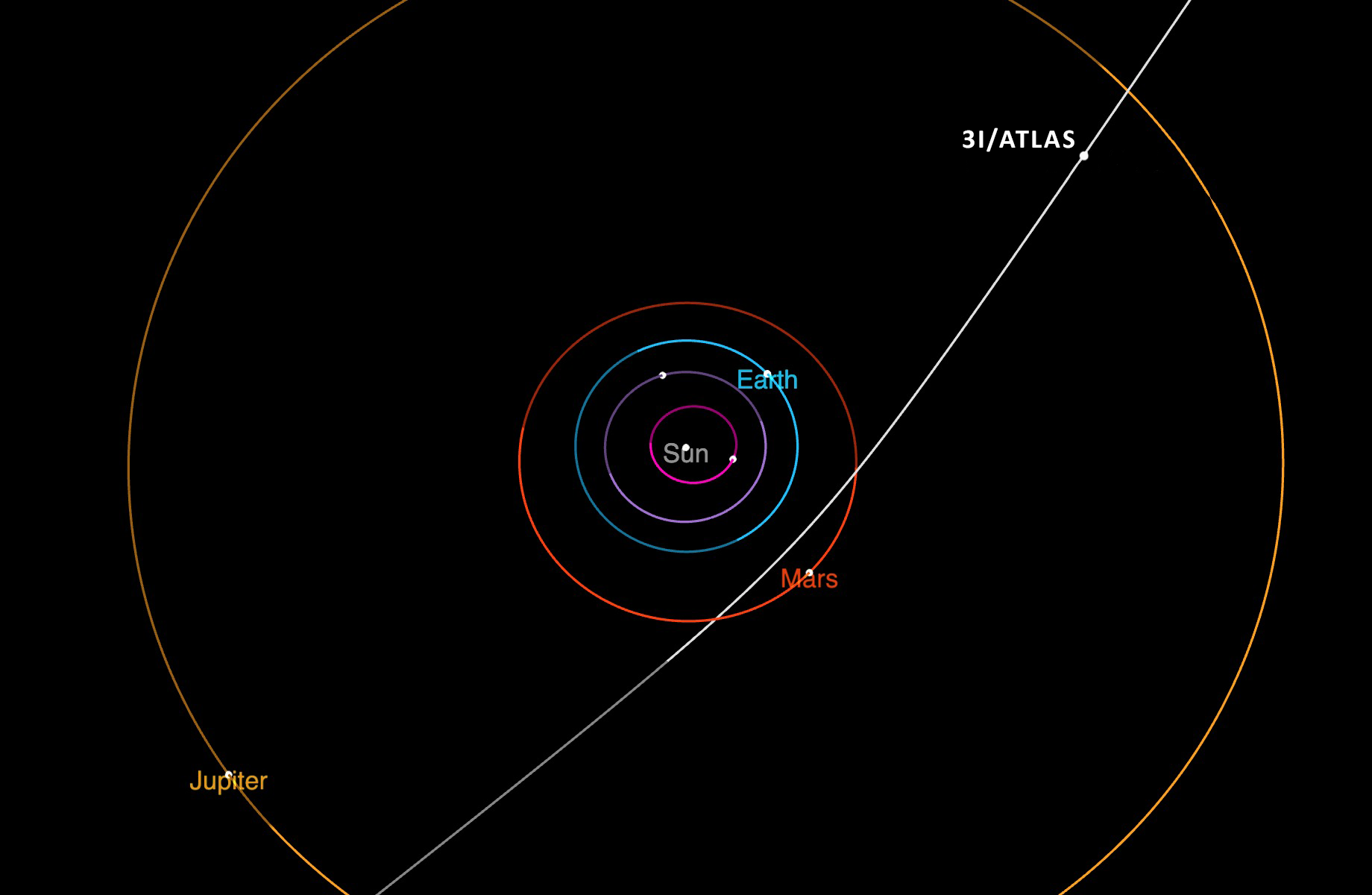
This week, astronomers confirmed the discovery of a new interstellar object zipping through our solar system from points unknown! It’s only the third such object we’ve ever discovered, but it seems these types of encounters are turning out to be far more common than we thought.
The object is designated 3I/ATLAS (That’s 3-“eye”, not the number thirty one), discovered by the NASA-funded Asteroid Terrestrial-impact Last Alert System (ATLAS) in Rio Hurdato, Chile, whose name has adorned many recent comet discoveries as it aids in the search for new near-earth asteroids and potential impactors. This object is not coming anywhere near Earth, but it is SCREAMING along at about 58 km/s (~130,000 mph) on a hyperbolic path – meaning it is NOT in orbit. Instead it will pass by the Sun and just keep right on going, never to be seen again.
It’s path does not indicate that it has passed near any large planets that would give it a gravitational kick into this extreme trajectory, which leaves the only conclusion – it’s an interstellar object from beyond the solar system.
After its official discovery on July 1, previous images were confirmed to include the object (though not noticed at the time) extending back as early as June 14. A combination of professional and amateur observations have enabled refinement of the trajectory and confirmation of 3I/ATLAS’s interstellar origins.
3I/ATLAS appears to be asymmetric, indicating it may have the beginnings of a tail – so for now it’s being designated as a comet. Though it’s hard to tell from available data, it is estimated to be several kilometers across, and is currently shining dimly at about magnitude 18 (far too dim for the typical backyard telescope). 3I/ATLAS is currently just inside the orbit of Jupiter, and will make its closest approach to the Sun (behind the Sun, from Earth’s perspective) in October, just inside the orbit of Mars. Coincidentally, its path is only about five degrees off the ecliptic plane (the disk of the solar system), so most terrestrial telescopes will continue to be able to track it. Its trajectory will be altered slightly by the gravity of the Sun, but it should re-emerge from behind the Sun in December, 2025 and visible for a few more months as it flies away.

‘Oumuamua (a Hawaiian name meaning “a messenger from afar arriving first”) was the first known interstellar object, and it caused a sensation back in 2017 when it was discovered, both because of its origins and its apparently oblong, slender shape. Then, in 2019, comet 2I/Borisov was discovered, confirming that ‘Oumuamua was not unique. Now, in 2025, we have 3I/ATLAS.
In addition to the network of resources dedicated to searching for near-Earth objects, we have an increasing arsenal of resources that are rapidly discovering thousands of unknown objects in our solar system. As our space based (Webb, Roman) and ground based (Rubin) telescopes continue to get bigger and better, it seems there is no doubt we will continue to find more and more objects “just passing through”. In the meantime, we’ll be doing everything we can to learn more about the nature of 3I/ATLAS!
Get Out There
 Flying Squirrel Outdoors
I’m looking forward to learning more about this object.
LikeLiked by 1 person
Me too. I expect as it gets a little closer it would be a good target for Webb to take a quick peek at, at least.
LikeLiked by 1 person
Every time one of these barrels through our solar system, I’m reminded of Rendezvous with Rama (1973) by Arthur C. Clarke. Maybe, one day, one of them will swing into orbit around Earth to ask directions?
LikeLiked by 1 person
I’m unfamiliar with that story (your comment prompted me to go look it up). I think it will get quite a lot of attention if anything comes by and starts to change trajectory, whether it’s to come see us or not. The alien theories that cropped up around ‘Oumuamua’s apparent acceleration were fun for a few weeks!
LikeLike
I hope this object brightens as it approaches perihelion. Its present magnitude of +18 would be an extreme challenge for small backyard astro imaging gear, especially taking account of its high velocity.
LikeLiked by 1 person
It would certainly be nice if it got bright enough for amateurs to get a good look at it. It does look as if it will be making a pretty close (in the scheme of things) approach to Mars – we should be so lucky!
LikeLiked by 1 person