
Before I start discussing the upcoming solstice (Friday, June 20, 2025), there are a couple other little tidbits of interest I wanted to highlight this week. It’s been tough to do any stargazing at home this week, as it’s been raining non-stop for days, but that can’t last forever!
1) Mars and Regulus
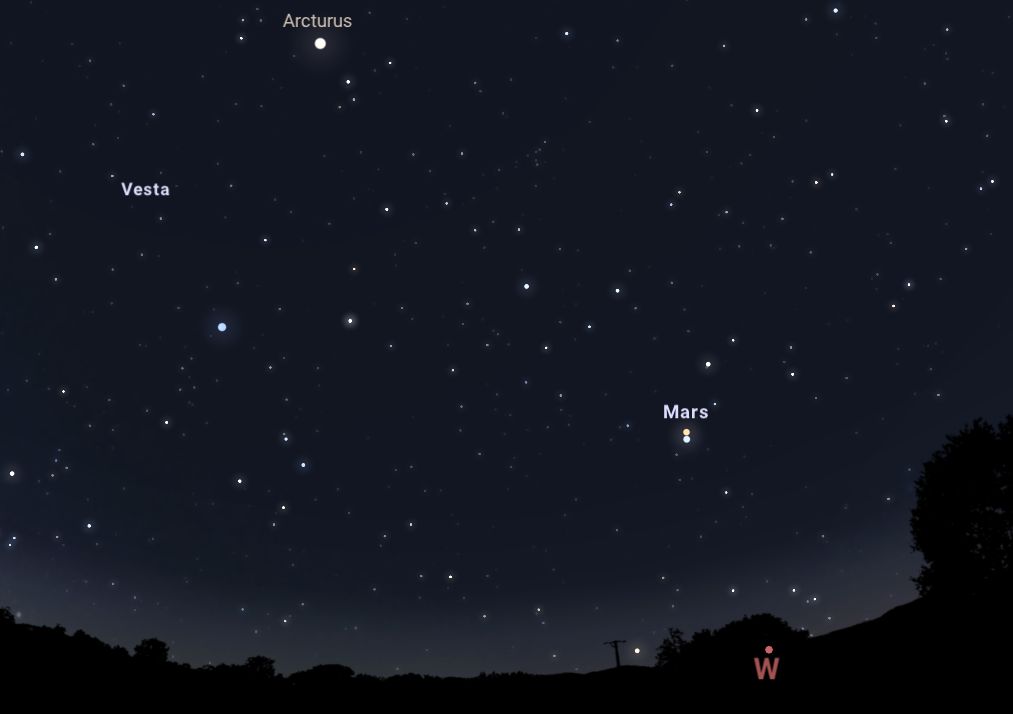
Mars has sidled up to and is passing very near Regulus, the brightest star in Leo this week. Regulus is the bottom of the “Sickle” asterism, the backwards question mark forming the neck and mane of the lion. It’s visible to the west after sunset, and the lion is about 30 degrees up off the horizon, facing down toward the western horizon. (See image below).
Mars is clearly redder than Regulus, but they are almost identical in brightness right now. Can you tell the difference?
2) Spring Triangle
This is an asterism I’d never heard of. The summer triangle (Vega-Altair-Deneb) is up now too. And of course there’s the winter hexagon (Aldebaran-Capella-Pollux-Procyon-Sirius-Rigel), now out of sight. But the Spring Triangle is a new one to me.
Given that summer starts on Friday, I’m almost out of time to know about it, I guess! It’s an almost-perfect equilateral triangle formed by Denebola, Arcturus, and Spica.
Denebola is the tail of Leo – look east of the Sickle (where Regulus and Mars are), and you’ll see a right triangle with the narrow end pointed away from the lion’s head. This forms the rear haunches of the lion, and the tip of the triangle is the second brightest star in the constellation, Denebola.
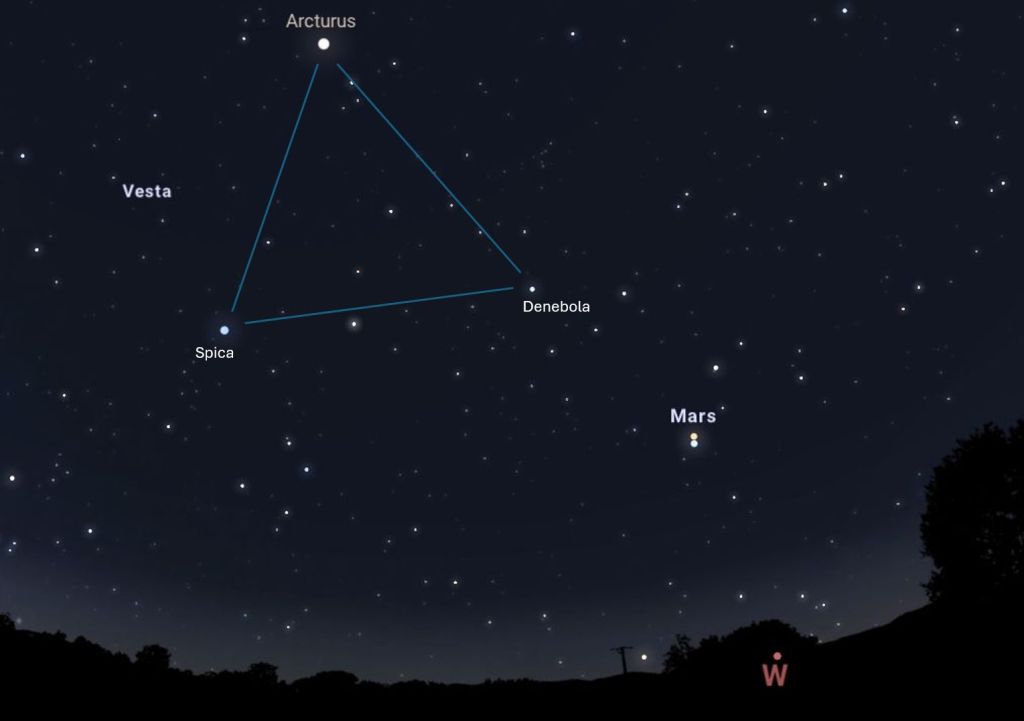
To find the other two, start with the big dipper – if you follow the arc of the handle, you’ll encounter a bright yellow-orange star, Arcturus (follow the Arc to Arcturus) in the constellation Bootes, and then from there continue in a straight line on the last direction of the arc, and you’ll run into bright white Spica, in Virgo (Spike to Spica). The three of these together, once you see it, are a can’t-miss perfect triangle.
3) The Summer Solstice
We typically think of the solstice as the longest day (in the northern hemisphere), or the first day of summer. It is also the day that the Sun reaches its northernmost point at noon, and on the horizon at sunset, and from here starts to move south again night by night. The Sun will be directly over the Tropic of Cancer (latitude 23.4394 deg, equivalent to the tilt of Earth’s axis with respect to its orbital plane) on the Solstice, and then start to move south again.
While all this is true, the solstice is actually a moment – the point in time at which the Earth’s tilt toward the sun (again in the northern hemisphere) is at its maximum, or that brief moment in time when the Sun is actually directly over the Tropic of Cancer. That moment will occur at 10:42 pm Eastern Daylight Time on Friday, June 20. So while we think of the solstice of being a whole day, it actually occurs and passes pretty quickly. This definition explains why the day of the solstice changes – most of the time it’s on the 21st, but this year it’s a little early, enough to slide the “first day of summer” to the 20th.
My twist on thinking about the solstice this year is to really appreciate the tilt angle of the Earth. I hearken back to an image I posted years ago when I was in Iceland for the solstice, and was amazed to realize that after sunset there, the closest direction to reach the day/night line on the planet was to look over the north pole, where you can experience 24 hours of daylight this time of year. This was something I hadn’t thought about before I traveled there, but at that latitude, the sun sets in the NORTH, and then rises again in the NORTH after a very short period below the horizon.

The other thing to note here though is the angle the day/night line (the “terminator” makes across the United States). On Friday, sunset in Cleveland, OH is at 9:04pm. Sunset in New Orleans, LA is at 8:04pm. BUT, when you consider that New Orleans is in the Central time zone, one hour “behind” Cleveland, you realize that sunset is at exactly the same time in these two cities, despite them being over 8 degrees in longitude apart – or about the same distance as the east-west length of the entire state of Tennessee.
This also makes you realize that there are places in the Central time zone when the Sun will set, in absolute, Universal, uncorrected time, BEFORE places in the Eastern time zone.
This is not intuitive! We tend to think of the Sun going west as it sets, and that sunsets should occur at the same time for locations at the same longitude – due north and south of each other. This is true on the equinoxes (March and September), but at the solstices we observe the biggest discrepancies, and the image above of a tilt-accurate globe demonstrates why. The terminator is always perpendicular to the Sun’s incoming rays, and the orbital plane of the Earth. The Earth’s tilt causes that line to wobble back and forth from north-south over the course of a year, and causes changes in the length of day and night to be much more pronounced toward the poles.
This is one of the many phenomena that are obvious when considering a spherical Earth, but difficult to appreciate without backing up and taking a literal worldwide view. I’ll admit I hadn’t really looked at the tilt of the terminator before my eye-opening Iceland experience, but the effect is clearly there!
Get Out There!
 Flying Squirrel Outdoors
I’m glad you corrected June 10 to June 20 later in your post. I was worried I’d missed the solstice.
LikeLiked by 2 people
Whoops! Thanks, I’ve corrected it. Appreciate the proofreading!
LikeLike