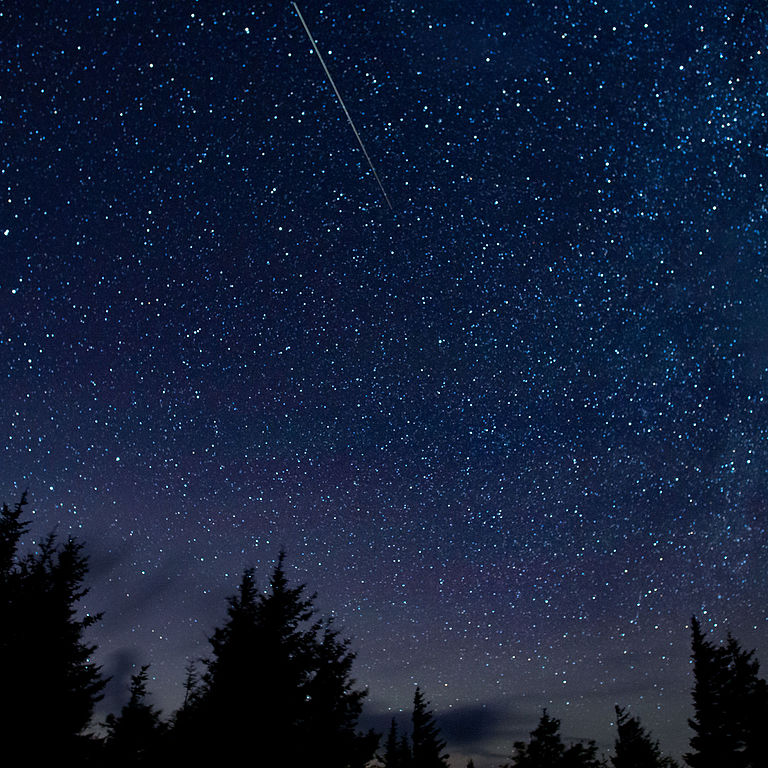
I’m always a little hesitant to write about meteor showers, since you never know really how a particular event is going to shape up. Then again, since you never know, it’s always worth an hour of my time to check things out. I still remember one December shower where the meteors were so thick and frequent it looked like we were in the Millenium Falcon making the jump to hyperspace. I’ve not seen that before or since – but it was definitely worth a look!
The shower early next week (peaking overnight between Monday, April 21 and Tuesday, April 22) likely WON’T simulate the jump to light speed, but it’s pretty reliable. The Lyrids typically only generate 10-20 streaks an hour, and many may be too dim to see, but there’s a good chance you’ll see something if you start paying attention to the night sky as early as this weekend.
I’ve said this before, but meteor showers actually happen in a place, not at a time. They happen when Earth intersects the river of dust and debris left by the tail of a comet – in this case, Comet Thatcher (C/1861 G1), a long-period comet with a 422-year orbit that won’t be back near Earth until 2283. When Earth passes through this comet dust, the flecks of debris slam into the atmosphere like bugs on a spring evening windshield, and burn out in a blaze of glory.
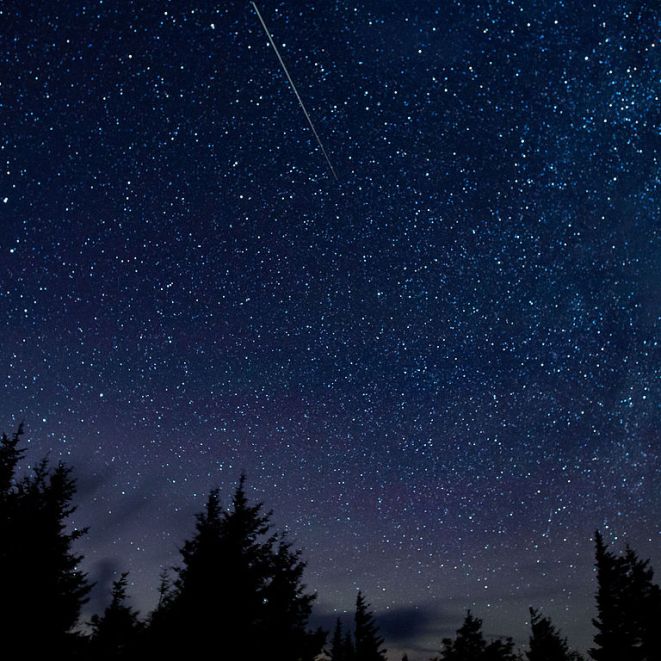
At the time Earth encounters the dust, our planet will be traveling roughly toward Vega, the bright star in Lyra that rises in the northeast shortly after sunset. The higher Lyra gets, and the darker it gets, the better your chance of seeing meteors appear to emanate from it. So while the best viewing might be around 2 am (the waning crescent moon rises around 3:30 and its light will interfere with the darkness), you can realistically spot meteors without staying up after midnight.
(Incidentally, I don’t know why I do this – but I always read the name of this shower as the “Lee-rids”, but they are actually the “Lie-rids”, since they come from Lyra, the Lyre. In fact both are technically wrong, because the actual radiant point lies within Hercules. The shower was named before the boundaries between constellations had been firmly established, and Lyra is more prominent than anything else in the area).
Comet Thatcher’s debris field is fairly wide, so we may see meteors for several days before and after the peak on the morning of the 22nd. At that time, Earth will be hitting the center, and presumably the most dense part of the cloud. But the dust itself is orbiting the Sun, and constantly changing. One year we might hit a sparse cloud, the net we might hit something impressive. You never know until you go out and take a look.

If you ARE up early in the morning, there’s a bonus just before sunrise next week. Venus and Saturn are close to each other, and Mercury a little lower down but still obvious. By the 24th, a delicate crescent Moon joins these planets. On the 25th, the Moon sits directly between the Venus/Saturn pair and Mercury.
Get Out There!
 Flying Squirrel Outdoors