There are a lot of natural phenomena in the world that generate awe – a sincere response to beauty, grandeur, something big and overwhelming that makes us feel small and insignificant, yet blessed by the opportunity to witness it.
Then, there are unique occurrences that make us raise an eyebrow in curiosity, but that don’t really look like much, in and of themselves. Those things are fascinating only after a little research and knowledge – in other words, they’re more impressive the more you know and understand about what’s really happening behind the subtle presentation.
The periodic nova T Coronae Borealis, the “Blaze Star”, is one of those objects. The star was predicted to ignite, to suddenly increase from magnitude 10 (invisible to the naked eye) to magnitude 2 (about equivalent to Polaris, the North Star), effectively creating a “new” star in the night sky back in September 2024. And it didn’t happen… so now we watch, and wait.
Periodic Novae
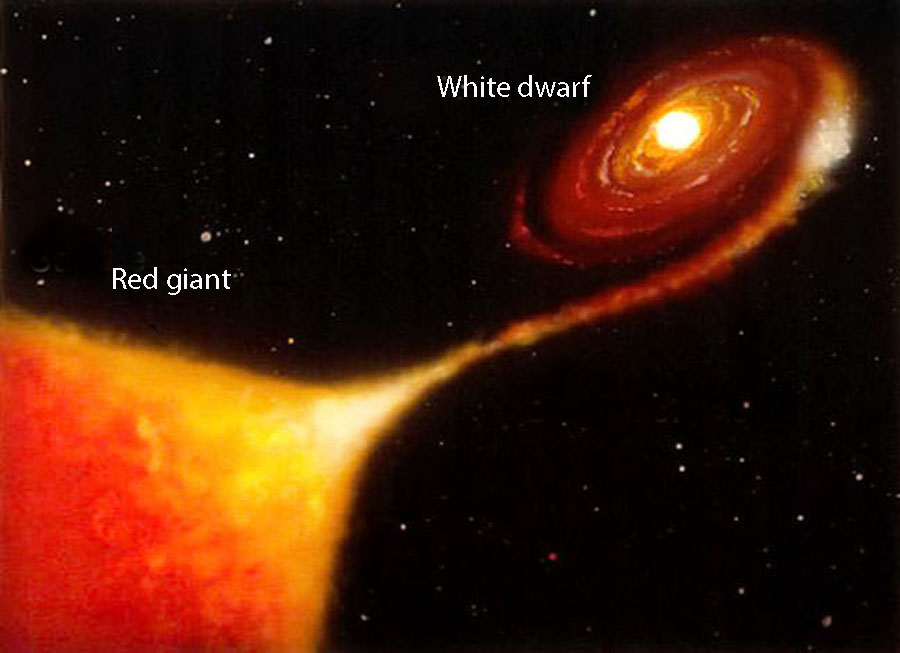
The Blaze Star (T Coronae Borealis, or T CrB) is a binary system just under 2700 light years away. The system consists of a red giant and a white dwarf that orbits is larger companion once every 277 days. That places the smaller star close enough that it is consistently stripping material (mostly hydrogen gas) from the red giant and adding that mass to its own collection. Every eighty years or so, the volume of material collected by the dwarf reaches a critical mass and it detonates in a massive thermonuclear explosion that causes the star to flash brightly and quickly. The star within is not destroyed, as it would be in a supernova, but lives on to continue collecting hydrogen and start the cycle anew.
From our perspective on Earth, we see this as the sudden appearance of a star in the sky that wasn’t there before, but one that winks into existence on a regular (predictable?) cycle.
History and Predictions
In the modern era, the Blaze Star was discovered in 1866 by John Birmingham, an Irish astronomer who recorded its appearance and transient nature. After subsequent observations, the Blaze Star erupted again in 1946, establishing an 80-year cycle for its behavior. Working backward, it is suspected that an observation in 1217 also corresponded to the Blaze Star. Observations from Burchard, abbot of Ursberg, Germany noted “a faint star that for a time shone with great light”.
Now, astronomers have been looking for telling indications that the Blaze Star is about to flare again. The star brightened slightly in 2016, and then in early 2023 there was a sudden dip in brightness that matched the pre-eruption data from 1946. Based on 1946 data, this behavior placed the anticipated eruption at 1.1+/-0.3 years from the beginning of the dip. That would have placed the appearance of the Blaze Star somewhere between April and September, 2024.
It didn’t happen.
The math-savvy among you will quickly point out that 80 years from 1946 is 2026, and that all the predictions were early, and perhaps it’s unsurprising that they’re wrong. But this uncertainty is part of the challenge, and the fun in observing such objects.
With so few data points, our models of systems like this are limited, and we truly don’t understand how variable, or conversely how predictable, its ignition characteristics really are. We also have vastly more observational horsepower available to us than at any time in the past, including the opportunity to view the Blaze Star in the X-Ray and Gamma Ray portions of the spectrum. High end telescopes are standing by to record new data, including (of course) the James Webb Space Telescope, NASA’s Fermi Gamma-ray Space Telescope, Neil Gehrels Swift Observatory, IXPE (Imaging X-ray Polarimetry Explorer), NuSTAR (Nuclear Spectroscopic Telescope Array), NICER (Neutron star Interior Composition Explorer), and the European Space Agency’s INTEGRAL (Extreme Universe Surveyor). Numerous ground-based radio telescopes and optical imagers, including the National Radio Astronomy Observatory’s Very Large Array in New Mexico will also help gather data on this event, increasing our understanding of stellar physics and how systems like this interact with one another.
How To See The Blaze Star
Now that I’ve gone to great lengths to describe how hard it is to say WHEN anything will happen, it’s only fair if we pinpoint WHERE.
Corona Borealis, the “Northern Crown”, sits in the northern sky between Bootes and Hercules. It’s a small but very distinctive constellation marked by a semicircle of stars. It doesn’t rise until about 10pm this time of year, but that time is earlier with each passing day. Since the ignition of the Blaze Star only lasts a day or so, it’s worth making frequent observations to try and catch it – it will truly be a once in a lifetime experience. (Again, made significant because you know what that bright pinpoint of light actually represents!)
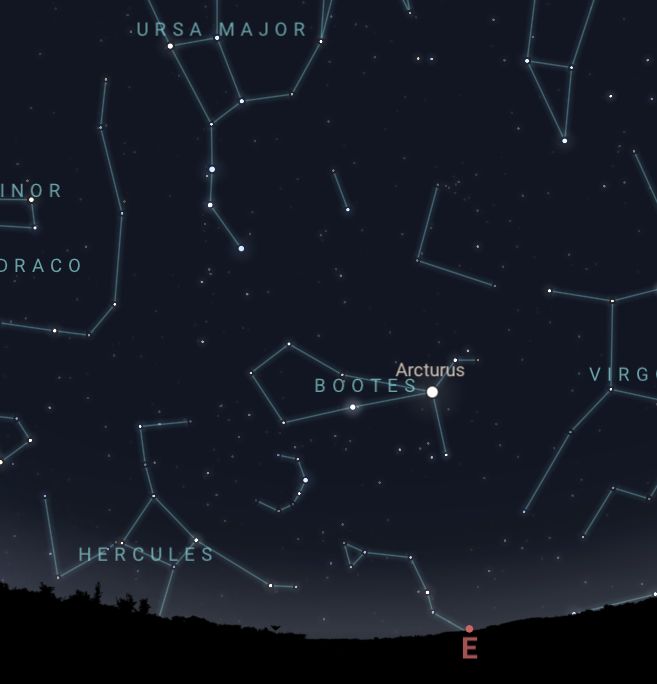
To find it, face northeast and follow the arc of the handle of the Big Dipper. Extending that curve will lead you to Arcturus, the bright anchor star of Bootes – the rest of the constellation stretches out to the north, or left, in a large diamond or kite-shape. Below and to the left of Bootes, you’ll see Corona Borealis, which from the northern hemisphere looks like a backwards C right now.
The empty space (hopefully still empty by the tie you read this) where the Blaze Star will illuminate is just below the bottom of the inverted “C”, nearest the next-to-last star in the semicircle. (Reference the attached figure for clarity).
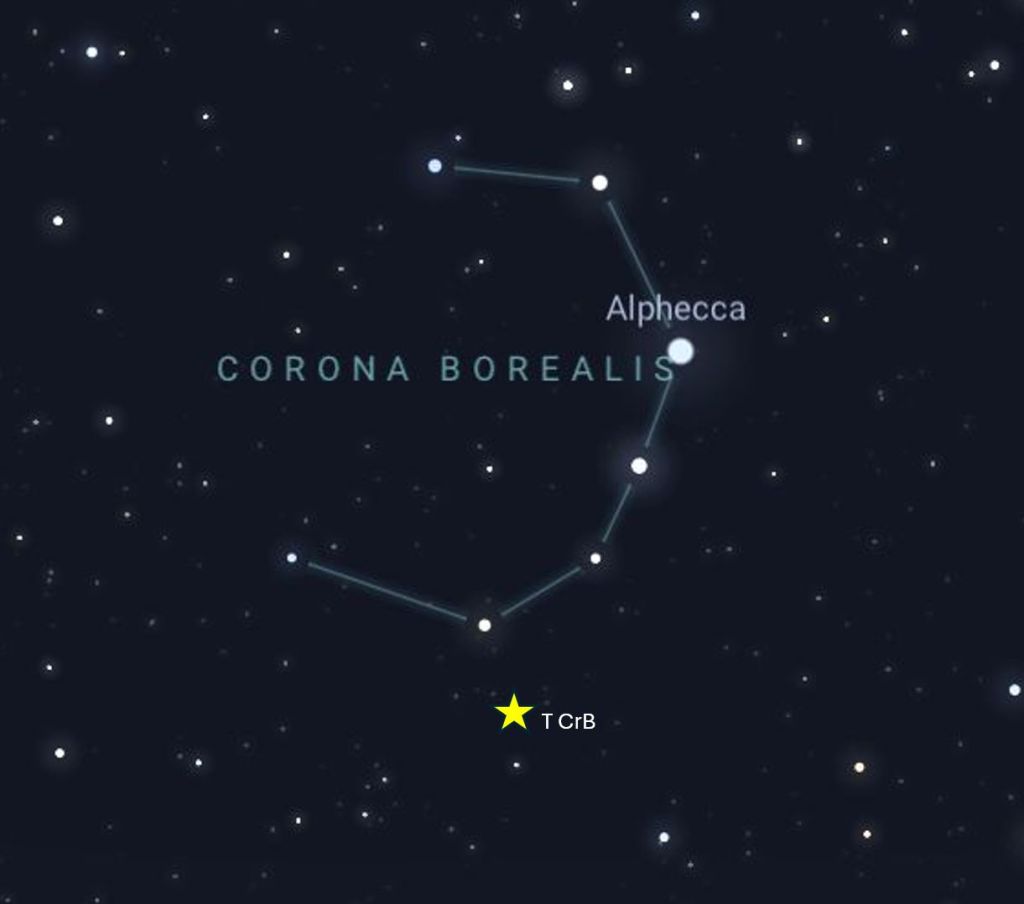
When T CrB does ignite, its brightness will be similar to that of Alphecca, the brightest star in Corona Borealis, but in a part of the sky that is very dark right now.
Citizen Science
If you’d like to join the growing group of amateur and professional observers who are eagerly awaiting the pending outburst of T Coronae Borealis, check out the forums of the American Association of Variable Star Observers (AAVSO). The embedded link here will take you directly to the page associated with T CrB, where all the latest news, including spectroscopy, can be found. At AAVSO you can also sign up for email alerts on T CrB and other variable stars that might catch your interest.
So, in conclusion – the illumination of the Blaze Star is a rare event! It’s the result of an intricate cosmic dance between two stars, and the semi-regular ignition of a fuel source that one star is literally stealing from another. It may just look like the appearance of a new star in the sky, but knowing what’s actually going on makes the event even more spectacular.
Get Out There!
Further Reading:
- Sky & Telescope, "Is the Blaze Star About To Blow?", Bob King, June 26, 2024
- NASA, "NASA, Global Astronomers Await Rare Nova Explosion", Jonathan Deal, June 6, 2024
- Space.com, "Where's The Blaze Star?", Sharmila Kuthunur, Dec 2, 2024
- Discover Magazine, "The Blaze Star Will Soon Explode After 80 Years Of Waiting", Jack Knudson, Jan 6, 2025
- Earthsky.org, "Why Won't The Blaze Star Explode?", Chris Harvey, Feb 16, 2025
 Flying Squirrel Outdoors