
Mars is in retrograde, and with some prominent stars and easy constellations in the background, now (and over the next few weeks) is a perfect time to see it!
When the ancients were trying to figure out the nature of the heavenly spheres, motion of planets caused a lot of confusion. This is particularly true if you start with the assumption that the Earth is the center of the solar-system, but even once you know the Sun is really the center of it all (thanks, Copernicus), there are some things going on that are hard to figure out.
One of these challenging observations is retrograde motion – the characteristic of outer planets wherein they stop moving east against the starry background, go BACKWARDS (west) for a few weeks, and then start to go back east again.
It’s easy to watch happen, and something that in our pre-electrified and light-polluted days would have been obvious to anybody who looked at a clear sky on a regular basis (which I’d argue is likely more of us, on average, than do it today). It’s also something that caused very convoluted models of planetary motion to explain, though hindsight being 20-20, it’s actually pretty straightforward, and offers very clear clues to the true nature of the solar system.
So first off, here’s the assignment – Mars is in the middle of its retrograde motion right now. It reversed direction on December 6, while in the constellation Cancer. At the time, Mars didn’t rise until several hours after sunset, AND Cancer is a fairly dark constellation without a lot of landmarks, so to speak, so it wasn’t a great time to watch the relative motion.
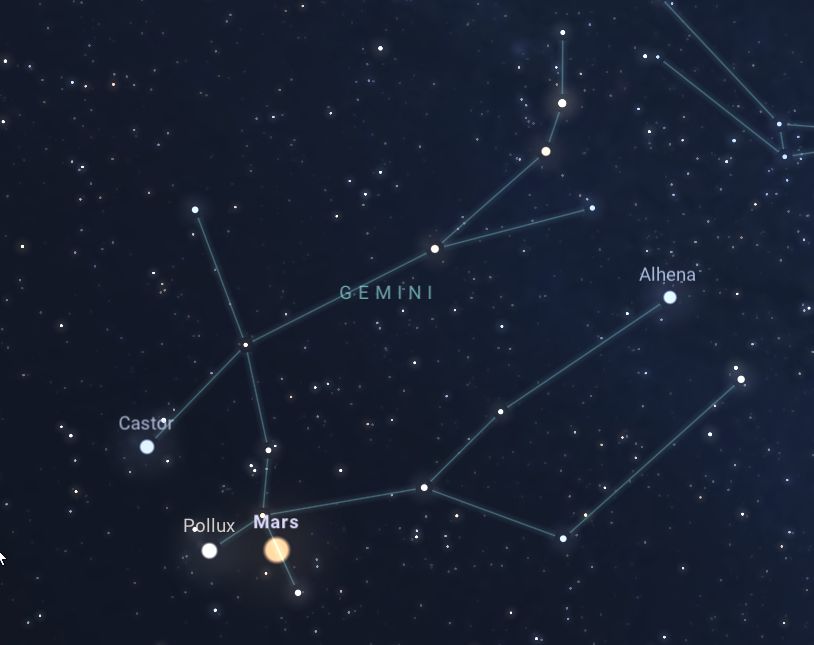
Now, Mars is easy to find and track. It is situated in Gemini, very close to the bright star Pollux, one of the bright stars in the Winter Hexagon. Look to the east right after sunset, and you’ll see the very distinctive constellation of Orion. To its left is Gemini – two stick figures with their feet next to Orion’s head, laying on their sides with two bright stars, Castor and Pollux, marking their heads. Pollux is the lower star – and just to the lower right of that, you’ll see the clearly reddish/rusty Mars. Note the location of Mars, and then go out regularly over the next few weeks to see how things change.
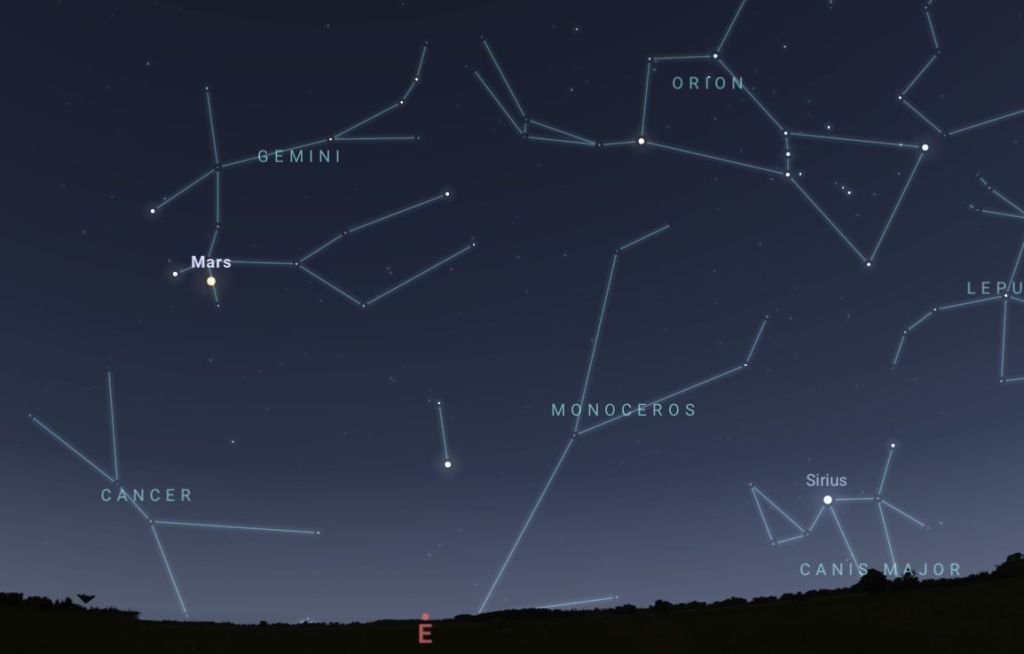
Note, Mars,Gemini, and everything to the East will continue to get higher and higher in the sky over time – that’s just the result of Earth moving around the Sun, and it’s not what we’re watching for. Instead focus on Mars’s location against the backdrop of stars, and in particular its relationship to Pollux.
What you’ll notice is that Mars will move up and right with respect to Pollux, and by February 24th it will be sitting right in the middle of the Gemini twins’ chest area. After that point, it will reverse direction and start moving BACK toward Pollux (in its normal, prograde direction). It will pass by Pollux again around March 30, and then continue on toward Cancer.
So what the heck is going on here? It certainly seems to defy notions of an orderly universe, and it lends some understanding to why we call them planets in the first place — the word comes from the Greek “planetes”, which means “wanderer”.
The key to understanding this is to realize that Mars is NOT changing direction, but that Earth is on an orbit INSIDE that of Mars, and moving faster. Some of you may recall that Mars was at opposition (directly opposite from the Sun) last week, on January 16. That’s actually key to what’s going on, because that’s the point in space where we (on Earth) PASSED Mars and are leaving it behind.

Picture yourself driving on a multi-lane highway, moving into the passing lane to go past a slower car. When you’re far behind that car, and you look at it with respect to a distant background, it’s clearly moving the same way you are. However, in the few moments when you’re very close, and very quickly passing that car, it appears to slide backward against the distant background. Then, after you’ve passed and there’s some distance between you again, the slower car appears to be moving forward again. It’s entirely a trick of perspective.
This passing car analogy is very similar to what’s going on between Earth and Mars, except if anything it’s exaggerated with planets because of our curved path. Take a look at this diagram from an old NASA tutorial. It shows the relative motion of Mars against background stars, as viewed from Earth, describing retrograde motion. When both planets are at position 1-3 (Earth overtaking), Mars appears to move left/east. As Earth passes Mars in positions 3-5, Mars moves backwards to the right/west, then resumes normal motion in positions 5-7.
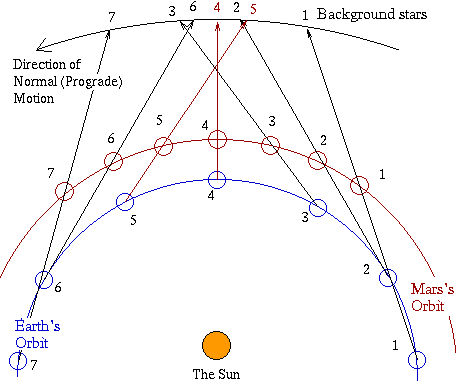
Once you realize this (or perhaps in order to realize this) several things are readily apparent: 1) Mars is, relatively speaking, very close to us, and the stars behind it are very, very far away; 2) Earth is moving in a way that’s roughly parallel to Mars, and Earth is moving faster; 3) If you correlate the timing of Mars retrograde motion to opposition, it’s not a huge leap to surmise that BOTH planets are moving around the Sun (and the Earth is not in the center of the solar system).

For bonus observational knowledge, you might notice that Jupiter and Saturn ALSO have retrograde motion, though not as pronounced, and not as easy to spot (they move much more slowly). You’ll also notice that Venus and Mercury don’t do this – and in fact never reach opposition – which might tell you something about where they are in the solar system…
So there you have it – an easy thing to witness with naked-eye observational backyard astronomy that reveals PROFOUND things about the nature of the solar system. Something the ancients struggled with is still observable – and it’s easy to understand both why this behavior was hard to understand AND why figuring it out helped the proper Sun-centric model of the cosmos fall into place.
Get Out There!
 Flying Squirrel Outdoors
One thought on “Observing Mars Retrograde: A Beginner’s Guide”